How to Convert Moles to Grams Easily
TL;DR
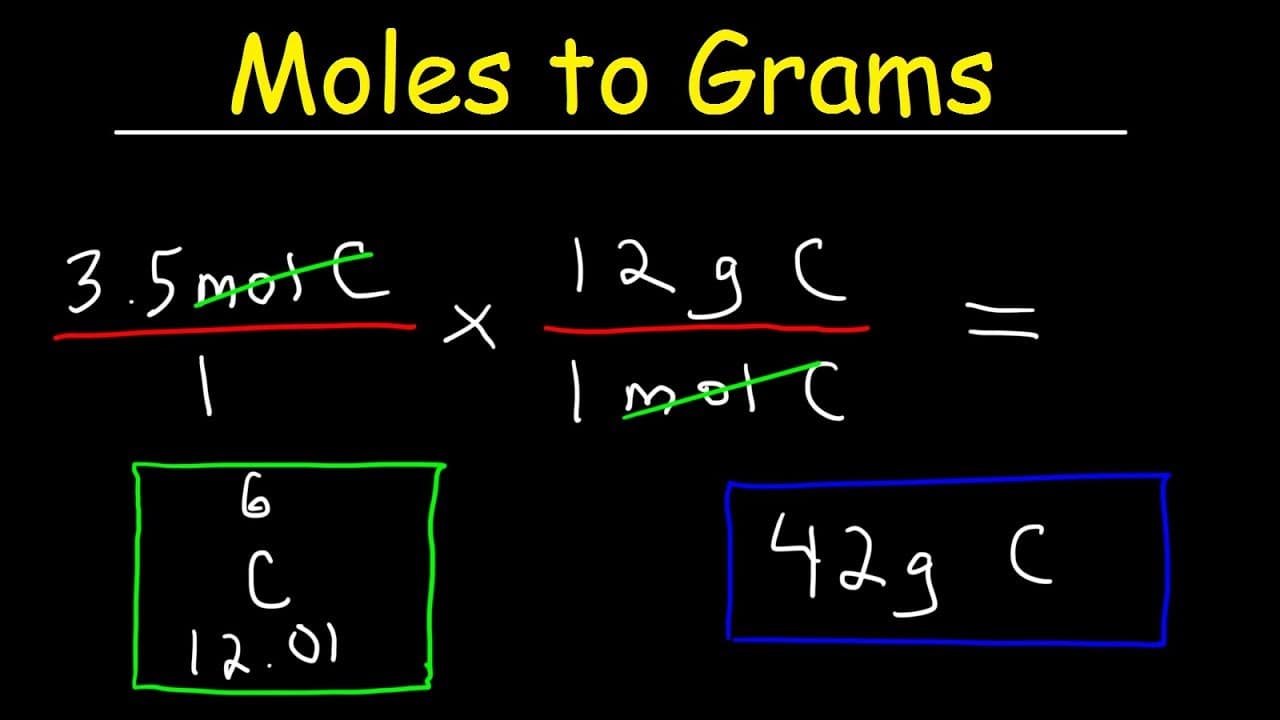
To convert moles to grams, multiply the number of moles by the substance's molar mass. For example, 3.5 moles of carbon equals 42 grams since the molar mass of carbon is 12 g/mol. Use this method with any substance, ensuring you determine its molar mass first.
Transcript
number one how many grams are there in 3.5 moles of carbon atoms so how can we do this the first thing you want to do is identify the molar mass of carbon so if you go to the periodic table you'll see that carbon has an atomic number of six and a mass number of twelve you wanna look for the larger of the two numbers which is twelve so that's the mo... Read More
Key Insights
- 💆 The molar mass of a substance is crucial for converting moles to grams.
- 🧑🏭 Conversion factors, using the molar mass, facilitate the conversion process.
- 🫀 The molar mass varies depending on the substance and can be determined using atomic masses.
- ❓ Practice and familiarity with the concept enable easier and efficient conversion.
- 💁 Chemical formulas provide the necessary information to determine the molar mass.
- 🫀 Converting moles to grams is applicable to both atoms and molecules.
- 🌥️ Conversion can also be done to larger units, such as kilograms or milligrams.
Install to Summarize YouTube Videos and Get Transcripts
Explore YouTube Video Summarizer or Get YouTube Transcript Extractor
Questions & Answers
Q: How do you convert moles to grams using molar mass?
To convert moles to grams, you need to identify the molar mass of the substance and use it as a conversion factor in the calculation. Multiply the number of moles by the molar mass to obtain the mass in grams.
Q: What is the molar mass of carbon?
Carbon has an atomic number of six and a mass number of twelve. The molar mass of carbon is 12 grams per mole, meaning one mole of carbon has a mass of 12 grams.
Q: How many grams of sulfur are present in 4.2 moles of sulfur?
Sulfur has an atomic number of 16 and an average atomic mass of 32.07. The molar mass of sulfur is 32.07 grams per mole. By multiplying 4.2 moles by the molar mass, we find that there are 134.694 grams of sulfur.
Q: What is the molar mass of carbon dioxide (CO2)?
Carbon dioxide consists of one carbon atom and two oxygen atoms. The molar mass of carbon dioxide is calculated by adding the atomic mass of carbon (12.01) to twice the atomic mass of oxygen (2 x 16). Therefore, the molar mass of CO2 is 44.01 grams per mole.
Summary & Key Takeaways
-
The content explains how to convert moles to grams by first identifying the molar mass of the substance.
-
It provides examples of converting moles of carbon atoms, sulfur, carbon dioxide, and glucose into grams.
-
Each example includes step-by-step instructions on using the molar mass as a conversion factor to solve the problem.
Read in Other Languages (beta)
Share This Summary 📚
Summarize YouTube Videos and Get Video Transcripts with 1-Click
Try YouTube Summary with ChatGPT & Claude or YouTube Transcript Generator
Explore More Summaries from The Organic Chemistry Tutor 📚




Summarize YouTube Videos and Get Video Transcripts with 1-Click
Try YouTube Summary with ChatGPT & Claude or YouTube Transcript Generator