Electron Microscopy - Lecture 5 - Field Emission Gun
TL;DR
The field emission gun is the most advanced electron source for microscopes, offering high brightness and resolution.
Transcript
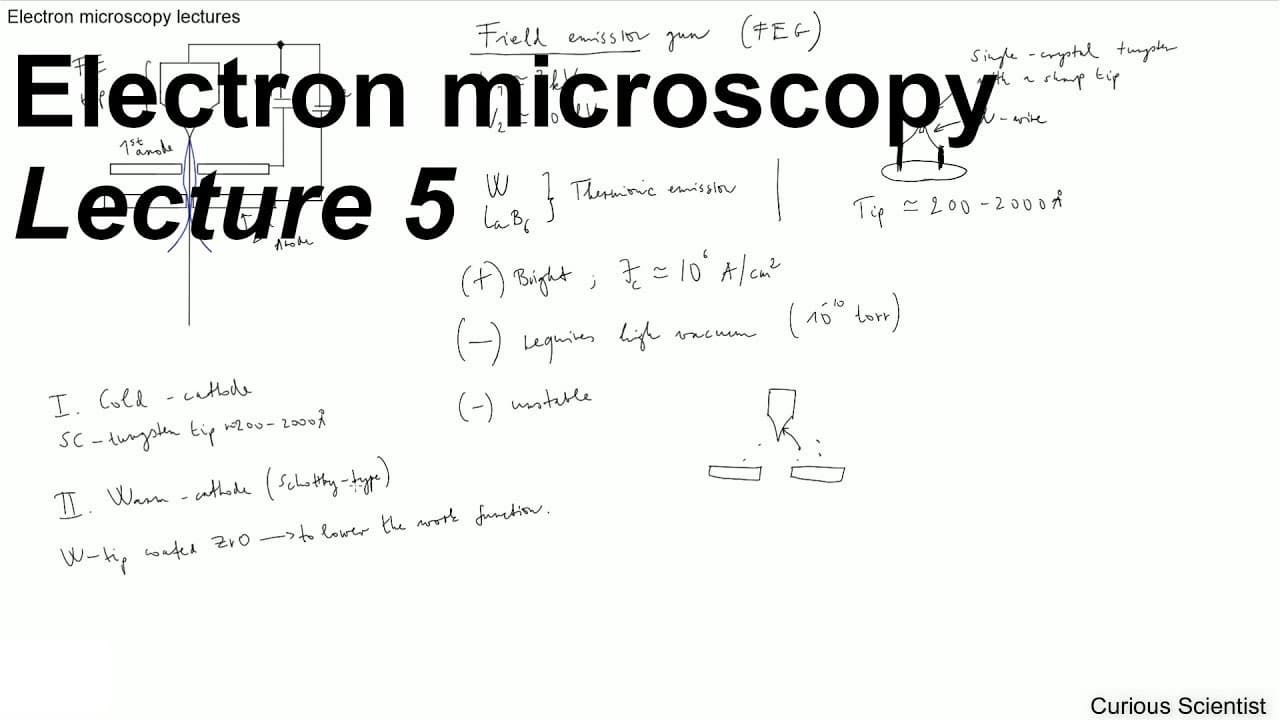
welcome everyone to another lecture of electron microscopy today I'm going to talk about another type of gun which is the field emission gun and it's of abbreviated as f EG so the field emission gun is basically the best available gun on the market for electron microscopes so and it works with a bit different principle than the previous ones I will... Read More
Key Insights
- 🔆 The field emission gun is the premier source for electron microscopy due to its exceptional brightness and ability to generate high-resolution images.
- ⚡ High voltage differences between anodes in FEGs enhance electron emission efficiency compared to traditional electron guns.
- ✋ FEGs are designed to produce extremely small spot sizes, which is essential for high-detail imaging in advanced microscopy applications.
- 👻 The unique construction of FEG tips allows for a very high current density, enabling more effective electron output and minimizing distortion in images.
- 😁 Ultrahigh vacuum conditions are critical for the optimal performance of field emission guns to prevent contamination and ensure beam stability.
- 😁 Maintaining the tungsten tip's sharpness is vital for preserving the beam quality, requiring regular monitoring and cleaning to avoid contamination risks.
- 🥶 The cold cathode FEG is less complex and does not require thermal management but is also less stable than the warm cathode variant.
Install to Summarize YouTube Videos and Get Transcripts
Explore YouTube Video Summarizer or Get YouTube Transcript Extractor
Questions & Answers
Q: What are the main advantages of using a field emission gun in electron microscopes?
The field emission gun (FEG) offers several advantages, including a very high current density of approximately 10^6 A/cm², which is substantially brighter than traditional sources. It can create focused spots smaller than 100 angstrom without auxiliary lenses, making it ideal for high-resolution imaging. Its specialized design allows for better electron beam quality and greater resolution in microscopic analysis.
Q: How does the field emission gun differ from traditional thermionic guns?
Traditional thermionic guns, like tungsten and lanthanum hexaboride, rely on thermal emission, where materials are heated to release electrons. In contrast, the field emission gun operates on the principle of applying a high electric field to extract electrons from a sharp tungsten tip, allowing for superior brightness and resolution. This fundamental difference in operation is what sets FEGs apart.
Q: What are the operational challenges associated with field emission guns?
One major challenge of field emission guns is their requirement for ultra-high vacuum conditions, around 10^-10 torr, which can complicate setup and maintenance. Additionally, they are more sensitive to environmental changes, which can affect stability and beam quality. Contamination of the tungsten tip by gas particles can lead to degradation of performance, resulting in a shorter service life compared to other types of electron guns.
Q: What are the two types of field emission guns, and how do they differ?
The two types of field emission guns are the cold cathode and warm cathode types. The cold cathode FEG uses a sharp tungsten tip without thermal assistance, while the warm cathode, often referred to as the Schottky type, is thermally assisted to improve electron emission. The warm cathode type, although generally more efficient, is also more sensitive to environmental factors and requires careful management of vacuum conditions.
Summary & Key Takeaways
-
The field emission gun (FEG) is considered the best electron source for electron microscopes due to its high brightness and focused illumination capabilities. It operates differently from conventional thermionic guns by utilizing field emission principles.
-
FEGs require significant voltage differences between anodes, with the first at about 3 kV and the second up to 100 kV, enhancing electron emission while necessitating a high vacuum environment for optimal performance.
-
While FEGs provide smaller spot sizes and better current density, they are sensitive to environmental factors, have less stability compared to traditional guns, and can experience contamination issues that degrade beam quality.
Read in Other Languages (beta)
Share This Summary 📚
Summarize YouTube Videos and Get Video Transcripts with 1-Click
Try YouTube Summary with ChatGPT & Claude or YouTube Transcript Generator
Explore More Summaries from Curious Scientist 📚
![Building a coil winder [Part 6] - A few improvements thumbnail](/_next/image?url=https%3A%2F%2Fi.ytimg.com%2Fvi%2F3eyxG_g2iUA%2Fhqdefault.jpg&w=750&q=75)


Summarize YouTube Videos and Get Video Transcripts with 1-Click
Try YouTube Summary with ChatGPT & Claude or YouTube Transcript Generator