What Are Capacitors and How Do They Work?
TL;DR
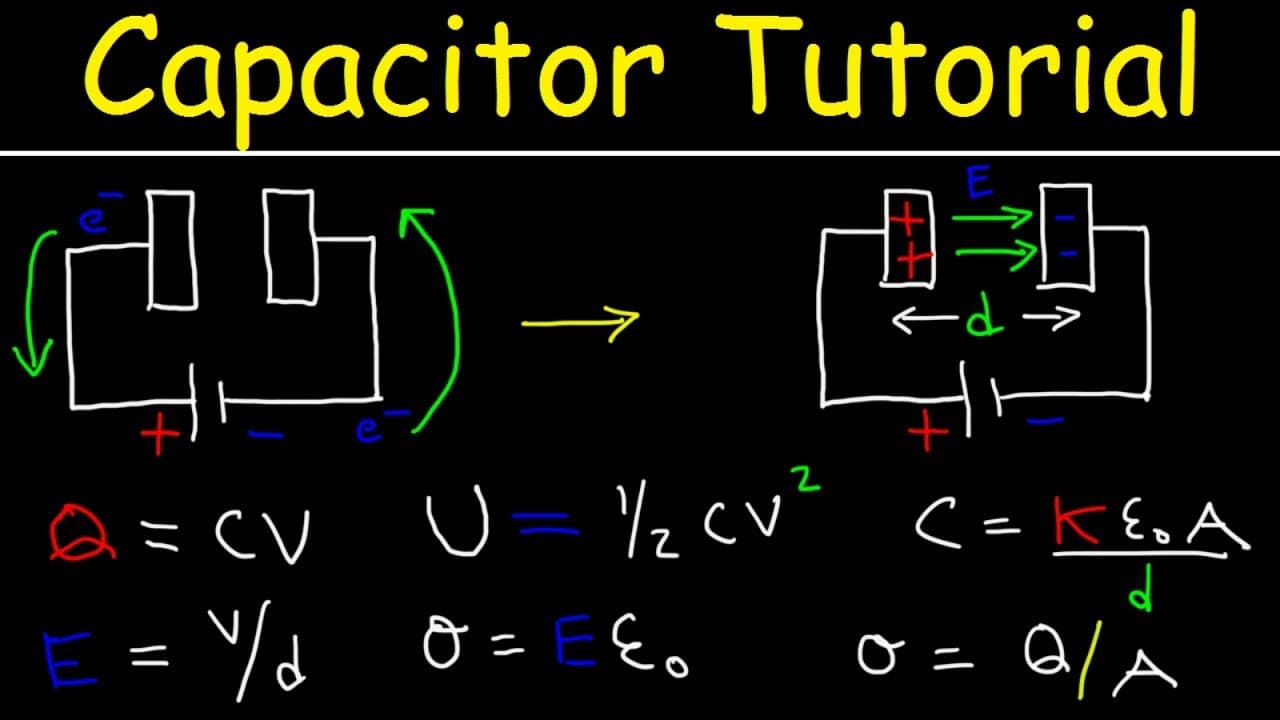
Capacitors store electrical charge between two metal plates separated by an insulator, with capacitance indicating how efficiently they hold charge per volt. Factors like construction, dielectric materials, and plate area influence capacitance, while the relationship between charge (Q), capacitance (C), and voltage (V) is expressed by the equation Q=CV.
Transcript
in this video we're going to talk about capacitors so what exactly is a capacitor a capacitor stores electrical charge it's not the same as a battery a capacitor uses two metal plates separated by an insulator and it basically stores charge by taking electrons from one side and pumping it towards the other side the insulator could be air it could b... Read More
Key Insights
- 🤘 Capacitors store electrical charge using two metal plates separated by an insulator.
- 🈂️ Capacitance measures the charge efficiency of a capacitor, determining how much charge can be stored per volt.
- ⚡ Adding a dielectric material can increase capacitance but decreases voltage.
- 👷 The capacitance depends on the construction of the capacitor, including the area of the plates and the distance between them.
- ⚡ The equation Q=CV relates charge (Q), capacitance (C), and voltage (V).
- 🈂️ Electric charge is associated with the quantity of charged particles, with electrons typically being the charge carriers.
- 😉 The permittivity of free space (ε0) and the dielectric constant (k) affect capacitance.
Install to Summarize YouTube Videos and Get Transcripts
Explore YouTube Video Summarizer or Get YouTube Transcript Extractor
Questions & Answers
Q: What is a capacitor and how does it store electrical charge?
A capacitor consists of two metal plates separated by an insulator, which stores charge by transferring electrons from one plate to the other.
Q: How does capacitance affect the charge efficiency of a capacitor?
Capacitance measures the charge efficiency of a capacitor, determining how much charge it can store per volt. Higher capacitance means more charge can be stored per volt.
Q: What factors affect capacitance?
Capacitance is determined by the construction of the capacitor, including the area of the plates and the distance between them. Adding a dielectric material can also increase capacitance.
Q: How does adding a dielectric affect capacitance and voltage?
Adding a dielectric increases capacitance, allowing for more charge to be stored per volt. However, it also decreases the voltage proportionally, as the total charge remains the same.
Summary & Key Takeaways
-
Capacitors store electrical charge using two metal plates separated by an insulator.
-
Capacitance quantifies the charge efficiency of a capacitor, determining how much charge can be stored per volt.
-
Dielectric materials can increase capacitance, allowing for more charge to be stored, but at the cost of decreased voltage.
Read in Other Languages (beta)
Share This Summary 📚
Summarize YouTube Videos and Get Video Transcripts with 1-Click
Try YouTube Summary with ChatGPT & Claude or YouTube Transcript Generator
Explore More Summaries from The Organic Chemistry Tutor 📚




Summarize YouTube Videos and Get Video Transcripts with 1-Click
Try YouTube Summary with ChatGPT & Claude or YouTube Transcript Generator