How to Begin Your Career in Cybersecurity

TL;DR
Cybersecurity offers roles for people with varied academic backgrounds, including technology, law, policy, psychology, music, mathematics, and science. Students and graduates can contribute by embracing their distinctive perspectives, developing an appetite for complex problems, and exploring work spanning technical security, privacy, fraud prevention, election integrity, infrastructure resilience, and cyber policy.
Transcript
And this meeting is being recorded now. I just wanted to make sure that you guys were aware of that as well. So again, my name is Cecilia Marignee. I run Innovation and Scholar Programs for the RSA Conference. I'd like to welcome you to the RSA Conference's podcast, Hacking the Cyber Security Market. I'll be introducing you to your moderator and pa... Read More
Key Insights
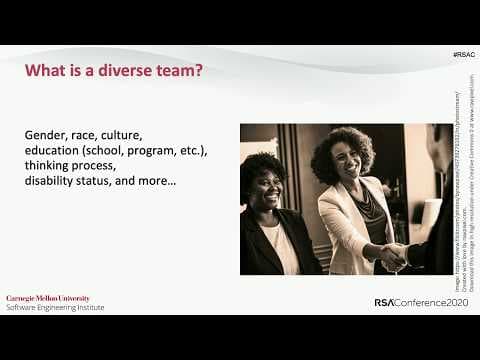
- Cybersecurity includes opportunities for people from many educational backgrounds, not only graduates holding cybersecurity degrees. Theresa Payton reports working with colleagues educated in music, psychology, mathematics, and science, arguing that varied forms of thinking are needed to address major security issues.
- Career paths into cybersecurity are not always planned in advance. Payton originally intended to pursue artificial intelligence, expert systems, law school, and elected office, but her experience confronting financial crime redirected her toward protecting people and organizations from cybercriminals.
- Financial technology work can create direct exposure to security problems. While working in financial services, Payton encountered fraud, terrorist financing, and money laundering, which motivated her to seek responsibility for cybersecurity alongside her existing responsibility for delivering technology.
- Understanding adversary capabilities can reshape career priorities. Payton says her work with special programs at the White House revealed that her banking experience had shown only a fraction of the threat landscape, leading her to dedicate the rest of her career to fighting cybercriminals.
- Cybersecurity policy connects technical systems with user protection. Camille Stewart describes writing policies for Google Play and Android concerning security, privacy, and the data developers may access, demonstrating that cybersecurity work can focus on governance and platform rules rather than only technical implementation.
- Election integrity is a cybersecurity career area that spans platforms, government, and consulting. Stewart says she built an election integrity program at Google Play and also worked on election integrity during roles connected with Deloitte and the Department of Homeland Security.
- Different personal perspectives can improve responses to complex cybersecurity problems. Stewart encourages newcomers to value the lens they bring, while also recognizing that security, social, and workplace issues may affect people differently depending on various facets of their lives.
- Cybersecurity intersects with numerous specialized policy subjects. Stewart’s work has included international cyber diplomacy, encryption, cyber export control, healthcare cybersecurity, infrastructure resilience, disinformation, misinformation, and the exfiltration of sensitive technology through courts.
Install to Summarize YouTube Videos and Get Transcripts
Explore YouTube Video Summarizer or Get YouTube Transcript Extractor
Questions & Answers
Q: Do I need a cybersecurity degree to start a cybersecurity career?
A cybersecurity degree is not presented as a requirement for entering the field. Theresa Payton says many of her colleagues do not have cybersecurity degrees and instead studied subjects including music, psychology, mathematics, and science. Her central point is that cybersecurity needs different kinds of thinking and people from varied walks of life to address major security problems.
Q: What kinds of backgrounds are useful in cybersecurity?
The panel identifies value in technical, scientific, legal, policy, and human-centered backgrounds. Examples include computer science, mathematics, information systems, law, psychology, music, and science. Payton emphasizes varied thinking, while Stewart demonstrates how legal and policy experience can support work involving privacy, platform security, election integrity, encryption, healthcare, and international cyber diplomacy.
Q: How can an unexpected career path lead to cybersecurity?
Payton’s experience shows that cybersecurity can emerge from responsibilities in another field. She entered financial services to work on cutting-edge technology, then encountered fraud, terrorist financing, and money laundering. Those problems motivated her to request cybersecurity responsibility while delivering technology. Later exposure to adversary capabilities at the White House confirmed her decision to focus her career on fighting cybercriminals.
Q: What does a cybersecurity policy professional do?
A cybersecurity policy professional can create rules that govern how platforms protect users and handle data. Stewart describes writing policies for Google Play and Android that address security, privacy, and the information developers may access. Her work also covers election integrity, disinformation, misinformation, encryption, cyber export controls, healthcare cybersecurity, international diplomacy, and infrastructure resilience.
Q: Why are diverse perspectives important in cybersecurity?
Diverse perspectives matter because cybersecurity contains complex problems that can look different depending on a person’s experiences and circumstances. Stewart urges newcomers to recognize the distinctive lens they bring and to remain aware that events and professional conditions can affect people differently. Payton similarly argues that solving major security issues requires different types of thinking from many walks of life.
Q: What cybersecurity work can protect individuals and organizations?
Payton describes cybersecurity as protecting individuals and companies from criminals who try to interfere with customers, identities, and money. Her stated mission extends to fighting cybercriminals on behalf of individuals, businesses, the United States, and its allies. Her career connects technology delivery, financial crime, White House cybersecurity responsibilities, and work informed by an understanding of adversary capabilities.
Q: How does election integrity relate to cybersecurity careers?
Election integrity appears as a security and policy specialty that can exist across technology platforms, government work, and consulting. Stewart says she built an election integrity program for Google Play and also addressed election integrity in previous work at Deloitte and the Department of Homeland Security. The topic sits alongside her work on infrastructure resilience, misinformation, disinformation, privacy, and user protection.
Q: What should students consider when entering cybersecurity during social change?
Students should consider both technical challenges and the social environment surrounding their work. The panel explicitly acknowledges the global pandemic, economic uncertainty, and a movement focused on systemic racism. Stewart encourages newcomers to use awareness of these conditions to strengthen their perspective, recognize that impacts can differ among people, and approach complex cybersecurity problems with greater consciousness of varied experiences.
Summary & Key Takeaways
-
The panel welcomes students and recent graduates to cybersecurity during a period shaped by a global pandemic, economic uncertainty, and a movement addressing systemic racism. The participants frame cybersecurity as an interesting, challenging career path and emphasize that current social and professional conditions should inform how newcomers approach security problems and workplaces.
-
Theresa Payton describes moving from information systems and financial technology into cybersecurity after encountering fraud, terrorist financing, and money laundering. Her subsequent White House responsibilities exposed broader adversary capabilities and convinced her to focus her career on fighting cybercriminals for individuals, companies, the United States, and its allies.
-
Camille Stewart presents cybersecurity as an interdisciplinary field connecting law, policy, and technology. Her work includes user security, privacy, developer data access, election integrity, misinformation, infrastructure resilience, encryption, export controls, and healthcare. She encourages newcomers to recognize that their experiences provide distinctive perspectives for solving the field’s complex problems.
Read in Other Languages (beta)
Share This Summary 📚
Summarize YouTube Videos and Get Video Transcripts with 1-Click
Try YouTube Summary with ChatGPT & Claude or YouTube Transcript Generator
Explore More Summaries from RSAC Cybersecurity 📚




Summarize YouTube Videos and Get Video Transcripts with 1-Click
Try YouTube Summary with ChatGPT & Claude or YouTube Transcript Generator