How to turn raw data into AI ready features
TL;DR
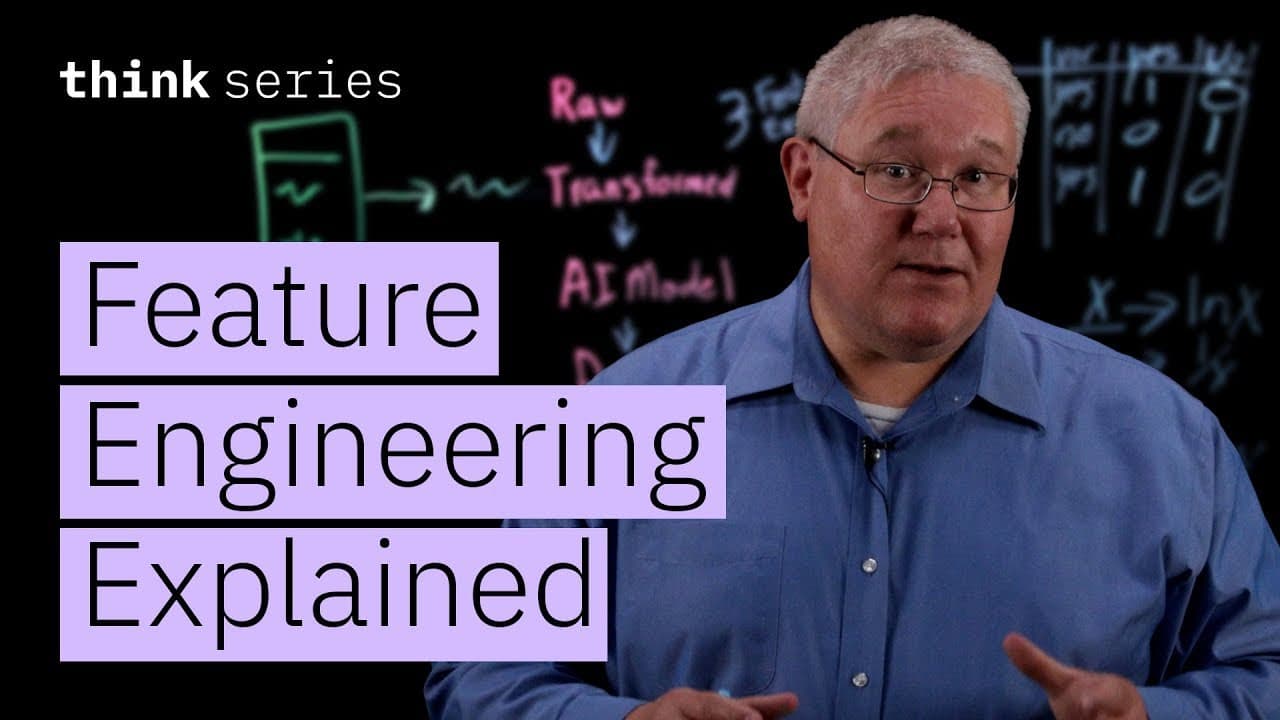
Feature engineering converts raw information into model friendly inputs that can improve predictive accuracy. It covers transforming categorical data with dummy variables, applying ETL or data pipelines, and creating new features through mathematical combos. For text or documents, summaries or extracted entities can become the model input instead of raw text. These steps unlock better AI predictions.
Transcript
Feature engineering, data transformations, ETL, data pipelines. If you've ever heard these terms and wondered what the heck they were, this video is for you. So if you put 10 data scientists in a room and ask them to define data science, you wouldn't get 10 answers. You would probably get 20 or 30. There's a lot of reasons for that, mainly where da... Read More
Key Insights
- Raw data must be transformed into transformed information to maximize a model’s predictive ability.
- One hot encoding creates separate numeric columns for each category, enabling models to process categorical data.
- ETL, data pipelines, and data transformations are interchangeable terms that describe preparing data for modeling.
- Feature engineering also involves combining or transforming variables, such as multiplying two columns to create a new feature.
- For text, summarization or feature extraction helps reduce input length while preserving predictive signal.
- The goal of feature engineering is to convert raw information into a more useful form for AI models.
- Document processing often uses summaries or extracted entities to feed models instead of full text.
- The versatility of feature engineering spans categoricals, numerics, and text, all aimed at improving model accuracy.
Install to Summarize YouTube Videos and Get Transcripts
Explore YouTube Video Summarizer or Get YouTube Transcript Extractor
Questions & Answers
Q: How to transform categorical data for AI models
Transforming categorical data typically involves creating dummy variables or one hot encoding, where a single categorical feature is split into multiple numeric columns representing each category. For example, a yes or no feature becomes two separate binary columns. This makes the information computable by most AI models and helps the model distinguish between categories when learning patterns.
Q: What is the role of ETL in feature engineering
ETL, or extract, transform, load, plays a central role in feature engineering by taking raw information from sources, transforming it into a form suitable for modeling, and loading it into the data pipeline. This pipeline ensures consistent, repeatable preprocessing that supports reliable model training and deployment over time.
Q: How can text data be made usable for models
Text data can be made usable by summarizing documents to extract core ideas or by identifying key features such as entities or involved parties. These summarized or feature extracted representations reduce input complexity while preserving important information, enabling models to learn from text without processing entire lengthy documents.
Q: Why are normalizing transformations useful in feature engineering
Normalizing transformations, such as applying the natural log or inverse, help stabilize variance, reduce skew, and bring different data scales closer together. This makes it easier for models to learn from the data and can improve convergence, especially for algorithms sensitive to feature scale differences.
Q: What does creating a new feature by multiplying columns achieve
Multiplying two columns to create a new feature captures interaction effects between variables. This can reveal combined influences on the target that are not evident when considering each feature alone, allowing the model to learn more nuanced patterns and potentially improve predictive accuracy.
Q: How is feature engineering applied to document data
For documents the approach centers on extracting essential information such as summaries or key entities. This distilled representation provides the model with the most relevant features, enabling it to base predictions on concise, informative inputs rather than unprocessed text, which can be noisy or irrelevant.
Q: What is the overarching goal of feature engineering
The overarching goal is to take raw information and convert it into a form that maximizes the AI model’s predictive ability. This involves selecting or creating features that are informative, usable by the model, and aligned with the chosen modeling approach, thereby improving accuracy and deployment effectiveness.
Q: Can you describe the difference between data transformations and ETL
Data transformations refer to the specific changes applied to data, such as encoding, normalization, or feature creation, to make it suitable for modeling. ETL encompasses the broader workflow of extracting data from sources, transforming it, and loading it into a system, such as a model training pipeline, ensuring end to end data readiness.
Summary & Key Takeaways
-
Feature engineering converts raw information into transformed formats that boost model predictiveness while aligning with data pipelines and ETL concepts. It highlights common techniques such as dummy variables and one hot encoding, and explains how transformations make data usable by AI models.
-
The process also covers handling text data by summarizing documents or extracting entities to feed models, instead of processing entire texts. It emphasizes turning raw data into actionable, usable features for better predictions.
-
Whether working with structured data or text, the goal is to transform raw information into numeric, model compatible features that maximize predictive performance and facilitate deployment of AI systems.
Read in Other Languages (beta)
Share This Summary 📚
Summarize YouTube Videos and Get Video Transcripts with 1-Click
Try YouTube Summary with ChatGPT & Claude or YouTube Transcript Generator
Explore More Summaries from IBM Technology 📚


Summarize YouTube Videos and Get Video Transcripts with 1-Click
Try YouTube Summary with ChatGPT & Claude or YouTube Transcript Generator