How to Calculate Entropy Change in Heating and Mixing Water
TL;DR
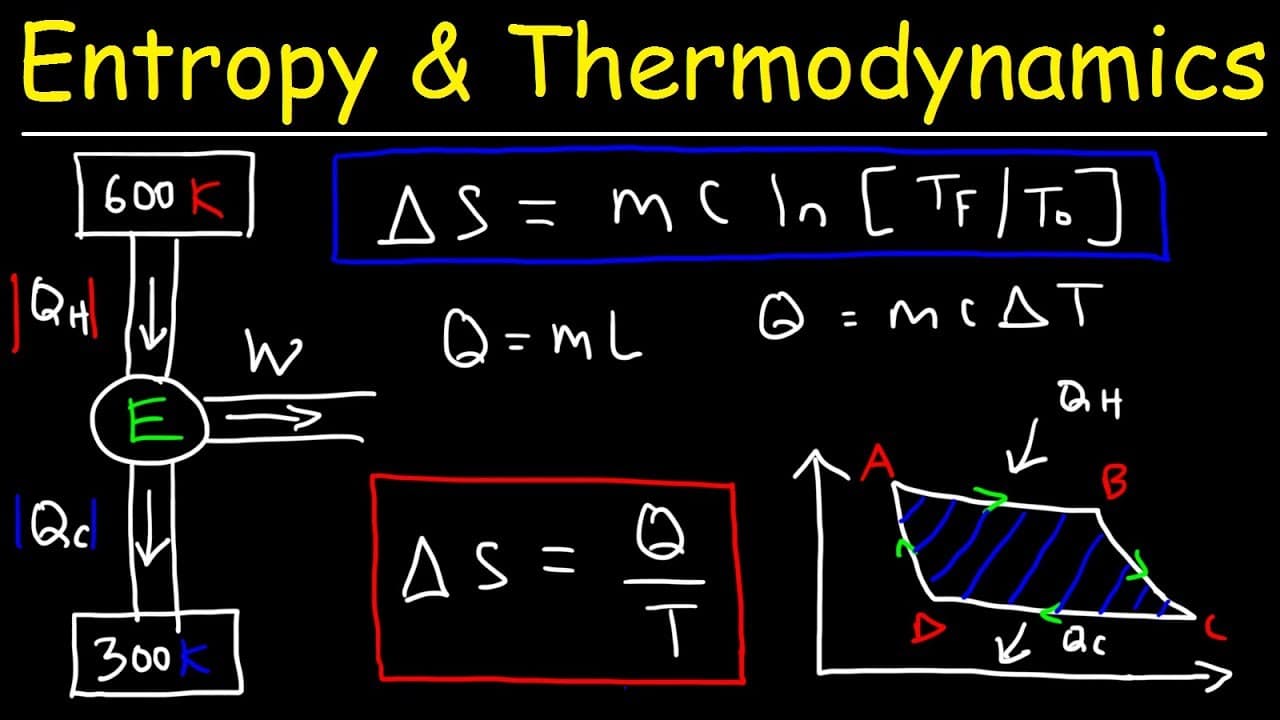
To calculate entropy change in processes like melting ice or heating water, use the formula: entropy change = heat transferred divided by temperature. For melting ice, the entropy change can be determined by the mass of ice times the latent heat of fusion divided by temperature. When mixing water at different temperatures, the entropy change varies: it is positive for the cold water sample and negative for the hot one.
Transcript
in this video we're going to focus on calculating the entropy change for certain processes as it relates to physics so let's start with this one calculate the entropy change of melting 15 grams of ice at zero degrees celsius the entropy change which is a measure of disorder is equal to the heat transferred divided by the temperature so to calculate... Read More
Key Insights
- 🥵 Entropy change can be calculated by dividing heat transferred by temperature.
- 💪 The entropy change of melting ice is equal to (mass of ice x latent heat of fusion)/temperature.
- 💦 When heating water, average temperature must be used in the entropy change calculation.
- 💱 Mixing water samples at different temperatures results in positive entropy change for the cold sample and negative entropy change for the hot sample.
- 🚒 The entropy change for reversible cyclic processes, like the Carnot engine, is zero.
- 💱 The entropy change formula can be derived using the antiderivative of temperature.
- 💱 The entropy change is affected by temperature changes, with an increase in temperature leading to a positive change and a decrease leading to a negative change.
Install to Summarize YouTube Videos and Get Transcripts
Explore YouTube Video Summarizer or Get YouTube Transcript Extractor
Questions & Answers
Q: How do you calculate the entropy change when melting ice?
The entropy change can be calculated by dividing the heat transferred during melting (mass of ice x latent heat of fusion) by the temperature in Kelvin.
Q: How do you calculate the entropy change when heating water?
To calculate the entropy change when heating water, multiply the mass of water by the specific heat capacity and the change in temperature. Divide this by the average temperature in Kelvin.
Q: What is the entropy change when mixing water samples at different temperatures?
The entropy change for each water sample can be calculated using the same formula as heating water. The final temperature is the average of the initial temperatures. The entropy change is positive for the cold sample and negative for the hot sample. The sum of these values gives the total entropy change.
Q: What is the relationship between temperature change and entropy change?
When heating a substance, an increase in temperature leads to a positive entropy change, as the disorder of the system increases. When cooling a substance, a decrease in temperature leads to a negative entropy change, as the disorder decreases.
Summary & Key Takeaways
-
The video explains how to calculate the entropy change when melting 15 grams of ice at 0 degrees Celsius, using the formula: entropy change = (heat transferred)/(temperature).
-
It also demonstrates the calculation of entropy change when heating 2 kilograms of water from 0 to 100 degrees Celsius and when mixing 3 kilograms of water at different temperatures.
-
The video showcases two methods for calculating entropy change, one using the specific heat capacity and change in temperature, and the other using natural logarithms.
Read in Other Languages (beta)
Share This Summary 📚
Summarize YouTube Videos and Get Video Transcripts with 1-Click
Try YouTube Summary with ChatGPT & Claude or YouTube Transcript Generator
Explore More Summaries from The Organic Chemistry Tutor 📚



Summarize YouTube Videos and Get Video Transcripts with 1-Click
Try YouTube Summary with ChatGPT & Claude or YouTube Transcript Generator