Find The Derivative Using The Chain Rule
TL;DR
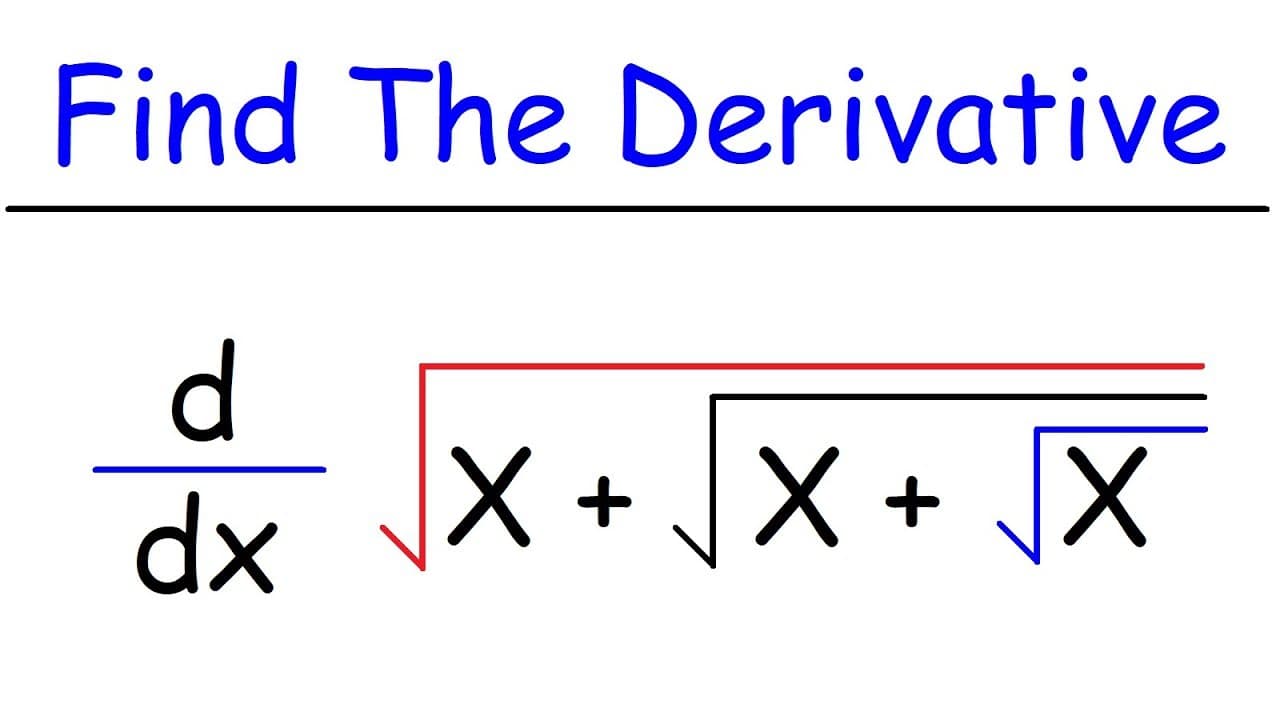
Differentiate the nested square-root function by rewriting each radical with an exponent of one-half, then repeatedly applying the power rule and chain rule from the outside inward. For a composite function f(g(x)), keep the inside unchanged while differentiating the outside, then multiply by the derivative of the inside. Negative one-half exponents can then be rewritten as square roots in denominators; read on for the step-by-step process and simplification.
Transcript
what is the derivative of this function the square root of x plus the square root of x plus the square root of x again how can we find the derivative of that expression well we need to use the chain rule because we have functions within other functions now just to review here's how you could use the chain rule so let's say you want to find the deri... Read More
Key Insights
- 📏 The chain rule is crucial for finding the derivative of composite functions.
- ✊ The power rule is used to differentiate exponents, including negative exponents.
- 😑 Simplification of the final derivative expression involves combining like terms and placing the expression in fraction form.
- 📏 Understanding how to apply the chain rule and power rule is essential for finding derivatives in calculus.
- ❎ The derivative of a square root function with a negative exponent appears in the denominator of the fraction.
- 😑 Careful rearranging of terms and fractions is needed to simplify the final expression.
- 👻 The chain rule allows us to differentiate functions within functions, enabling us to find more complex derivatives.
Install to Summarize YouTube Videos and Get Transcripts
Explore YouTube Video Summarizer or Get YouTube Transcript Extractor
Questions & Answers
Q: How do you find the derivative using the chain rule?
For a composite function f(g(x)), differentiate the outside function while keeping the inside expression unchanged. Then multiply that result by the derivative of the inside function, repeating the process when more functions are nested.
Q: Why does this nested square-root function require the chain rule?
The expression contains square-root functions inside other square-root functions. Because these are nested composite functions, each outside derivative must be multiplied by the derivative of its inside expression.
Q: How should the nested square roots be rewritten before differentiating?
Rewrite every square root as a power with exponent one-half. The example is represented using x, an inner x plus x to the one-half, and additional outer powers of one-half corresponding to the surrounding radicals.
Q: How is the power rule applied to an exponent of one-half?
Move the one-half exponent to the front as a coefficient and subtract one from the exponent. Since one-half minus one is negative one-half, the differentiated power has an exponent of negative one-half.
Q: What is the derivative of x to the one-half?
Using the power rule, the derivative is one-half times x to the negative one-half. The transcript then rewrites this as one divided by two times the square root of x.
Q: How is the derivative of each inside function calculated?
The derivative of x is one. For an inside term raised to the one-half, apply the power rule and then multiply by the derivative of the expression nested within it.
Q: What does a negative one-half exponent mean in the derivative?
A negative one-half exponent places the corresponding square-root expression in the denominator. For example, one-half times x to the negative one-half becomes one over two square root x.
Q: How is the final derivative expression simplified?
Rewrite negative one-half powers as radicals in denominators, then arrange the chained factors into fractions. Terms such as one plus one over two square root x can be combined within the numerator, while the outer square-root factors remain in the denominator.
Summary & Key Takeaways
-
The video explains how to find the derivative of a composite function using the chain rule.
-
The example function is the square root of x, plus the square root of x, plus the square root of x.
-
The power rule is used to differentiate the exponents, and the chain rule is applied to find the derivative of the inside function.
Read in Other Languages (beta)
Share This Summary 📚
Summarize YouTube Videos and Get Video Transcripts with 1-Click
Try YouTube Summary with ChatGPT & Claude or YouTube Transcript Generator
Explore More Summaries from The Organic Chemistry Tutor 📚


Summarize YouTube Videos and Get Video Transcripts with 1-Click
Try YouTube Summary with ChatGPT & Claude or YouTube Transcript Generator