What Is the Nvidia-Groq Deal Really? License Plus Acquihire
TL;DR
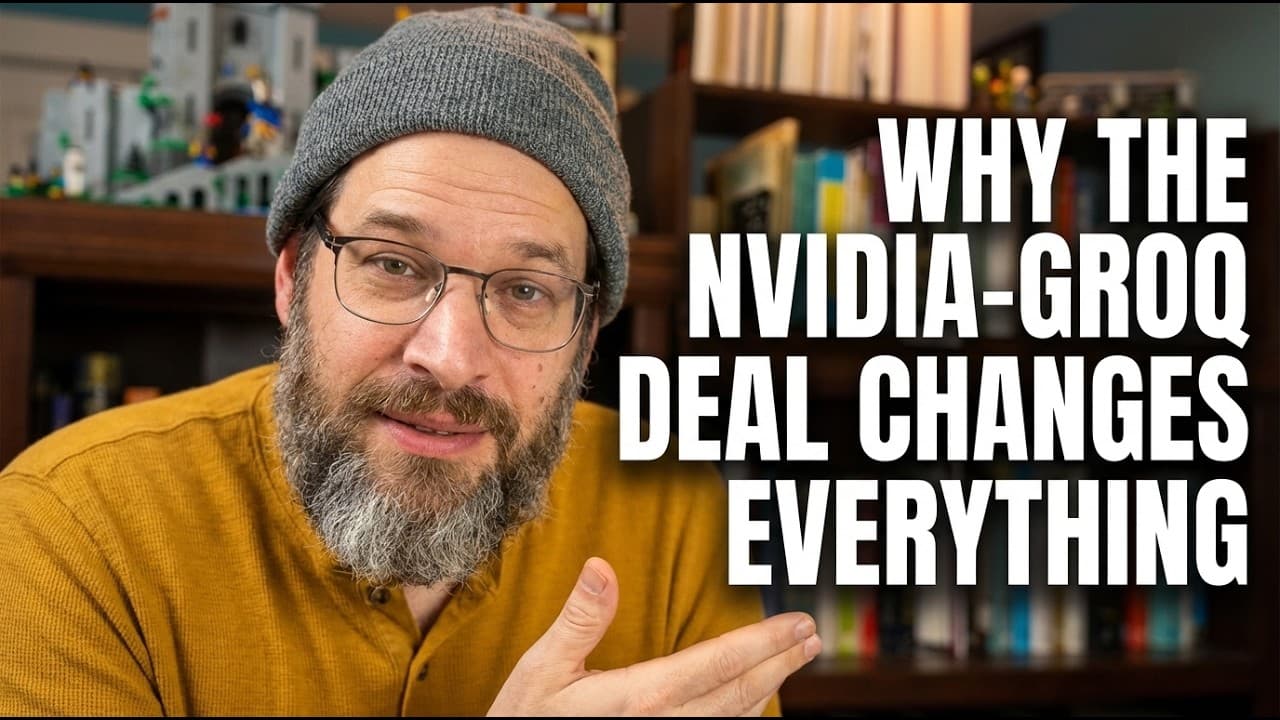
Nvidia did not straightforwardly acquire Groq, the inference-and-memory chip startup. It signed a non-exclusive license for Groq's inference technology while founder Jonathan Ross, president Sunny Madra, and other team members moved to Nvidia. Groq stays independent under new CEO Simon Edwards, with Groq Cloud continuing. It is a capability transfer, not a change-of-control acquisition.
Transcript
There's only one news story that mattered this week and it was the story of Grock with a Q. Not Grock with a K, not the AI model company. Grock with a Q, the inference on a chip memory company. Grock with a Q was quote unquote bought by Nvidia. And I use scare quotes for that because the story is much more complicated. This is one of the defining p... Read More
Key Insights
- Nvidia's Groq deal is structured as a non-exclusive licensing agreement for Groq's inference technology combined with an acquihire, not a full acquisition. Groq remains independent under new CEO Simon Edwards, and its Groq Cloud product continues operating.
- A non-exclusive license means Groq can still license the same inference technology to other parties, so on paper the deal is not a takeover even though key leaders including founder Jonathan Ross and president Sunny Madra are moving to Nvidia.
- License-plus-acquihire deals let large AI companies grab key people without triggering a change-of-control event or regulatory review, which leaves remaining startup employees uncertain about whether their equity yields any reward.
- The frontier AI race is bound as much by people as by compute. A few individuals can be worth more than an entire company, as shown by Mira Murati and Ilya Sutskever each raising large rounds largely on their names after leaving prior roles.
- The deeper constraint on AI is memory bandwidth: how fast a chip moves model weights, activations, and the KV cache in and out of working memory during inference, not just raw matrix-multiplication compute. Groq's work centered on this memory problem.
- High-bandwidth memory (HBM) is DRAM stacked vertically and packaged next to the processor with very wide interfaces, letting the chip pull data far faster than conventional memory and avoiding the memory-wall stalls that limit AI accelerators.
- HBM supply is being pre-sold years ahead. SK Hynix reported its high-bandwidth memory sold out through 2025 and into 2026, and Google executives were fired this week for failing to secure pre-allocated HBM for the company's TPU goals.
- Advanced packaging like TSMC's CoWoS (chip on wafer on substrate) places logic dies and HBM stacks together on a silicon interposer. As miniaturization slows, packaging has become essentially required to deliver generative AI performance.
Install to Summarize YouTube Videos and Get Transcripts
Explore YouTube Video Summarizer or Get YouTube Transcript Extractor
Questions & Answers
Q: What did Nvidia and Groq actually announce?
Groq announced a non-exclusive licensing agreement with Nvidia for Groq's inference technology, and in the same announcement said founder Jonathan Ross, president Sunny Madra, and some other team members are moving to Nvidia as the acquihire part of the deal. Groq also said it remains independent, named Simon Edwards as CEO, and confirmed that Groq Cloud, one of its products, is continuing. It is not a straight acquisition but a transfer of capability, described as a brain transplant without a clean change-of-control event.
Q: What does non-exclusive licensing mean in this deal?
A license means one company pays for the right to use another company's technology. Non-exclusive means the seller, Groq, can license the same inference technology to other parties as well. Because of this, the arrangement is not on paper a takeover, even though Nvidia gains Groq's inference technology and its key people. This distinguishes the deal from a full acquisition, where the company changes hands entirely and control transfers to the buyer.
Q: What is an acquihire and why does it matter here?
An acquihire is when the real asset being acquired is the team, meaning key leaders and engineers who matter more than the company's revenue or product. Historically that kind of buy only happened via full acquisition, such as when Meta bought WhatsApp. What is new is that hiring the team plus licensing the tech, while someone else keeps the startup's corporate shell alive, is becoming a standard play frontier AI companies run to snap up smaller startups.
Q: Why do license-plus-acquihire deals change the meaning of exit for startup employees?
Previously an exit, whether going public or being acquired, meant the company changed hands in a change-of-control event that triggered equity rewards for employees who held equity. In this Groq deal it is unclear what remaining employees get, if anything. Larger companies can grab key people and pull them into their corporate entity without triggering the change-of-control event or regulatory review, which is handy for them but leaves things awkward for exit and culture in Silicon Valley.
Q: Why are a few people worth more than entire companies in AI?
The market has shown that a small number of valuable people are worth more than whole companies. Mira Murati, coming out of OpenAI and founding her own business, got a large seed round off her name alone. Ilya Sutskever founding Safe Superintelligence raised a large round similarly. Frontier AI companies increasingly want the people rather than the tech, assets, or cap table. The video suggests we may be people-bound, not just compute-bound, since a few people can drive AI forward.
Q: Why is memory bandwidth more important than raw compute for AI?
Memory bandwidth is how fast a chip can move data in and out of working memory while doing the matrix multiplications at the heart of large language model inference. Modern AI models constantly fetch and move enormous amounts of data, including model weights, activation parameters, and the KV cache that stores context so the model can keep generating. Fast AI is as much about feeding the chip as about the chip's raw compute, which is exactly the memory problem Groq was working on.
Q: What is high-bandwidth memory (HBM) and why does it keep appearing in Nvidia conversations?
HBM is not a new kind of memory; it is DRAM stacked vertically and packaged right next to the processor, physically connected with very wide interfaces so the chip pulls data far faster than conventional memory. SK Hynix defines it as vertically interconnecting multiple DRAM chips to dramatically increase processing speed. It appears in Nvidia conversations because a GPU can do staggering operations per second but stalls if it cannot pull model weights fast enough, which is the memory wall. Essentially all leading AI accelerators must use HBM.
Q: What is CoWoS packaging and why does it matter for AI performance?
CoWoS means chip on wafer on substrate, TSMC's advanced packaging technology that places logic dies and HBM stacks together on one large silicon interposer with dense interconnects between them. TSMC describes it as accommodating logic chiplets alongside HBM cubes stacked over a silicon interposer for AI and HPC workloads. As miniaturization slows, techniques like HBM stacking and CoWoS-style integration have become essentially required to reach the generative AI performance being sought, making advanced packaging capacity increasingly central and constrained.
Summary & Key Takeaways
-
Groq, the inference and on-chip memory company (spelled with a Q, not the AI model Grok), was quote-unquote bought by Nvidia. In reality it signed a non-exclusive license for its inference tech while founder Jonathan Ross, president Sunny Madra, and others joined Nvidia. Groq stays independent under CEO Simon Edwards.
-
This license-plus-acquihire structure is a capability transfer, not a clean change-of-control acquisition. Big AI firms use it to grab key people while keeping the startup's corporate shell alive, avoiding regulatory review. This redefines exit for employees, whose equity rewards become unclear without a triggering change-of-control event.
-
The deal reflects that AI is constrained by memory bandwidth as much as compute. HBM stacks DRAM next to the processor, and TSMC's CoWoS packaging co-locates logic and HBM on a silicon interposer. HBM is sold out through 2025 and 2026, and Google execs were fired over failing to secure it.
Read in Other Languages (beta)
Share This Summary 📚
Summarize YouTube Videos and Get Video Transcripts with 1-Click
Try YouTube Summary with ChatGPT & Claude or YouTube Transcript Generator
Explore More Summaries from AI News & Strategy Daily | Nate B Jones 📚






Summarize YouTube Videos and Get Video Transcripts with 1-Click
Try YouTube Summary with ChatGPT & Claude or YouTube Transcript Generator