How Do Vision Transformers Enhance Computer Vision?
TL;DR
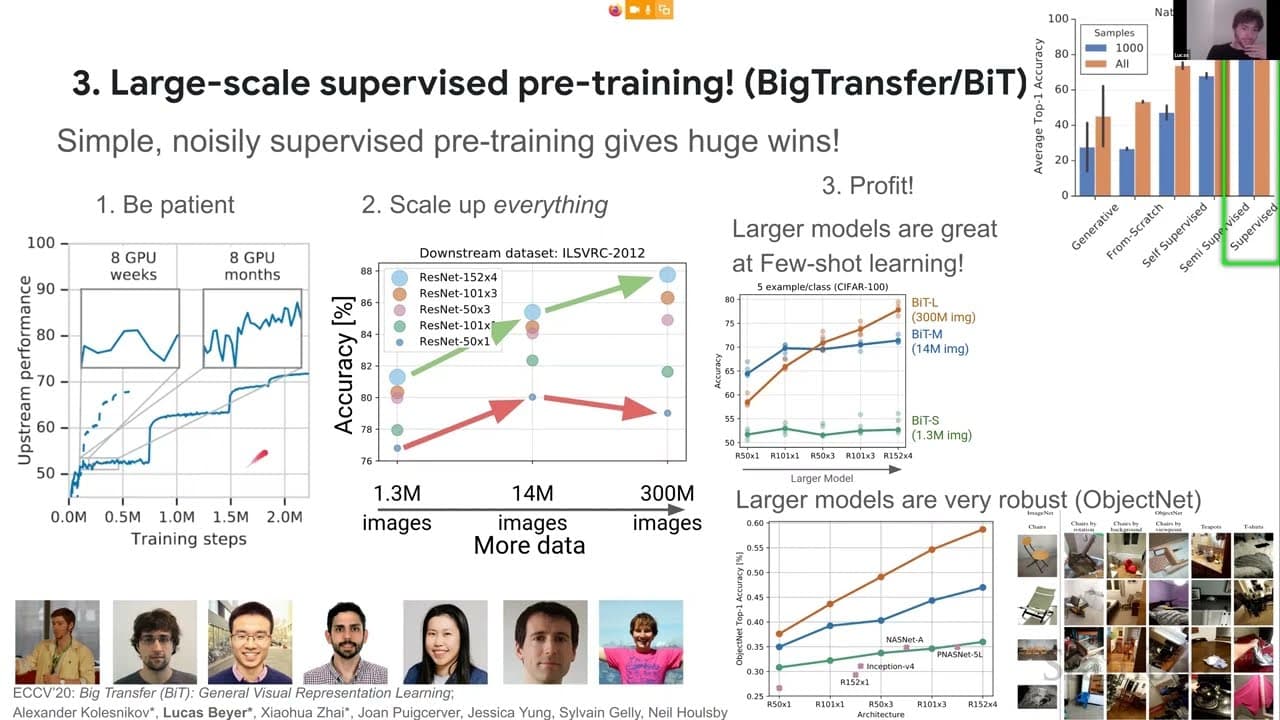
Vision transformers improve performance in computer vision by creating a general visual representation through the use of attention mechanisms and patch embeddings. By scaling up both data and model size, these transformers can achieve significant advancements in accuracy and generalization, outperforming traditional convolutional networks when trained on large datasets.
Transcript
today i'm going to talk to you about vision transformers since this is all about transformers um specifically their application for visual representation burning but before we jump into transformers i'm gonna spend like 10 or 15 minutes giving you a lot of context on all of this uh and specifically also on the vision part of things because i think ... Read More
Key Insights
- 📺 Vision transformers can be applied to various visual tasks by learning a general visual representation.
- 📺 Scaling up the data and model size in vision transformers improves performance and generalization.
- 💁 Vision transformers leverage the concept of attention and patch embeddings to process visual information effectively.
- 🌥️ Pre-training on large datasets is essential for vision transformers to learn a robust visual representation.
Install to Summarize YouTube Videos and Get Transcripts
Explore YouTube Video Summarizer or Get YouTube Transcript Extractor
Questions & Answers
Q: How do vision transformers differ from traditional convolutional neural networks in terms of architecture?
Vision transformers cut the image into smaller patches and process them using transformers, which leverage attention mechanisms. In contrast, CNNs use convolutional layers to extract features hierarchically from the entire image.
Q: What is the role of pre-training in vision transformers?
Pre-training is crucial in vision transformers as it allows the model to learn a general visual representation by training on massive amounts of data. This pre-trained model can then be fine-tuned on specific tasks.
Q: Do vision transformers exhibit locality bias?
Vision transformers do not explicitly encode locality bias in their architecture. Instead, they learn to capture both local and global information from the image patches during training.
Q: How does scaling up the model affect performance in vision transformers?
Scaling up the model in terms of data and model size leads to significant improvements in performance, especially in tasks that require general visual representation. Larger models show better accuracy and can generalize well with more data.
Summary & Key Takeaways
-
Vision transformers aim to create a general visual representation that can be applied to various visual tasks.
-
By scaling up the data and model size, vision transformers show significant improvements in performance, especially when trained on massive datasets.
-
Transformers leverage the concept of attention and the use of patch embeddings to process visual information.
-
Scaling up the model size and data leads to better performance in terms of accuracy and generalization.
Read in Other Languages (beta)
Share This Summary 📚
Summarize YouTube Videos and Get Video Transcripts with 1-Click
Try YouTube Summary with ChatGPT & Claude or YouTube Transcript Generator
Explore More Summaries from Stanford Online 📚



Summarize YouTube Videos and Get Video Transcripts with 1-Click
Try YouTube Summary with ChatGPT & Claude or YouTube Transcript Generator