How to Use the Node Voltage Method for Circuit Analysis
TL;DR
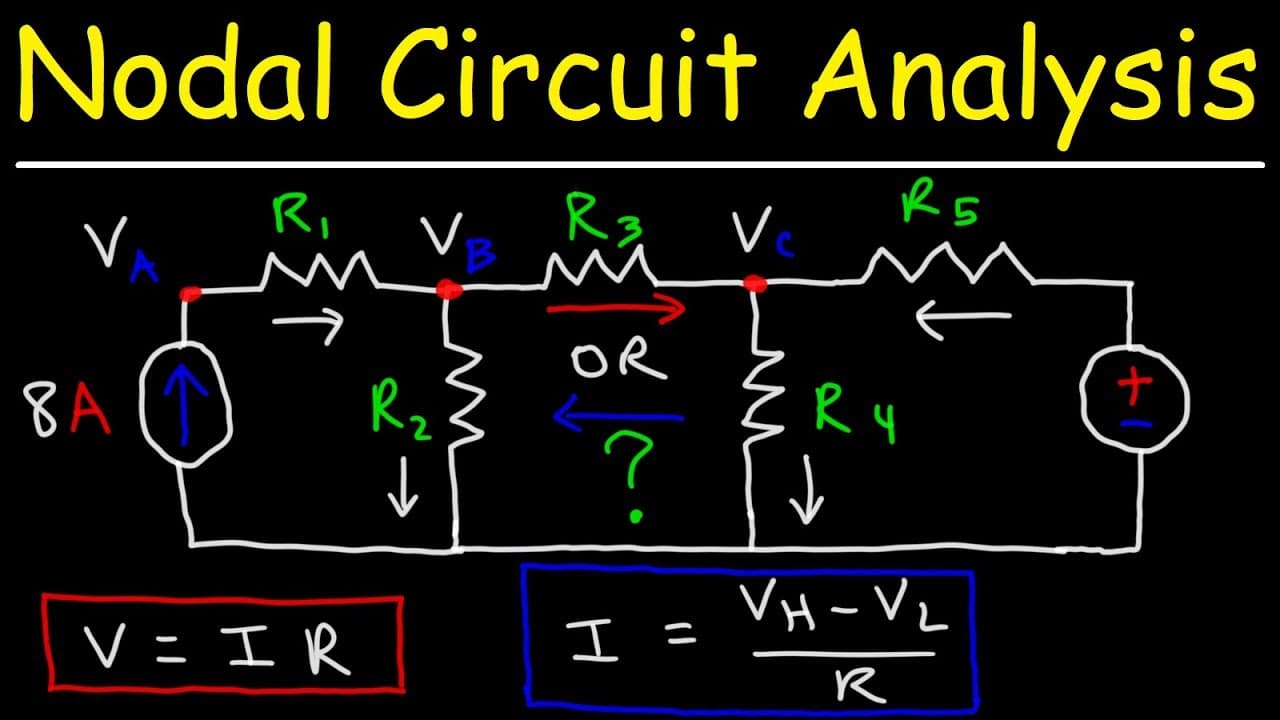
To use the node voltage method for circuit analysis, identify nodes, assign a reference voltage, and apply Kirchhoff's current law alongside Ohm's law. This method allows you to calculate the currents flowing through resistors and the voltages at different points in the circuit, providing a structured approach for solving complex network equations.
Transcript
in this video we're going to solve this circuit using the node voltage method so on the left we have a voltage source we're going to say it's 70 volts r1 is 10 ohms r2 has a value of 5 ohms and r3 has a value of let's say 6 ohms now here we have an independent current source with a value of 5 amps so with this information how can we use the node vo... Read More
Key Insights
- ⚡ The node voltage method is an effective technique for solving complex circuits and calculating currents and voltages.
- 👮 Kirchhoff's current law and Ohm's law are fundamental principles used in the node voltage method.
- ⚡ Identifying nodes and assigning reference voltage is crucial for the accurate calculation of voltages and currents.
- ⚡ Through careful analysis and calculations, the node voltage method helps in obtaining accurate results for circuit analysis.
- ⚡ Solving circuits using the node voltage method requires carefully applying principles and formulas to determine unknown variables.
- ℹ️ The voltage source and current source in a circuit affect the direction and magnitude of current flow.
- ⚡ The node voltage method eliminates the need for solving multiple simultaneous equations and provides a systematic approach to circuit analysis.
Install to Summarize YouTube Videos and Get Transcripts
Explore YouTube Video Summarizer or Get YouTube Transcript Extractor
Questions & Answers
Q: How does the node voltage method help in solving circuits?
The node voltage method is an approach to analyze circuits by identifying nodes and solving for the voltage at each node. It allows us to calculate currents and voltages in complex circuits.
Q: What is Kirchhoff's current law, and how is it applied in this method?
Kirchhoff's current law states that the sum of currents entering a node is equal to the sum of currents leaving that node. It is used to write equations based on the current flow at each node.
Q: How are the currents and voltages calculated using Ohm's law in the node voltage method?
Ohm's law is used to relate the voltage across a resistor with the current flowing through it. By knowing the resistances and voltages across resistors, the currents can be calculated.
Q: Why is it important to identify nodes and reference voltage in the node voltage method?
Nodes are the points where multiple branches of a circuit meet. By identifying nodes and assigning a reference voltage, we can determine the potential differences and currents at different points in the circuit.
Summary & Key Takeaways
-
The video demonstrates the process of solving a circuit using the node voltage method.
-
The circuit consists of resistors, voltage sources, and an independent current source.
-
By identifying nodes, assigning reference voltage, and applying Kirchhoff's current law and Ohm's law, the currents flowing through each resistor and the voltages at different points can be calculated.
Read in Other Languages (beta)
Share This Summary 📚
Summarize YouTube Videos and Get Video Transcripts with 1-Click
Try YouTube Summary with ChatGPT & Claude or YouTube Transcript Generator
Explore More Summaries from The Organic Chemistry Tutor 📚



Summarize YouTube Videos and Get Video Transcripts with 1-Click
Try YouTube Summary with ChatGPT & Claude or YouTube Transcript Generator