What Is the Minimum Frequency and Wavelength for the Photoelectric Effect?
TL;DR
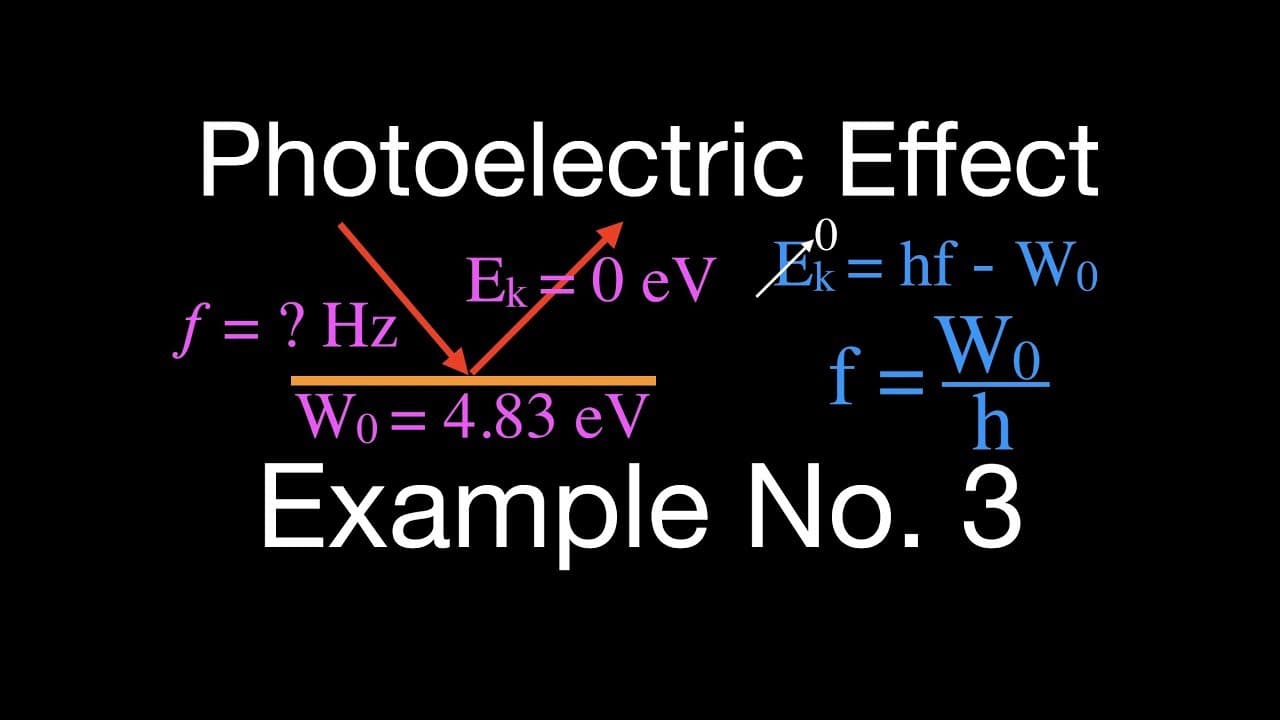
The minimum frequency required to emit an electron from a metal plate with a work function of 4.83 electron volts is approximately 1.17 x 10^15 Hz, while the corresponding wavelength is about 256 nanometers. These calculations assume zero kinetic energy for the emitted electrons and involve converting electron volts to joules for accurate results.
Transcript
okay in this video I'm gonna go over another example for the photoelectric effect before we get started please don't forget subscribe to my channel get all my excellent physics chemistry and math videos subscribe to my channel step-by-step science by clicking in that bottom right hand corner at red icon and don't forget to click on the bell and get... Read More
Key Insights
- 🔇 The speaker emphasizes the importance of drawing a diagram to understand the problem and stay organized.
- 🙂 The photoelectric effect equation, which relates kinetic energy, energy of light, frequency, and work function, is used to solve the problem.
- ⚡ Units conversion between electron volts and joules is necessary to ensure consistency in calculations.
- 😫 The minimum frequency and wavelength needed to emit an electron from a metal plate can be determined by setting the kinetic energy to zero.
Install to Summarize YouTube Videos and Get Transcripts
Explore YouTube Video Summarizer or Get YouTube Transcript Extractor
Questions & Answers
Q: What is the work function of the metal plate in the example?
The work function of the metal plate in the example is 4.83 electron volts.
Q: Why do we want to eject the electrons with zero electron volts of kinetic energy?
Ejecting the electrons with zero kinetic energy means that they have just enough energy to be released from the metal plate without gaining any additional energy.
Q: How is the frequency of the light calculated in the example?
The frequency of the light is calculated by dividing the work function by Planck's constant, resulting in a frequency of 1.17 x 10^15 Hertz.
Q: What is the wavelength of the light in the example?
The wavelength of the light is found by dividing the speed of light by the frequency, resulting in a wavelength of 2.56 x 10^-7 meters or 256 nanometers.
Summary & Key Takeaways
-
The video discusses the problem of determining the minimum frequency and wavelength of light required to emit an electron from a metal plate with a work function of 4.83 electron volts.
-
The speaker uses a diagram to understand the problem and sets up the equation for the photoelectric effect.
-
By setting the kinetic energy to zero, the speaker solves for the frequency and wavelength of the required light.
Read in Other Languages (beta)
Share This Summary 📚
Summarize YouTube Videos and Get Video Transcripts with 1-Click
Try YouTube Summary with ChatGPT & Claude or YouTube Transcript Generator
Explore More Summaries from Step by Step Science 📚
Summarize YouTube Videos and Get Video Transcripts with 1-Click
Try YouTube Summary with ChatGPT & Claude or YouTube Transcript Generator