How to Engineer Faster Incident Response Workflows
TL;DR
Effective incident response improves when engineering is applied intentionally to automate tedious work, expose useful context, and support analysts throughout detection, scoping, analysis, and containment. Target’s approach combines user feedback, reliable metrics, rigorous log-ingest validation, automated investigations, risk-based phishing triage, and endpoint collection and isolation, with incremental improvements favored over waiting for a single major advance.
Transcript
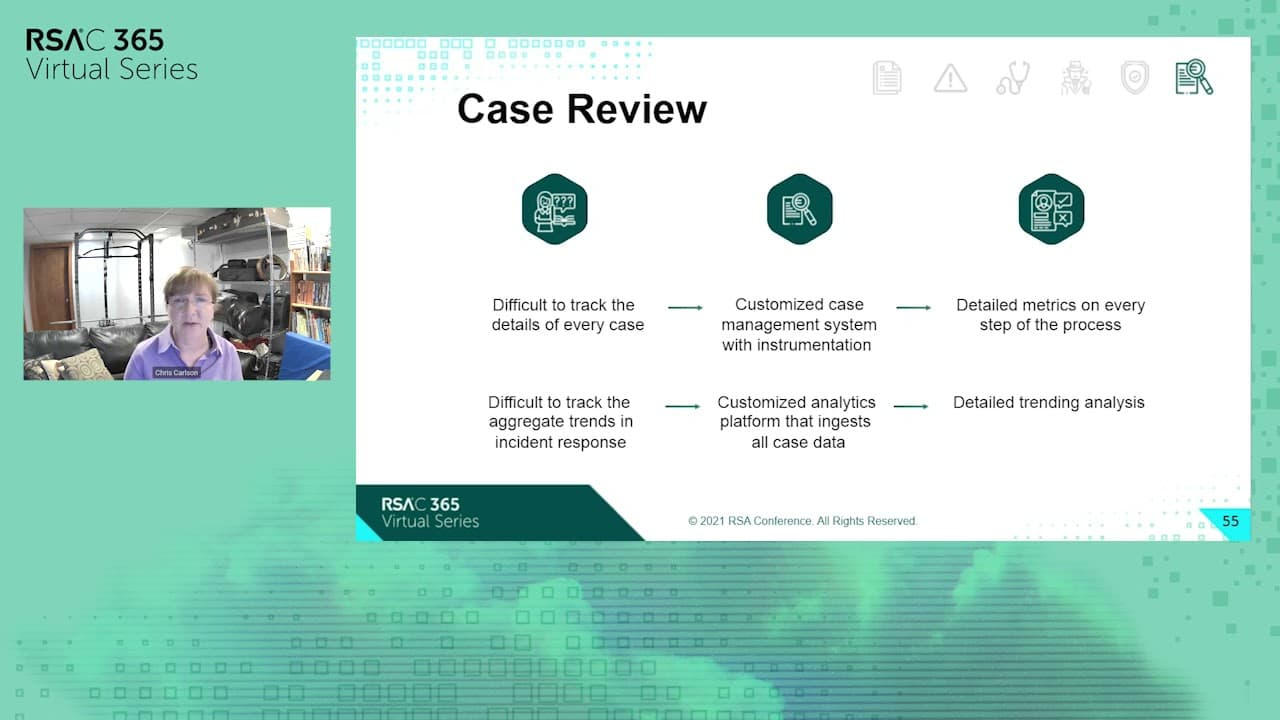
So in this discussion, um, I'll show how intentional tool development integrated into existing solutions and, uh, tools and workflows can aid incident response throughout the containment process and r- and beyond. Um, when we started this work about six years ago now, we started from the idea that every step of incident response can be assisted in ... Read More
Key Insights
- Every incident-response stage can be assisted by engineering, ranging from complete automation to a carefully designed interface that makes analysts’ work faster and more effective. The central requirement is intentional development that fits existing solutions, tools, and workflows rather than treating tooling as separate from operational response.
- User feedback is the only reliable confirmation that an incident-response tool meets its intended need. Target involves its response teams in feature prioritization and user acceptance testing, while planning two-way communication across five incident-response teams distributed through five time zones.
- Data-driven decision-making depends on metrics that are created, implemented, and refined until they are reliable enough to guide choices. The process is nontrivial, but it allows development priorities and results to be evaluated through evidence rather than assumptions alone.
- Incremental improvement is more dependable than waiting for a dramatic leap in capability. Small, continuing refinements accumulate into substantial benefits, and the approach remains relevant whether an organization develops custom tools or relies on commercial off-the-shelf solutions.
- SIEM effectiveness depends on usable logs, not merely on collecting them. Target ingests more than 30 log types and validates each feed for the specific fields and security events it expects, alerting its own team when required data changes or disappears without warning.
- Alert context helps analysts understand unfamiliar detections and act more quickly. With more than 700 detection rules to manage, Target generates customized information with each alert to summarize key indicators, identify the precise trigger, and point incident responders toward the next investigative step.
- Automated scoping reduces both analyst effort and the risk of overlooking related activity. Customized SIEM searches run automatically against an alert and return their results for review, providing a backstop for repetitive but mission-critical tasks such as determining whether one phishing email belongs to a wider campaign.
- Carnivore combines forensic collection with rapid endpoint containment. When deployed to a host, it gathers files, memory dumps, running-process information, and other relevant data, produces a customized report for incident-response review, and can block network traffic unrelated to the response team when isolation is needed.
Install to Summarize YouTube Videos and Get Transcripts
Explore YouTube Video Summarizer or Get YouTube Transcript Extractor
Questions & Answers
Q: How can engineering improve incident response workflows?
Engineering can assist every stage of incident response through complete automation, carefully designed interfaces, or intermediate forms of workflow support. Target applies this idea to detection, scoping, case analysis, mitigation, and containment. The aim is to remove repetitive work, present useful context, reduce errors, and help analysts respond quickly while keeping development integrated with existing tools and operational practices.
Q: What principles guide incident-response tool development?
Target uses three main principles: remain focused on users, make decisions with reliable data, and embrace incremental improvement. User focus requires feedback, feature prioritization, user acceptance testing, and deliberate two-way communication. Data-driven work requires metrics that are refined until trustworthy. Incremental improvement means continuing to deliver smaller gains instead of allowing the pursuit of major advances to delay practical progress.
Q: Why is SIEM log-ingest validation important?
Log-ingest validation is important because collected data provides little value when it is unusable or missing fields required for detection and response. Target ingests more than 30 log types, many from feeds that security does not control. Its ingest process therefore checks for expected content in each log and security event, then alerts the security team when something changes or disappears unexpectedly.
Q: How does customized alert context help incident responders?
Customized alert context gives responders an immediate starting point when a detection fires, including alerts they may not have encountered before. Target generates a message that summarizes the alert’s key indicators, highlights exactly what caused the detection rule to trigger, and points the incident-response team in the right direction. This support is especially valuable when managing more than 700 detection rules.
Q: How can automation improve the scoping of security alerts?
Automation can run consistent, customized SIEM searches as soon as an alert appears, then store the results for incident-response review. In a phishing case, these searches can help determine whether the triggering email is isolated or part of a broader campaign. This saves time and provides a backstop for detailed, repetitive scoping steps whose omission could leave a serious security breach under-scoped.
Q: How does automated file analysis improve security cases?
Automated file analysis ensures that analysts consistently compare relevant files with a data store of existing samples and context. The comparison can reveal whether a file matches something known to be good, bad, or somewhere between. Target reduced a previously time-consuming and sometimes forgotten task to a single-button search, producing quicker case resolution, higher-quality outcomes, and fuller use of the available data store.
Q: How can reported phishing emails be triaged efficiently?
Reported phishing emails can be triaged by automatically examining each message for risk indicators and applying filters that help responders focus on the highest-risk submissions. Target created this process after employees used the reporting button for many unexpected but low-risk emails. The automated assessment reduces the incident-response time spent manually filtering those reports while preserving attention for messages that warrant closer investigation.
Q: What does the Carnivore incident-response tool do?
Carnivore is an endpoint forensic collection and containment tool. When deployed to a host, it gathers files of interest from the file system along with memory dumps, running processes, and related information. It returns the collected data in a customized report designed for rapid incident-response review. When necessary, it can also isolate the host by blocking inbound and outbound network traffic unrelated to incident response.
Summary & Key Takeaways
-
Target approaches incident response as an engineering problem in which every stage can benefit from automation, better interfaces, or other purpose-built assistance. Development remains focused on incident-response users, data-driven decisions, and incremental improvement. Regular feedback, feature prioritization, user acceptance testing, and communication across five teams and five time zones guide the work.
-
The SIEM ingests more than 30 log types and evaluates them against more than 700 detection rules. Because security does not own many data feeds, rigorous ingest validation detects missing or changed fields. Customized alert data then summarizes key indicators, identifies exactly what triggered each alert, and directs analysts toward appropriate next steps.
-
Automation supports investigation, analysis, and containment by performing customized SIEM searches, checking file samples against a contextual data store, and filtering reported emails according to risk indicators. Carnivore collects endpoint files, memory dumps, and running-process information, creates a report for rapid review, and can isolate a host by blocking unrelated network traffic.
Read in Other Languages (beta)
Share This Summary 📚
Summarize YouTube Videos and Get Video Transcripts with 1-Click
Try YouTube Summary with ChatGPT & Claude or YouTube Transcript Generator
Explore More Summaries from RSAC Cybersecurity 📚




Summarize YouTube Videos and Get Video Transcripts with 1-Click
Try YouTube Summary with ChatGPT & Claude or YouTube Transcript Generator