How to Factor Trinomials: Step-by-Step Guide
TL;DR
To factor trinomials, identify two numbers that multiply to the constant term and add to the middle coefficient. For trinomials with a leading coefficient greater than one, multiply it by the constant term and find numbers that meet the required conditions for factoring. Use the quadratic formula when necessary to solve complex equations.
Transcript
in this video we're going to talk about how to factor trinomials in this example we have a trinomial where the leading coefficient is 1. in order to factor it you need to find two numbers that multiply to the constant term 12 but add to the middle coefficient 7. so what are those two numbers well let's begin by writing the factors of 12. if we divi... Read More
Key Insights
- 🖕 Factoring trinomials involves finding two numbers that multiply to the constant term and add up to the middle coefficient.
- 🧑🏭 Quadratic equations can be solved by factoring the trinomial, setting each factor equal to zero, and solving for x.
- ❓ The quadratic formula provides a method to solve quadratic equations even when factoring is not easily achievable.
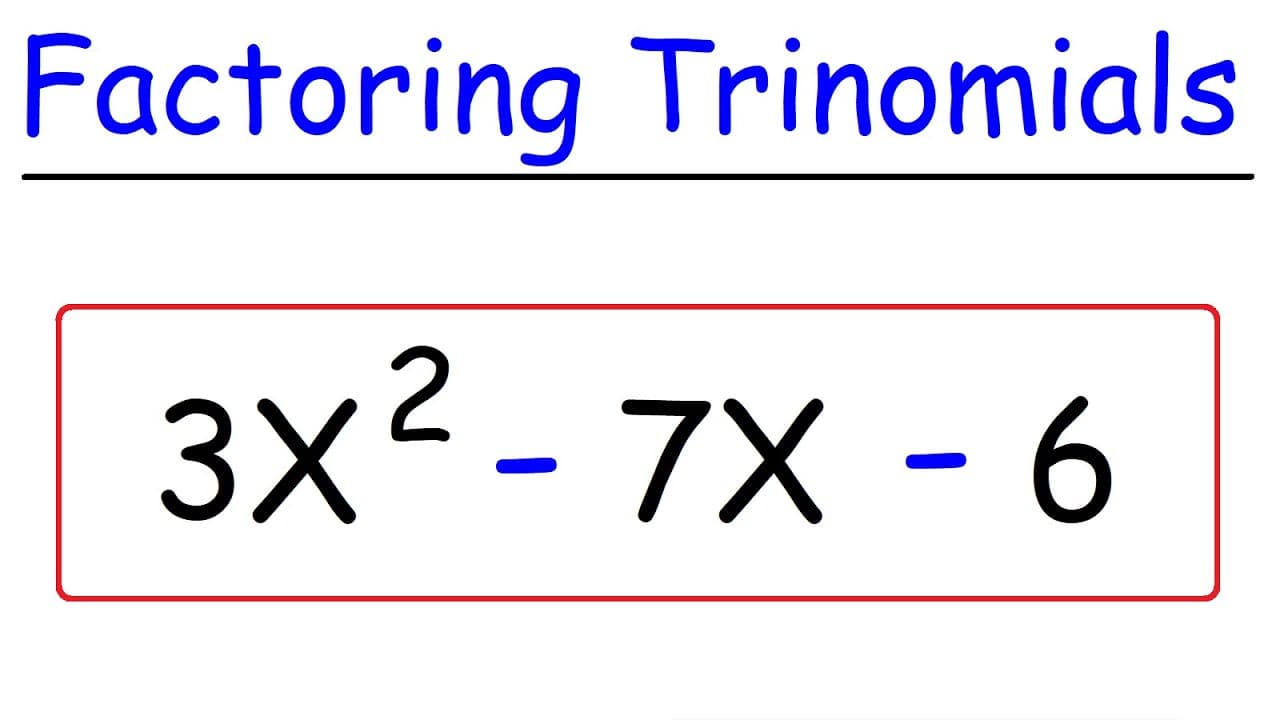
- 🥺 When factoring trinomials with a leading coefficient not equal to 1, multiply the leading coefficient by the constant term and find appropriate factors to replace the middle term.
Install to Summarize YouTube Videos and Get Transcripts
Explore YouTube Video Summarizer or Get YouTube Transcript Extractor
Questions & Answers
Q: How do you factor a trinomial with a leading coefficient of 1?
To factor a trinomial with a leading coefficient of 1, find two numbers that multiply to the constant term and add up to the middle coefficient. Write the trinomial as the product of two binomials with these numbers.
Q: How do you solve a quadratic equation by factoring?
To solve a quadratic equation by factoring, factor the trinomial on one side of the equation. Set each binomial factor equal to zero and solve for x to find the solutions.
Q: What should you do if the leading coefficient of a trinomial is not 1?
When the leading coefficient of a trinomial is not 1, multiply the leading coefficient by the constant term. Find two numbers that multiply to this product and add up to the middle coefficient. Replace the middle term with these numbers and factor by grouping.
Q: What is the quadratic formula and how is it used?
The quadratic formula (x = (-b ± √(b^2 - 4ac))/(2a)) is used to solve quadratic equations when factoring is challenging. Substitute the values of a, b, and c from the quadratic equation into the formula and simplify to find the solutions.
Summary & Key Takeaways
-
To factor trinomials with a leading coefficient of 1, find two numbers that multiply to the constant term and add up to the middle coefficient. Write the trinomial as the product of two binomials with these numbers.
-
To solve quadratic equations with a trinomial on one side, factor the trinomial. Set each binomial factor equal to zero and solve for x to find the solutions.
-
When the leading coefficient of a trinomial is not 1, multiply the leading coefficient by the constant term. Find two numbers that multiply to this product and add up to the middle coefficient. Replace the middle term with these numbers and factor by grouping.
-
Use the quadratic formula (x = (-b ± √(b^2 - 4ac))/(2a)) to solve quadratic equations when factoring is challenging. Substitute the values of a, b, and c from the quadratic equation into the formula and simplify to find the solutions.
Read in Other Languages (beta)
Share This Summary 📚
Summarize YouTube Videos and Get Video Transcripts with 1-Click
Try YouTube Summary with ChatGPT & Claude or YouTube Transcript Generator
Explore More Summaries from The Organic Chemistry Tutor 📚




Summarize YouTube Videos and Get Video Transcripts with 1-Click
Try YouTube Summary with ChatGPT & Claude or YouTube Transcript Generator