How to Write Rate Laws for Reaction Mechanisms
TL;DR
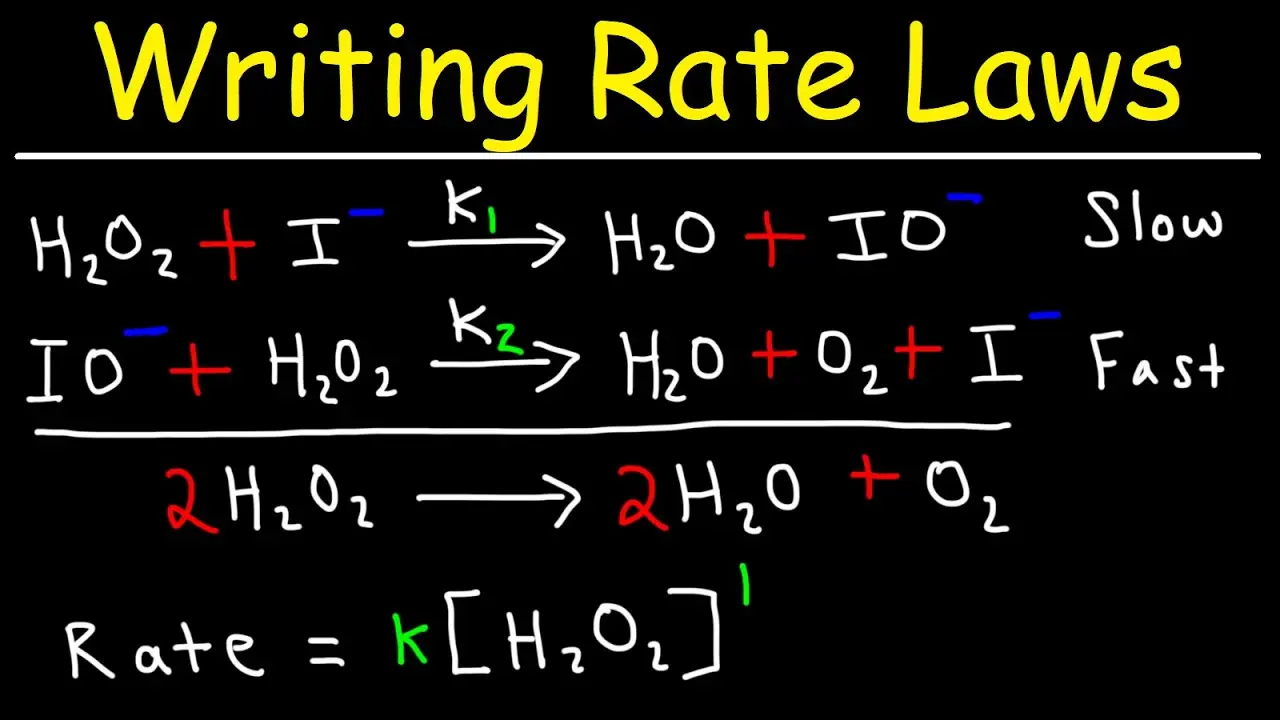
To write rate laws for reaction mechanisms, identify the rate-determining step and use the coefficients of reactants from elementary reactions. Catalysts and intermediates can be distinguished by their presence and consumption: catalysts are present at both the start and end, while intermediates appear in the middle of the reaction, produced first and then consumed.
Transcript
in this video we're going to focus on reaction mechanisms how to write the rate law for the overall reaction and things like that so reaction mechanism is basically a step-by-step pathway by which a particular reaction occurs and each individual step in a reaction mechanism are known as elementary reactions so let me give an example so let's say th... Read More
Key Insights
- ❓ Reaction mechanisms consist of elementary reactions that occur in a stepwise manner.
- 😑 Rate law expressions for elementary reactions can be written based on the reactant coefficients.
- 🎁 Catalysts are present at the beginning and end of a reaction, while intermediates are only present in the middle.
- 😃 A uni-molecular reaction involves one reactant, while a bi-molecular reaction involves two reactants.
- ❓ Termolecular reactions are rare, as they require three molecules to collide simultaneously.
- ☠️ The overall reaction rate depends on the rate-determining step, which is usually the slowest step.
Install to Summarize YouTube Videos and Get Transcripts
Explore YouTube Video Summarizer or Get YouTube Transcript Extractor
Questions & Answers
Q: What is a reaction mechanism?
A reaction mechanism is a step-by-step pathway by which a reaction occurs, consisting of elementary reactions.
Q: How can rate law expressions be written for elementary reactions?
Rate law expressions can be written based on the coefficients of the reactants in each elementary reaction.
Q: How can catalysts and intermediates be identified in a reaction mechanism?
Catalysts are consumed first and then produced later, while intermediates are produced first and consumed later.
Q: How do catalysts affect chemical reactions?
Catalysts speed up chemical reactions by providing an alternative pathway for reactants to become products and by lowering the activation energy.
Summary & Key Takeaways
-
Reaction mechanisms involve step-by-step pathways by which a reaction occurs, with each step known as an elementary reaction.
-
Rate law expressions can be written for each elementary reaction based on the coefficients of the reactants.
-
Catalysts are consumed first and then produced later, while intermediates are produced first and consumed later.
Read in Other Languages (beta)
Share This Summary 📚
Summarize YouTube Videos and Get Video Transcripts with 1-Click
Try YouTube Summary with ChatGPT & Claude or YouTube Transcript Generator
Explore More Summaries from The Organic Chemistry Tutor 📚



Summarize YouTube Videos and Get Video Transcripts with 1-Click
Try YouTube Summary with ChatGPT & Claude or YouTube Transcript Generator