How Can AI Preserve Privacy and Earn Trust?
TL;DR
AI systems need privacy protections built into their training data and operation before widespread adoption makes exposure harder to contain. Machine learning is most reliable when data is plentiful, variables are limited, and opponents adapt slowly, while security requires human judgment because intelligent adversaries change their behavior in response to defenses.
Transcript
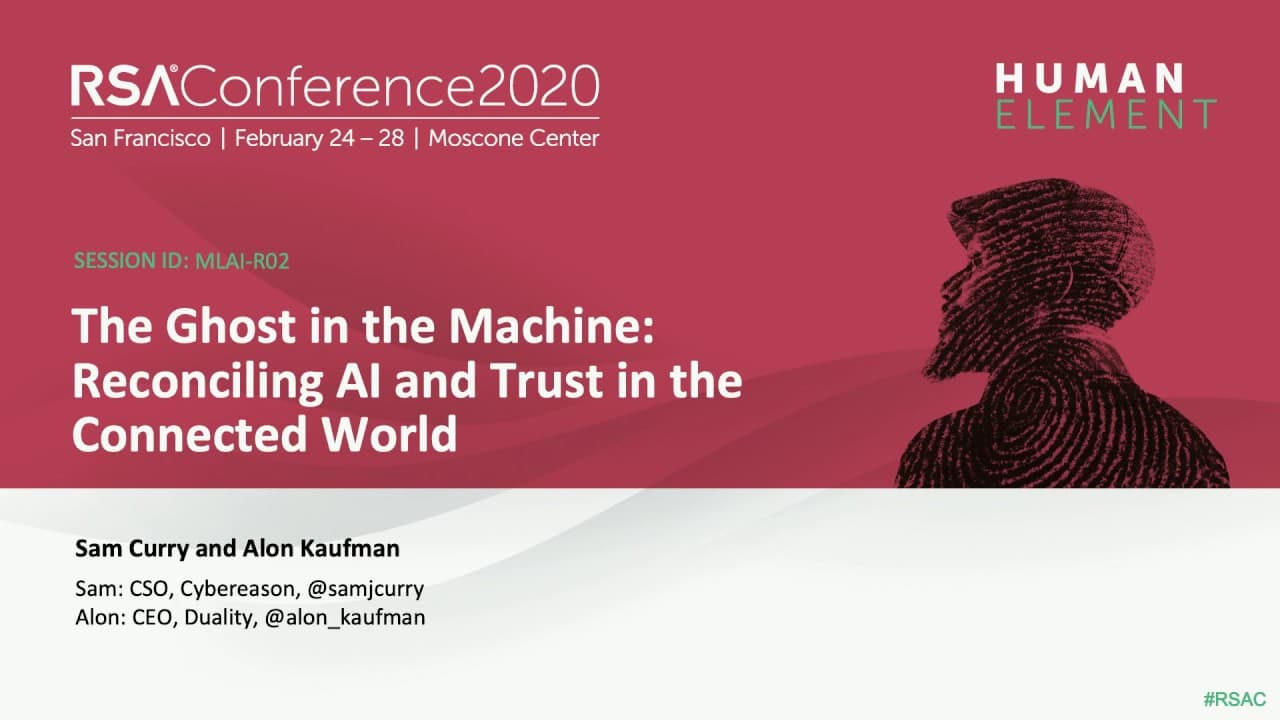
Hey, good morning, everybody. We'll go ahead and get this started. Thank you for coming in this morning. Um, today's session we're gonna have is The Ghost in the Machine: Reconciling AI and Trust in a Connected World, just to make sure you're all in the right place. Our two speakers today are Mr. Sam Curry, Chief Security Officer for Cybereason, an... Read More
Key Insights
- Data science is a collection of tools for analytics, pattern identification, and inference, especially across very large datasets. Its growing usefulness reflects the sheer quantity of available data and the declining expense of storing information and performing the computation needed to examine it.
- Machine learning is a set of methods through which a machine adapts its behavior using a feedback loop. Unlike conventional deterministic programming, it is not limited to explicit instructions such as performing one fixed action whenever a predefined condition occurs.
- Artificial intelligence is the broader scientific pursuit of human-like or progressively greater intelligence. It can incorporate machine learning and other techniques, but AI and machine learning are not interchangeable terms, despite marketing language that often treats them as equivalent.
- Security is a second-order chaos system because intelligent adversaries react to defensive measures. Unlike weather, where taking shelter does not redirect a storm, security controls can influence attackers to change their methods, locations, or targets.
- Machine learning works best when substantial data is available, opponents adapt slowly, and the problem contains relatively few variables. It becomes less dependable when feedback is limited, variability is high, and an intelligent opponent continually modifies behavior.
- Predictive defenses can become vulnerable when attackers learn how the system responds. The mirror chess problem describes how a human adversary can recognize predictable, static defensive behavior and find a path around it.
- AI and machine learning should bolster human decision-making rather than automatically replace it in most security settings. Human involvement remains important because security operates against adaptive opponents whose responses can undermine fixed predictions and automated controls.
- AI training datasets can create inadvertent privacy leakage, exposure, or vulnerability. A trustworthy connected world therefore requires a privacy ethic and privacy-enforcing technologies before increasingly personal systems enable widespread monitoring, control, or manipulation.
Install to Summarize YouTube Videos and Get Transcripts
Explore YouTube Video Summarizer or Get YouTube Transcript Extractor
Questions & Answers
Q: What is the difference between data science, machine learning, and artificial intelligence?
Data science uses analytics, pattern identification, and inference to extract knowledge from large datasets. Machine learning consists of tools that adapt machine behavior through feedback rather than relying only on explicit, deterministic instructions. Artificial intelligence is the broader scientific pursuit of human-like or progressively greater intelligence, and it may combine machine learning with other techniques. The terms are related, but they are not interchangeable.
Q: How does machine learning differ from deterministic programming?
Deterministic programming gives a computer explicit instructions, such as performing one action when it encounters a particular condition and another action otherwise. Machine learning instead changes system behavior through a feedback loop. Some approaches receive assistance and others operate more independently, but their defining feature is adaptation. The underlying algorithms may be old, while abundant data and inexpensive storage and computation make broader experimentation possible.
Q: Why is cybersecurity considered a second-order chaos system?
Cybersecurity is a second-order chaos system because the opponent is intelligent and responds to defensive actions. A natural system such as weather does not change its path because people take shelter. An attacker, by contrast, can observe a security protocol, prediction, or control and develop a way around it. Defensive choices therefore affect subsequent adversarial behavior, making the environment adaptive and difficult to predict.
Q: When does machine learning work best for security problems?
Machine learning works best when a system has a large amount of data, relatively few variables, and an opponent that adapts slowly. The presentation identifies fraud as a type of problem where those conditions can make machine learning useful. Performance becomes more problematic when feedback is scarce, the number of variables is high, and adversaries display substantial variability in response to defensive measures.
Q: Why can automated security predictions become ineffective?
Automated security predictions can become ineffective because human adversaries learn how defenses behave and adjust their tactics. A system built around static predictions may become predictable, allowing an attacker to identify a route around it. This dynamic is described as the mirror chess problem. Because security involves adaptive opponents, past patterns alone cannot guarantee that future attacks will follow the same behavior.
Q: How should AI and machine learning support cybersecurity teams?
AI and machine learning should generally strengthen human capabilities rather than create fully automatic security systems. Data-driven tools can identify patterns, support predictions, and deliver useful results, but adaptive attackers may exploit predictable responses or behave differently from the training data. Human judgment is therefore important for interpreting outputs, understanding changing circumstances, and responding when fixed models no longer match an adversary's behavior.
Q: What privacy risks can arise from AI training data?
Training datasets used for machine learning and combined AI methods can cause inadvertent privacy leakage, exposure, or vulnerability. The risk emerges because intelligent systems depend on data, while connected technologies are becoming smarter and more personal across the economy. Without privacy-enforcing measures, many parties could potentially monitor, control, or manipulate people. Privacy protection should therefore be addressed before these capabilities become deeply embedded in systems.
Q: Why must ethics, privacy, and legality be distinguished in AI governance?
Ethics, privacy, and legality describe different concerns and should not be treated as interchangeable. Ethics provides a framework for deciding what a society considers good or evil, fair or unfair. Different ethical models can produce different judgments, even when participants believe they are defending what is right. Developing trustworthy AI therefore requires an explicit privacy ethic alongside discussions of legal requirements and technological privacy protections.
Summary & Key Takeaways
-
Data science, machine learning, and artificial intelligence are related but distinct. Data science extracts patterns and inferences from large datasets, while machine learning changes behavior through feedback. Artificial intelligence is the broader pursuit of progressively greater intelligence, including systems intended to approximate human cognition rather than merely follow deterministic instructions.
-
Security differs from natural or first-order chaotic systems because adversaries observe defenses and adapt around them. Machine learning can overlearn, become predictable, and perform poorly when feedback is scarce, variables are numerous, and opponents change rapidly. The preferred role of these technologies is therefore to strengthen human capabilities rather than replace people with automatic systems.
-
AI training sets can create inadvertent privacy leakage, exposure, and vulnerability as advanced data technologies spread throughout the economy. Addressing that risk requires distinguishing ethics, privacy, and legality, developing a shared privacy ethic, and deploying privacy-enforcing technologies before extensive monitoring, control, or manipulation becomes embedded in connected systems.
Read in Other Languages (beta)
Share This Summary 📚
Summarize YouTube Videos and Get Video Transcripts with 1-Click
Try YouTube Summary with ChatGPT & Claude or YouTube Transcript Generator
Explore More Summaries from RSAC Cybersecurity 📚





Summarize YouTube Videos and Get Video Transcripts with 1-Click
Try YouTube Summary with ChatGPT & Claude or YouTube Transcript Generator