How Much Energy to Heat Ice to Steam?
TL;DR
To heat 100 grams of ice from -30°C to steam at 300°C requires a total of 347.3 kilojoules. The major energy component comes from vaporizing the water into steam, accounting for 65% of the total energy needed. The process is endothermic, as energy must be added to heat the substance through multiple phases.
Transcript
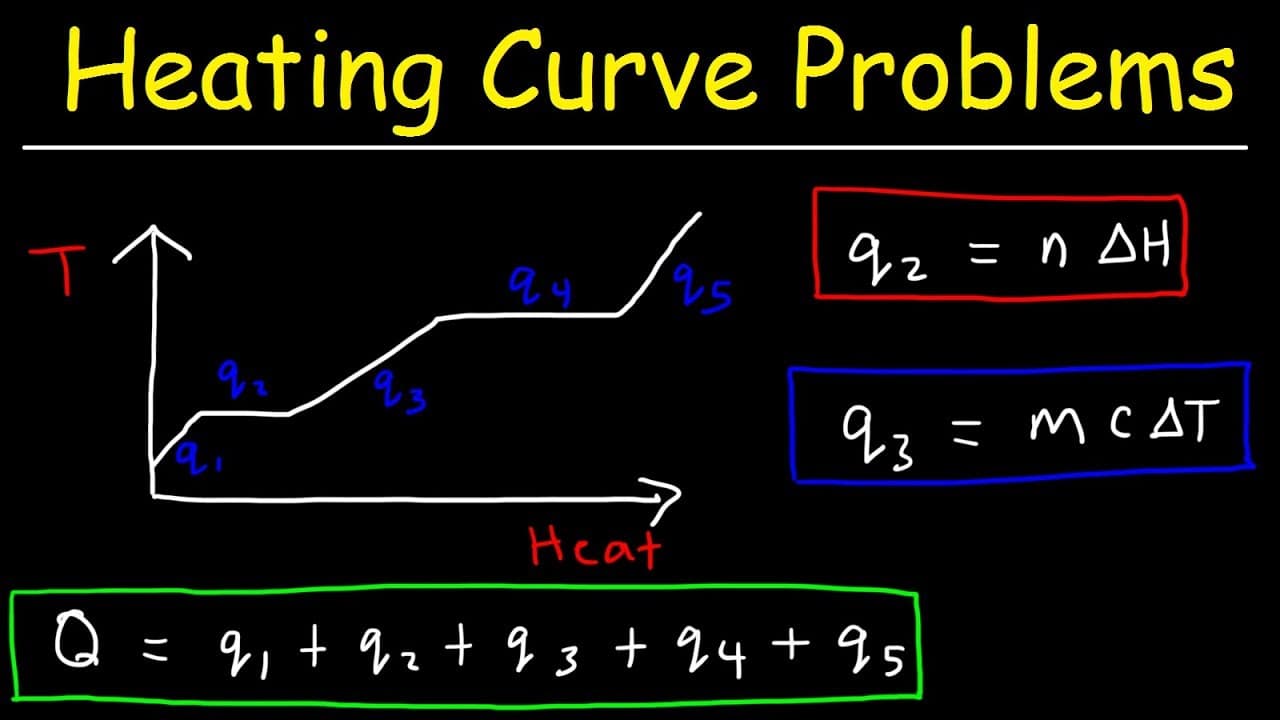
so here's a question for you how much energy is required to heat 100 grams of ice at negative 30 degrees celsius to steam at 300 so hopefully you saw my last video on heating curves and cooling curves but if you haven't here's the gist of it so we're going to deal with a heating curve let's say this is 0 degrees celsius and this is 100 so we'll sta... Read More
Key Insights
- 🥵 Heating ice to steam requires multiple steps, including raising the temperature of the ice, melting it into liquid water, heating the water, vaporizing it into steam, and finally heating the steam.
- 😤 The majority of the energy required for this process comes from the vaporization of liquid water into steam.
- 🖐️ The enthalpy of fusion and the enthalpy of vaporization play crucial roles in calculating the energy required for phase changes.
- 🥵 The direction of the process, whether heating or cooling, affects the sign of the calculated energy value.
Install to Summarize YouTube Videos and Get Transcripts
Explore YouTube Video Summarizer or Get YouTube Transcript Extractor
Questions & Answers
Q: How is the energy required to melt ice calculated?
The energy required to melt ice is calculated by multiplying the moles of ice by the enthalpy of fusion for water, which is approximately 6 kJ/mol.
Q: What is the significance of the enthalpy of vaporization?
The enthalpy of vaporization represents the energy required to convert one mole of a substance from a liquid to a gas phase. In this analysis, it is used to calculate q4, the energy required to vaporize liquid water into steam.
Q: Why is the enthalpy of fusion important in this analysis?
The enthalpy of fusion represents the energy required to convert one mole of a substance from a solid to a liquid phase. In this analysis, it is used to calculate q2, the energy required to melt ice into liquid water.
Q: What is the significance of the positive total energy value?
The positive total energy value indicates that the process of heating ice to steam is an endothermic process, meaning it requires an input of energy. This is because energy is being added to the system to raise the temperature and undergo phase changes.
Summary & Key Takeaways
-
The analysis focuses on calculating the energy required for each step of the heating process, including heating the ice, melting it into liquid water, heating the water, vaporizing it into steam, and finally heating the steam.
-
The specific heat capacity of ice is used to calculate q1, the energy required to raise the temperature of the ice.
-
The enthalpy of fusion for water is used to calculate q2, the energy required to melt the ice.
-
The specific heat capacity of liquid water is used to calculate q3, the energy required to heat the water.
-
The enthalpy of vaporization for water is used to calculate q4, the energy required to vaporize the liquid water.
-
The specific heat capacity of steam is used to calculate q5, the energy required to heat the steam.
-
The total energy for the whole process is calculated by summing q1, q2, q3, q4, and q5.
Read in Other Languages (beta)
Share This Summary 📚
Summarize YouTube Videos and Get Video Transcripts with 1-Click
Try YouTube Summary with ChatGPT & Claude or YouTube Transcript Generator
Explore More Summaries from The Organic Chemistry Tutor 📚





Summarize YouTube Videos and Get Video Transcripts with 1-Click
Try YouTube Summary with ChatGPT & Claude or YouTube Transcript Generator