Is Blockchain Best for Distributed Trust?
TL;DR
Public blockchain enables anonymous, independent nodes to agree on a shared append-only ledger without official authorized entities. Bitcoin achieves this through proof-of-work mining, dynamically adjusted hash difficulty, rewards, and selection of the longest chain, but many familiar components, including logs, linked structures, hashes, Merkle trees, and distributed databases, existed before blockchain.
Transcript
Okay. So hello. Welcome to, um, Is Blockchain the Best Approach to Distributed Trust? And I'll explain what distributed trust is and explain what blockchain is and so forth. Uh, tomorrow morning at 8:00, uh, Charlie and I are doing a BOF about this, so if you have use cases that you think, "Hey, you know, what about this? This would be great for a ... Read More
Key Insights
- Blockchain is difficult to define precisely because extensive promotion and numerous variants have moved the term far beyond its original Bitcoin meaning, making some proposed blockchain technologies hard to distinguish from non-blockchain systems.
- Bitcoin was designed for participants who did not want to trust banks, governments, or any known organization, so its architecture prioritizes survival without official control rather than ordinary organizational governance.
- A public blockchain is a collaboration among anonymous, independent nodes that maintain a single ledger and reach consensus on which recorded sequence represents the official history of events.
- A ledger is an append-only log that records events in sequence, preserves old entries even when they are wrong, and handles errors through later correcting entries rather than historical modification.
- A blockchain is a chain of blocks in which every block contains a hash of its predecessor, so the final block commits to the complete sequence of blocks that came before it.
- Blockchain's familiar components are not new because logs, linked lists, cryptographic hashes, Merkle trees, redundant storage, and distributed databases all existed before Bitcoin's design.
- Public blockchain's distinctive contribution is an integrity mechanism that operates without official authorized entities, allowing anonymous participants to cooperate without the system knowing their identities.
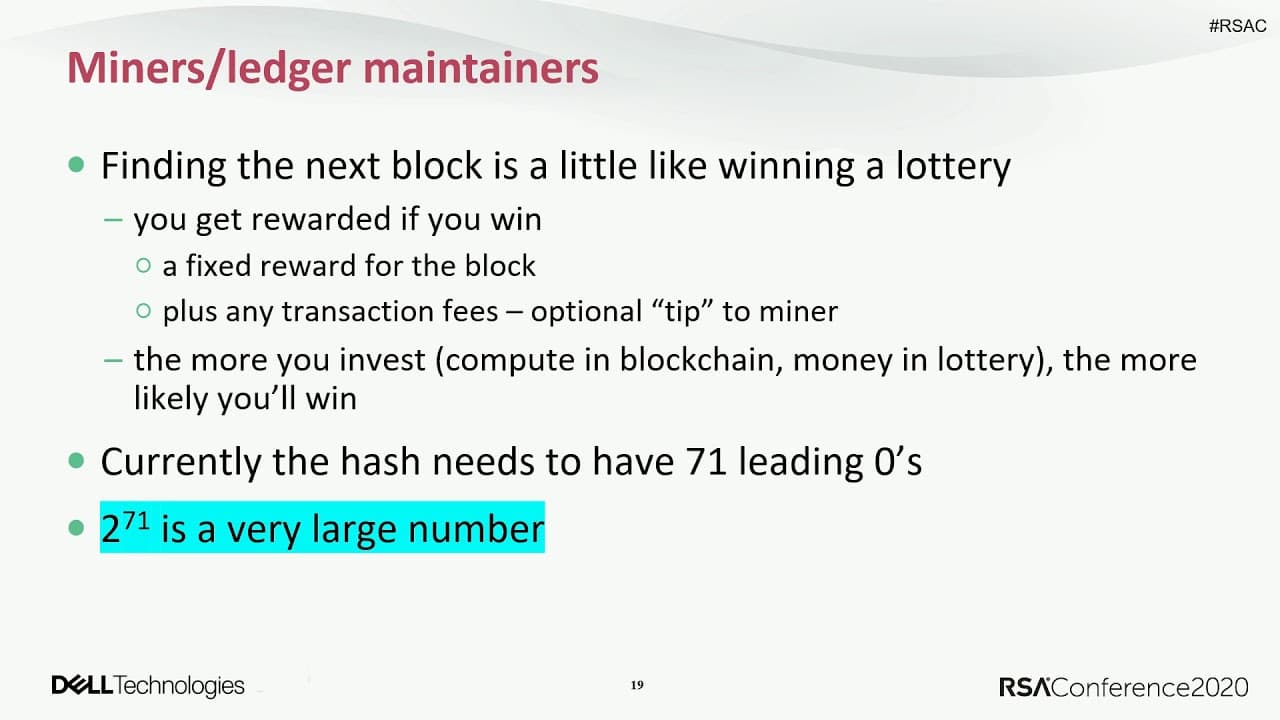
- Bitcoin mining works by repeatedly changing a random number and hashing a candidate block until the result falls below an adjustable threshold, with successful miners receiving bitcoins as their incentive.
Install to Summarize YouTube Videos and Get Transcripts
Explore YouTube Video Summarizer or Get YouTube Transcript Extractor
Questions & Answers
Q: What is distributed trust in a public blockchain?
Distributed trust in a public blockchain means that anonymous, independent nodes collaborate to maintain one shared ledger without relying on an official authorized entity. The nodes seek consensus on the accepted sequence of recorded events. In Bitcoin, those events state that one public key transfers a specified number of bitcoins to another public key.
Q: How does Bitcoin mining create a new block?
A miner gathers a group of valid transactions, selects a random number, and computes a hash over the candidate block. If the resulting hash is smaller than the required threshold, the candidate becomes a new block. If it is too large, the miner changes the random number and tries again in a tight computational loop.
Q: Why does Bitcoin adjust its mining difficulty?
Bitcoin adjusts mining difficulty to produce a block approximately every ten minutes. When more participants are searching for acceptable hashes, the problem must become harder to preserve that pace. The system changes the required hash threshold according to block timing, balancing the combined effort of the anonymous ledger maintainers participating in the process.
Q: Why do Bitcoin miners maintain the ledger?
Bitcoin miners maintain the ledger because the system rewards whoever finds an acceptable new block with bitcoins. Since bitcoins are worth money according to the transcript, participants have a financial reason to perform repeated hash calculations. This automated incentive supports ledger maintenance even though the miners are anonymous and no known organization officially authorizes them.
Q: Why do miners build on the longest blockchain?
Miners build on the longest available chain because other participants are expected to do the same. A miner can extend a shorter chain, but the talk says its chances of eventually becoming the longest chain are remote. Extending the longest chain therefore gives a miner the strongest opportunity to have its work accepted and maximize its profit.
Q: What information does a blockchain ledger contain?
A blockchain ledger contains an ordered record of events accepted by its maintainers. In Bitcoin, an entry records that public key A transfers a stated number of bitcoins to public key B. Other blockchain systems may record different events. The ledger preserves earlier records and adds correcting entries later instead of modifying old information directly.
Q: What parts of blockchain technology existed before Bitcoin?
Several major blockchain components existed before Bitcoin, including append-only logs, linked structures made from blocks, cryptographic hashes, Merkle trees, redundant data storage, and distributed databases. The talk describes a blockchain as comparable to a Merkle tree without branching. Its claimed novelty lies in coordinating integrity among anonymous participants without official authorized entities.
Q: Why should blockchain proposals be evaluated skeptically?
Blockchain proposals should be evaluated skeptically because publicity often emphasizes importance rather than explaining the technology's actual properties. Bitcoin investors and startups had incentives to amplify attention, while many articles described applications merely being considered rather than used. Evaluation should therefore compare what a blockchain genuinely provides with what established distributed database or non-blockchain approaches can accomplish.
Summary & Key Takeaways
-
Blockchain originated as the design supporting Bitcoin, a currency intended to operate without trusting banks, governments, or other known organizations. Its goals included resisting shutdown, obscuring money trails, and preventing authorities from controlling transfers. The talk argues that understanding these original requirements is necessary before applying the design elsewhere.
-
A public blockchain consists of anonymous, independent ledger maintainers that collaborate on one accepted history of events. Its ledger is an append-only log: old entries remain unchanged, while corrections appear as later entries. Each block contains the previous block's hash, linking the complete sequence and providing an integrity check.
-
Bitcoin targets approximately one new block every ten minutes by dynamically adjusting mining difficulty. Miners repeatedly combine valid transactions with a changing random number and compute a hash until one falls below the required value. Rewards motivate participation, while building on the longest chain gives miners the best chance of earning money.
Read in Other Languages (beta)
Share This Summary 📚
Summarize YouTube Videos and Get Video Transcripts with 1-Click
Try YouTube Summary with ChatGPT & Claude or YouTube Transcript Generator
Explore More Summaries from RSAC Cybersecurity 📚



Summarize YouTube Videos and Get Video Transcripts with 1-Click
Try YouTube Summary with ChatGPT & Claude or YouTube Transcript Generator