How Does Regularization Affect Bias and Variance?
TL;DR
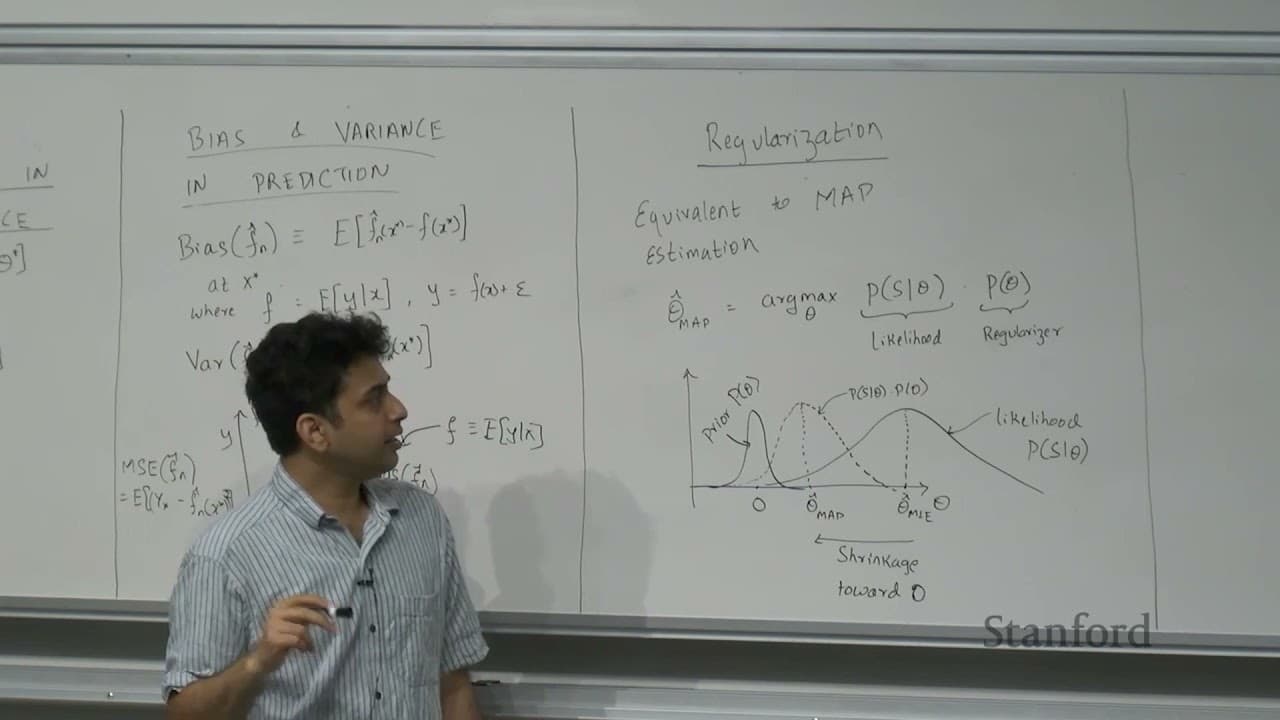
Regularization helps balance bias and variance in machine learning models by penalizing large parameter values, which can prevent overfitting. Understanding the bias-variance trade-off is essential, as improvements in one area can lead to increases in the other, making it crucial to find the right balance for effective model performance.
Transcript
so today uh the the plan is to cover bias variance trade-off and the role played by regularization and the role played by the hypothesis class in bias variance trade off so in last class we spoke about the concepts of bias and variance and we probably briefly mentioned that there is a trade-off between the two some kind of a trade-off and today we ... Read More
Key Insights
- 🧑🏭 Bias and variance are two important factors in machine learning models. Balancing them is crucial for building models that generalize well.
- 🌥️ Regularization is a technique that helps balance bias and variance by penalizing large parameter values.
- 🐕🦺 The bias-variance trade-off is the idea that reducing bias can increase variance, and vice versa.
- 🏛️ The choice of hypothesis class can impact the bias-variance trade-off.
Install to Summarize YouTube Videos and Get Transcripts
Explore YouTube Video Summarizer or Get YouTube Transcript Extractor
Questions & Answers
Q: What is the bias-variance trade-off in machine learning?
The bias-variance trade-off refers to the balance between bias and variance in machine learning models. Bias represents incorrect assumptions made by the model, while variance represents sensitivity to fluctuations in the training data. Increasing bias can reduce variance and vice versa, so finding the right balance is important.
Q: How does regularization help in balancing bias and variance?
Regularization is a technique used to balance bias and variance in machine learning models. It adds a penalty term to the cost function, which discourages large parameter values. This helps to prevent overfitting and improve generalization by reducing variance. Regularization acts as a control parameter to balance bias and variance.
Q: What is the role of the hypothesis class in bias-variance trade-off?
The hypothesis class refers to the set of all possible models or hypotheses that can be considered for a given problem. The choice of hypothesis class can impact the bias-variance trade-off. A more complex hypothesis class, such as neural networks, can have lower bias but higher variance. On the other hand, simpler hypothesis classes, such as linear regression, can have higher bias but lower variance.
Q: How can we determine the optimal value of lambda in regularization?
The optimal value of lambda in regularization can be determined using cross-validation. By dividing the data into training and validation sets, we can measure the performance of different models with different values of lambda. We can then choose the lambda that minimizes the validation error, which is an estimate of the model's generalization error.
Summary & Key Takeaways
-
Bias and variance are two important factors in building predictive models. Bias refers to the error caused by incorrect assumptions in the model, while variance refers to the error caused by sensitivity to fluctuations in the training data.
-
Regularization is a technique used to balance bias and variance in machine learning models. It penalizes large parameter values to prevent overfitting and improve generalization.
-
The bias-variance trade-off is the idea that reducing bias in a model can increase variance, and vice versa. Finding the right balance is crucial for building effective machine learning models.
Read in Other Languages (beta)
Share This Summary 📚
Summarize YouTube Videos and Get Video Transcripts with 1-Click
Try YouTube Summary with ChatGPT & Claude or YouTube Transcript Generator
Explore More Summaries from Stanford Online 📚



Summarize YouTube Videos and Get Video Transcripts with 1-Click
Try YouTube Summary with ChatGPT & Claude or YouTube Transcript Generator