How to Build a Highly Secure Organization
TL;DR
Strong security comes from risk-based leadership, capable people, clear requirements, and consistent operating practices, not from expensive products alone. Organizations should empower an executive-level CISO, identify and monitor risks, define problems before purchasing technology, and use documented policies and standard procedures to keep security controls consistent across locations.
Transcript
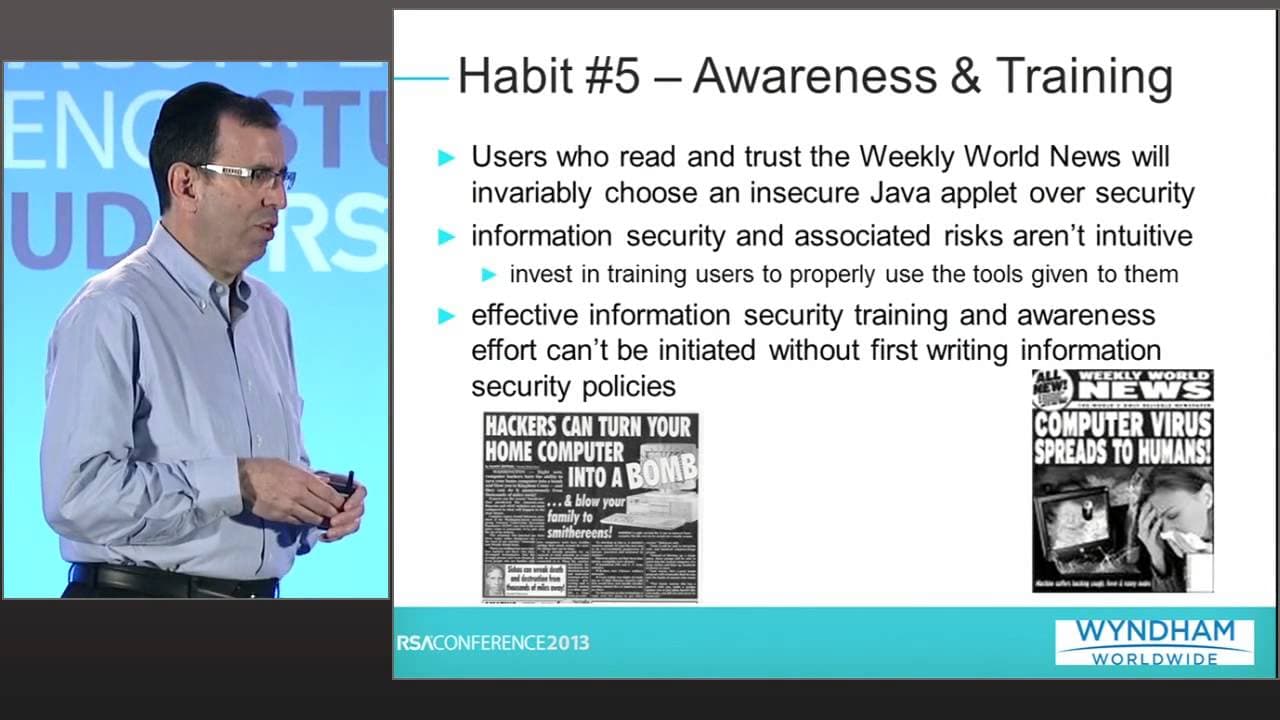
Okay. Thank you. Welcome. Uh, Letterman may have, uh, a top ten list, but I came with a, uh, a top five list. We're gonna talk about the five habits of highly secure organizations. What we're talking about is not an ITIL perspective, not about, um, ISO, but just what are organizations doing which make them, you know, highly secure. I based a lot of... Read More
Key Insights
- A highly secure organization is built on risk, trust, and defined requirements. The price of its hardware and software does not determine program effectiveness, because strong people and suitable open-source tools may deliver more security than millions spent without clear direction.
- A capable CISO combines technical understanding with business judgment. Information security extends beyond individual technologies into physical security, legal matters, privacy, international law, and organizational goals, so leadership must integrate all of these areas rather than manage security as an isolated technical function.
- Executive authority is essential for effective security leadership. A CISO who carries responsibility but cannot establish rules or address violations may become the person blamed after a major incident, while the underlying organizational weaknesses remain unchanged.
- Risk management is broader than defending against hackers. Organizations must identify the full range of risks they face, analyze their relative significance, decide how each should be mitigated through business judgment, and continue monitoring whether each risk is increasing, decreasing, or disappearing.
- Security investment should be proportional to the risk being addressed. Spending half a million dollars to correct a risk expected to introduce fifty thousand dollars per year is not presented as a sensible choice, so mitigation decisions must account for both potential impact and cost.
- Security products should follow requirements rather than define them. Before purchasing a tool, an organization must state its security problem, explain how the product is expected to solve it, and define the processes, procedures, and metrics needed to evaluate whether the deployment works.
- People and internal processes are more important than product obsession. Products can consume substantial time and effort without improving security when their roles and requirements are unclear, while capable staff can select, configure, operate, and measure tools according to actual organizational needs.
- Standard operating procedures create consistency across locations. Documented instructions for installing, configuring, monitoring, and managing devices help administrators in cities such as Chicago, Tokyo, Miami, and Los Angeles operate them in the same way, reducing confusion, costs, liability, and security gaps.
Install to Summarize YouTube Videos and Get Transcripts
Explore YouTube Video Summarizer or Get YouTube Transcript Extractor
Questions & Answers
Q: What habits make an organization highly secure?
Highly secure organizations appoint an effective CISO, manage security through a comprehensive risk framework, invest in capable people instead of relying on products, and establish clear policies and procedures. The talk also identifies awareness and training as a core habit. Together, these practices connect executive leadership, business priorities, staff behavior, and consistent technical operations.
Q: Why does a secure organization need an executive-level CISO?
An executive-level CISO can connect technical security decisions with business goals and gain access to the board. Security covers technical, physical, legal, privacy, and international concerns, so it requires leadership that can coordinate across the organization. Without authority to establish rules or address violations, the CISO may carry responsibility for incidents without having the power to prevent them.
Q: What characteristics make a strong CISO?
A strong CISO combines deep technical knowledge with a practical understanding of business. The talk presents an electrical engineer with an MBA as a particularly strong combination and also mentions an NSA veteran with substantial corporate experience. Effective CISOs are not intimidated by senior leaders, do not merely agree with the board, and remain flexible enough to reconsider policies when change is justified.
Q: How should an organization manage information security risk?
An organization should use four risk management functions: identify its risks, analyze their relative importance, choose how to mitigate them, and monitor them over time. Not every risk is equally important or equally expensive to address. Management should make business decisions about mitigation costs and reconsider investments when a risk increases, decreases, or disappears.
Q: How should security spending relate to the size of a risk?
Security spending should be guided by the expected business impact of the risk rather than by fear or product availability. The talk illustrates this with a risk that could introduce fifty thousand dollars per year in loss, arguing that spending half a million dollars to fix it is unnecessary. Mitigation should therefore be economically proportionate and based on informed business judgment.
Q: What should a company determine before buying a security product?
A company should first define the security problem and explain exactly how the proposed product is expected to solve it. It should also document detailed requirements, processes, procedures, and metrics for effectiveness. Without those foundations, a costly deployment can consume time and effort while failing to make the organization more secure, regardless of the product’s advertised capabilities.
Q: Why should organizations invest in people instead of products?
Products do not create effective security on their own. Skilled staff must define requirements, select appropriate tools, configure them correctly, operate them consistently, and measure whether they solve the intended problem. The talk argues that organizations can achieve substantial security with good people and inexpensive or open-source tools, while poorly planned investments worth millions may produce little meaningful improvement.
Q: Why are security policies and standard procedures important?
Policies define expected security behavior, while procedures explain how technologies and operations should be implemented, configured, monitored, and managed. Standard operating procedures help administrators across different cities and countries manage devices consistently. This consistency reduces confusion, improves accountability, lowers costs and liabilities, and prevents configuration differences from weakening security in a complex multinational environment.
Summary & Key Takeaways
-
Highly secure organizations treat information security as a business-wide responsibility involving technical, physical, legal, privacy, and international considerations. They appoint a CISO who understands both business goals and technology, operates at the executive level, advises the board honestly, and has enough authority to establish rules and address violations.
-
A comprehensive risk management program identifies the organization’s many risks, analyzes their relative importance, selects economically sensible mitigation measures, and monitors changes over time. Security spending should reflect business impact. A risk representing fifty thousand dollars per year, for example, does not justify spending half a million dollars to eliminate it.
-
Security products deliver value only when selected from defined organizational needs. Before purchasing technology, organizations should document the security problem, requirements, processes, procedures, and effectiveness metrics. Policies and standard operating procedures then connect people and technology, create accountability, reduce confusion and costs, and ensure consistent administration across offices and technical environments.
Read in Other Languages (beta)
Share This Summary 📚
Summarize YouTube Videos and Get Video Transcripts with 1-Click
Try YouTube Summary with ChatGPT & Claude or YouTube Transcript Generator
Explore More Summaries from RSAC Cybersecurity 📚


Summarize YouTube Videos and Get Video Transcripts with 1-Click
Try YouTube Summary with ChatGPT & Claude or YouTube Transcript Generator