What Is Sanderson's First Law of Magic? Lecture #5: Worldbuilding Part One with Brandon Sanderson
TL;DR
Sanderson's First Law says that solving problems with magic feels satisfying in direct proportion to how well readers understand that magic. Brandon Sanderson developed the principle after realizing that Mistborn 1 effectively gave Vin a new power at the 95% mark. The lecture connects that mistake to problems found across genres and explains the tradeoff between magical mystery and problem solving, making the full reasoning worth exploring.
Transcript
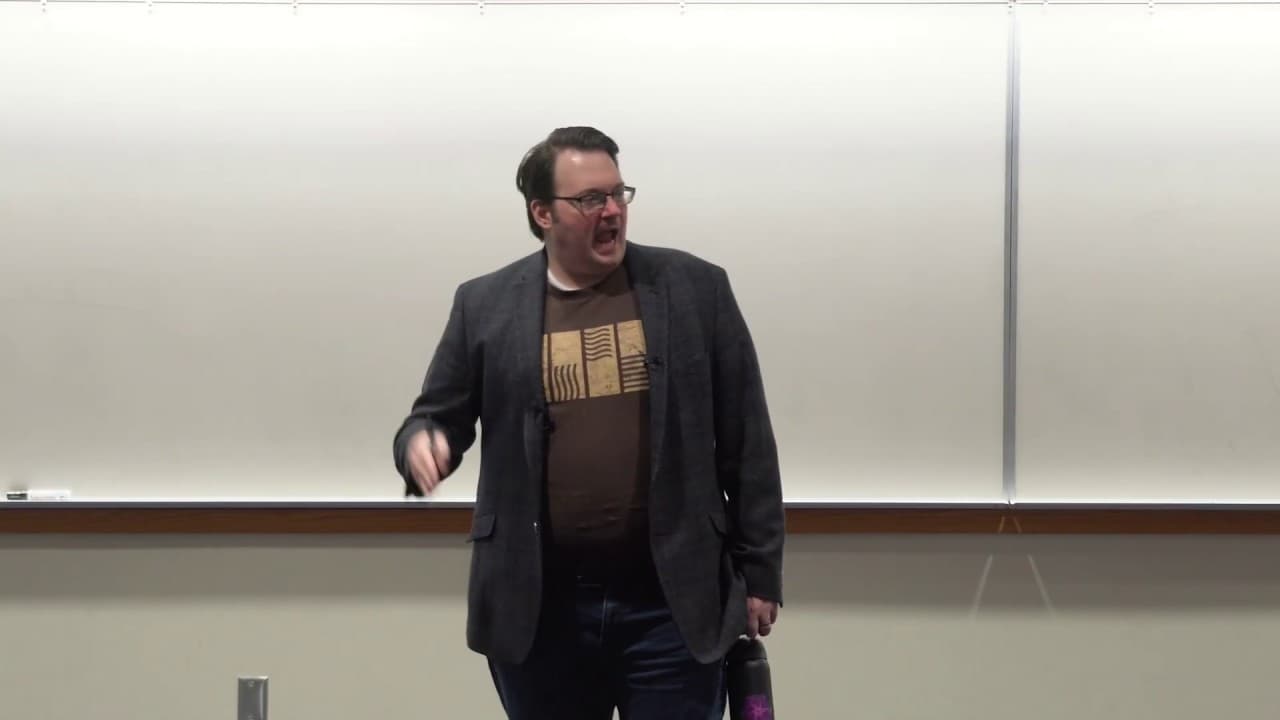
BRANDON: I had a request out of my 15-person workshop that I move world building up a little bit, because they're starting new stories and the world building comes up very early. I'm going to do world building for the next two weeks. Isaac, Mary Robinette is coming when? ISAAC: The 20th. BRANDON: The 20th, okay. We'll have this week and next week o... Read More
Key Insights
- Workshop needs changed sequencing: The worldbuilding material moved earlier because members of Sanderson's 15-person workshop were beginning new stories and facing worldbuilding questions immediately. The adjustment shows that the lecture sequence responds to practical writing needs rather than following an inflexible order established in advance.
- The lecture has wider context: Sanderson's Laws begin a two-week worldbuilding unit, but they are only one part of the announced course sequence. Mary Robinette is scheduled to discuss short stories on the 20th, after which students will receive a worldbuilding Q&A with prose material and two weeks on character.
- The laws began with revision: The pivotal Mistborn problem did not arise simply because Sanderson lacked an ending. It emerged when he revised an already functioning climax after Moshe requested extra oomph. The attempted improvement created a deeper structural weakness by introducing an insufficiently established solution.
- Foreshadowing was moved forward: Vin drawing on the mist to power allomancy belonged to a plot thread designed to foreshadow material needed in book three. Sanderson moved it into the first book's climax because it offered something new and interesting, but its earlier appearance changed how the immediate resolution felt.
- Experience did not prevent error: Mistborn 1 was Sanderson's first book written with the knowledge that it would be published, although he had already written 14 novels. Working with an editor while writing was also new to him, since Elantris had been completed years before its editorial process.
- Approval did not ensure satisfaction: Moshe considered the revised climax successful because the new element supplied the requested extra oomph. Publication and reader feedback exposed another issue, however. A change can answer an editor's immediate concern while still weakening the audience's sense that the final resolution was earned.
- The 95 percent timing matters: Sanderson describes the mistake plainly as adding a new power to the main character at the 95% mark. Because readers did not know Vin could access that ability, its use to save the day deflated some of the ending's satisfaction rather than deepening it.
- Genre preference remains legitimate: Sanderson does not argue that everyone should enjoy science fiction or fantasy. He calls each a flavor of storytelling and accepts personal dislike. His objection is narrower: the claim that invented settings uniquely allow authors to erase conflict does not survive comparison with other genres.
- Patches differ from resolutions: A plot can reach a formal conclusion without delivering a satisfying resolution. Both Vin's newly available power and the romance character's newly discovered royalty remove obstacles, but they do so by applying late patches instead of resolving the conflicts through previously understood possibilities.
- Romance proves the broader point: The noble and commoner example reproduces the same structural failure without magic. A long-lost uncle can declare the commoner royal at the 90% mark, permitting the marriage immediately. The genre changes, but the author still invents a late mechanism that evaporates tension.
- Fluency supports better endings: Sanderson calls fluency with this problem an important storytelling mechanic. Recognizing when an ending relies on an unprepared patch helps a writer understand why the conclusion feels weaker, even when the new event logically allows characters to escape their predicament.
- Understanding governs magical solutions: The First Law does not prohibit characters from using magic to resolve conflicts. It establishes a proportional relationship between satisfaction and reader understanding. The more clearly readers understand the relevant magic before the climax, the more effectively that magic can function as the mechanism of resolution.
Install to Summarize YouTube Videos and Get Transcripts
Explore YouTube Video Summarizer or Get YouTube Transcript Extractor
Questions & Answers
Q: What is Sanderson's First Law of magic?
Sanderson's First Law states that an author's ability to solve problems with magic satisfyingly is directly proportional to how well the reader understands that magic. Readers need prior understanding of the relevant capability before it becomes the decisive solution. That preparation lets the resolution arise from an established tool. Without it, the ending can feel like an author-created escape rather than an earned outcome.
Q: Why did Brandon Sanderson create Sanderson's Laws?
Sanderson created the laws after examining a problem in the ending of Mistborn 1. Reader feedback showed him that he had effectively added a new power to Vin at the 95% mark. He wanted a framework that explained why this weakened the climax. The resulting rule would help him recognize and avoid the same storytelling mistake in future work.
Q: What went wrong with the Mistborn 1 climax?
Moshe told Sanderson that the climax needed extra oomph. Sanderson responded by moving forward a plot thread in which Vin uses the mist to power allomancy. That material had been intended as foreshadowing for book three. Because the ability appeared so late and helped save the day, readers experienced it as a newly invented solution.
Q: Why can a late magical power feel unsatisfying?
A late power can resolve danger without drawing on possibilities readers already understand. The character escapes because the author reveals a capability at the moment it is needed. This deflates satisfaction because the solution does not emerge from the established conflict and tools. Vin's mist-powered allomancy created that problem when introduced at the 95% mark.
Q: Is inventing a convenient solution only a fantasy problem?
No, Sanderson argues that any genre can use an invented late solution. His romance example separates a noble from a commoner until a long-lost uncle declares that she is royalty. The announcement at the 90% mark makes marriage possible but evaporates the established tension. This shows that the weakness comes from conflict resolution, not from fantasy itself.
Q: What is the difference between a patch and a satisfying resolution?
A patch removes the obstacle through information or power introduced near the ending. A satisfying resolution instead works through possibilities that the audience already understands. The late declaration of royalty and Vin's late power both technically solve their plots. They feel weaker because they sidestep the developed conflict instead of resolving it through established elements.
Q: How did editing contribute to Sanderson's First Law?
The original Mistborn climax prompted Moshe to ask for more oomph. Sanderson revised it by advancing a magical development planned to foreshadow book three. Moshe thought the added element worked, so the book was released with the change. Later feedback revealed that solving one editorial concern had created the separate problem of an insufficiently prepared power.
Q: How does Lecture #5 fit into Brandon Sanderson's course plan?
Lecture #5 begins a two-week section on worldbuilding and introduces Sanderson's Laws. The unit was moved earlier because the 15-person workshop encountered worldbuilding issues while starting stories. Mary Robinette is scheduled to discuss short stories on the 20th. A worldbuilding Q&A with prose material and two weeks on character are planned afterward.
Summary & Key Takeaways
-
Reordering the writing course: Brandon Sanderson opens Lecture #5 by explaining that his 15-person workshop asked him to move worldbuilding earlier because students encounter it quickly when starting stories. He plans two weeks on worldbuilding, followed by Mary Robinette discussing short stories on the 20th. A worldbuilding Q&A with prose material comes next, then two weeks focused on character. This first worldbuilding lecture addresses Sanderson's Laws and how they developed.
-
Finding Mistborn's ending problem: Sanderson traces his laws to writing Mistborn 1 while beginning Mistborn 2. His editor, Moshe, felt the climax needed extra oomph, so Sanderson moved forward Vin's ability to use the mist to power allomancy. The material had been intended to foreshadow developments needed in book three. Moshe approved the change, but reader feedback later helped Sanderson recognize that he had effectively granted the main character a new power at the 95% mark.
-
Rejecting a genre-specific criticism: Some readers argue that science fiction and fantasy lack conflict because authors can invent anything to save their characters. Sanderson accepts that people may dislike those genres as a matter of taste, but disputes this particular reasoning. Any author can create a late escape from consequences. Fantasy makes the maneuver visible through invented powers, yet the underlying storytelling failure is not unique to speculative fiction.
-
Testing the idea across genres: Sanderson illustrates the same failure with a romance about a noble and a commoner who cannot marry. If a long-lost uncle appears at the 90% mark and declares that the commoner is actually royalty, the central conflict simply evaporates. The revelation technically resolves the plot, but it sidesteps rather than confronts the established problem. Sanderson compares that patch directly with the late magical ability he inserted into Mistborn 1.
-
Formulating the First Law: To understand his mistake and avoid repeating it, Sanderson framed the lesson as a scientific-sounding rule for fantasy magic systems. His First Law states that an author's ability to solve problems with magic satisfyingly is directly proportional to how well readers understand that magic. The wording captures why Vin's late power weakened the climax: readers had not understood that she possessed the tool before it became essential to saving the day.
Read in Other Languages (beta)
Share This Summary 📚
Summarize YouTube Videos and Get Video Transcripts with 1-Click
Try YouTube Summary with ChatGPT & Claude or YouTube Transcript Generator
Explore More Summaries from Brandon Sanderson 📚

Summarize YouTube Videos and Get Video Transcripts with 1-Click
Try YouTube Summary with ChatGPT & Claude or YouTube Transcript Generator