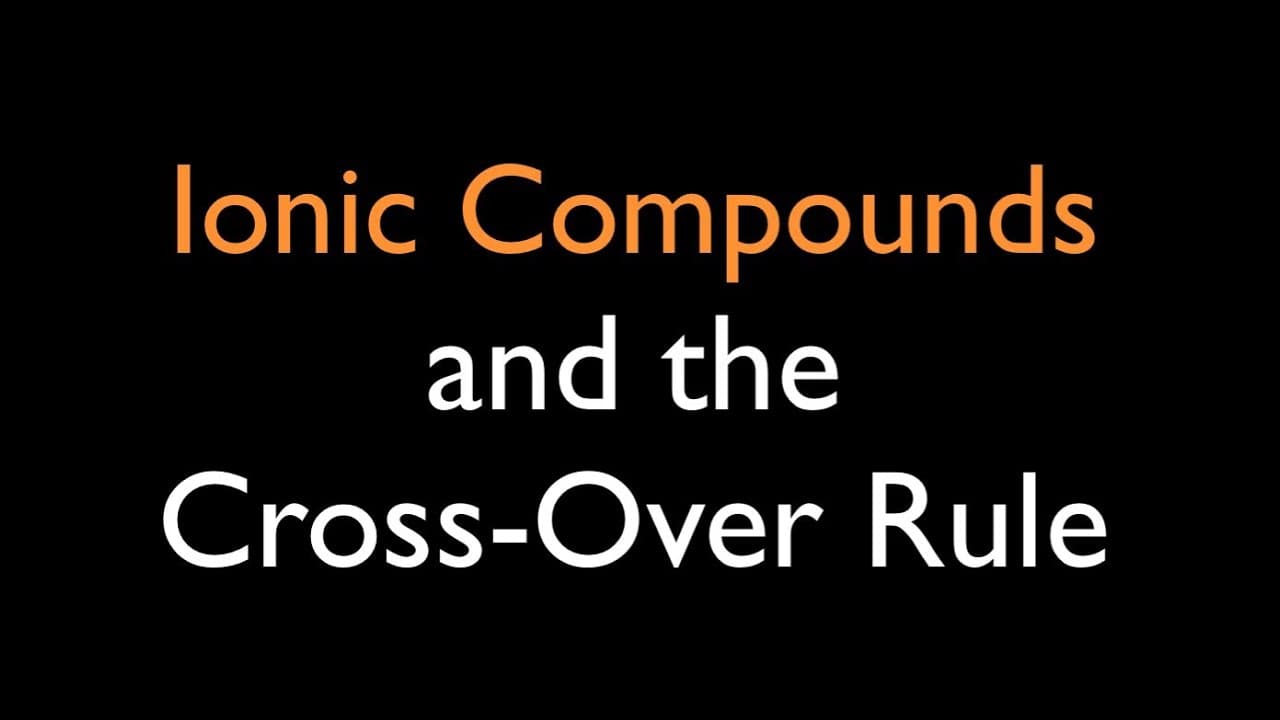
What Is the Crossover Rule for Naming Ionic Formulas?
TL;DR
The crossover rule names ionic formulas by taking the charges of each element, swapping them to become subscripts, and then simplifying. For example, in barium fluoride, barium's +2 charge becomes the subscript for fluoride, resulting in BaF2. This method applies to various compounds, necessitating familiarity with periodic table charges and polyatomic ions.
Transcript
okay in this video I'm going to use the cross or go over the crossover Rule and how we use it to name ionic formulas okay and we're going to use we have the formula name we're going have the ionic names and then we're going to come up with the ionic formulas all right before we do that let's just make sure that everybody has their handy dandy perio... Read More
Key Insights
- ⚾ The crossover rule is a systematic approach to naming ionic formulas based on the charges of elements.
- 👥 Charges of elements in groups 1, 2, 3, 15, 16, and 17 are important for determining the chemical formula.
- 😑 It is crucial to have a periodic table with charges or a list of polyatomic ions to accurately name compounds.
- 😵 The charges of elements are crossed over and written as subscripts to obtain the correct ionic formula.
Install to Summarize YouTube Videos and Get Transcripts
Explore YouTube Video Summarizer or Get YouTube Transcript Extractor
Questions & Answers
Q: What is the crossover rule in chemistry?
The crossover rule is a systematic method for writing ionic formulas. You write down the charge of each element or polyatomic ion, then cross those charges over so each becomes the subscript of the other. The subscript 1 is not written, so barium (+2) and fluoride (-1) give the formula BaF2.
Q: How do you use the crossover method step by step?
First look up and write down the charge on each element or polyatomic ion. Next write the element or polyatomic symbols side by side. Then take the number of the charge from one and place it as the subscript on the other, and do the same in reverse. Drop any subscript of 1 to get the final formula.
Q: How do you know the charges of elements like barium and fluoride?
Charges come from an element's group on the periodic table. Group 1 forms +1, group 2 forms +2, and group 3 metals form +3, while groups 15, 16, and 17 form -3, -2, and -1. Barium is in group 2 so it is +2, and fluoride is in group 17 so it is -1. Transition metals and polyatomic ions are looked up separately.
Q: Do you need a periodic table for the crossover rule?
Yes. The video stresses having a periodic table with the charges written on it, or knowing the group charges by heart. You also need to have memorized the polyatomic ions or have a list of them from your teacher, since the method relies on knowing each ion's charge before crossing over.
Q: What happens when both ions have a charge of one, like in sodium nitrate?
When both charges are 1, the formula stays one-to-one and no subscripts are needed. Sodium is +1 and nitrate is -1, so sodium nitrate is simply written as the two symbols together. Any equal-and-opposite charges, such as +2 and -2 or +3 and -3, also reduce to a one-to-one ratio.
Q: What is the formula for chromium(II) phosphate and why does it need parentheses?
Chromium is +2 and phosphate is -3, so crossing over gives three chromium and two phosphate ions: Cr3(PO4)2. The phosphate ion is placed in parentheses because the subscript 2 must apply to the whole polyatomic ion, not just one atom. Checking the charges, three chromium at +2 equals +6 and two phosphate at -3 equals -6, so the unit is neutral.
Q: Why do you write down the charges and symbols before crossing over?
Writing the charges and symbols first keeps the method organized and ensures the final charges balance to zero. After building the formula you can add the charges back up as a check. For BaF2, one barium at +2 plus two fluorines at -1 each sums to zero, confirming the formula is correct.
Q: How do you check that an ionic formula is correct?
Add up all the charges in the formula; the overall charge on a neutral ionic unit must equal zero. Multiply each ion's charge by how many of that ion appear. For chromium(II) phosphate, +6 from three chromium and -6 from two phosphate ions cancel to zero, which confirms the crossover result.
Summary & Key Takeaways
-
The video teaches the crossover rule for naming ionic formulas, using the charges of elements and polyatomic ions.
-
It emphasizes the importance of having a periodic table with charges written on it, especially for group 1, 2, 3, 15, 16, and 17 elements.
-
The video provides examples of using the crossover rule to name compounds such as barium fluoride, sodium nitrate, and chromium(II) phosphate.
Read in Other Languages (beta)
Share This Summary 📚
Summarize YouTube Videos and Get Video Transcripts with 1-Click
Try YouTube Summary with ChatGPT & Claude or YouTube Transcript Generator
Explore More Summaries from Step by Step Science 📚
Summarize YouTube Videos and Get Video Transcripts with 1-Click
Try YouTube Summary with ChatGPT & Claude or YouTube Transcript Generator