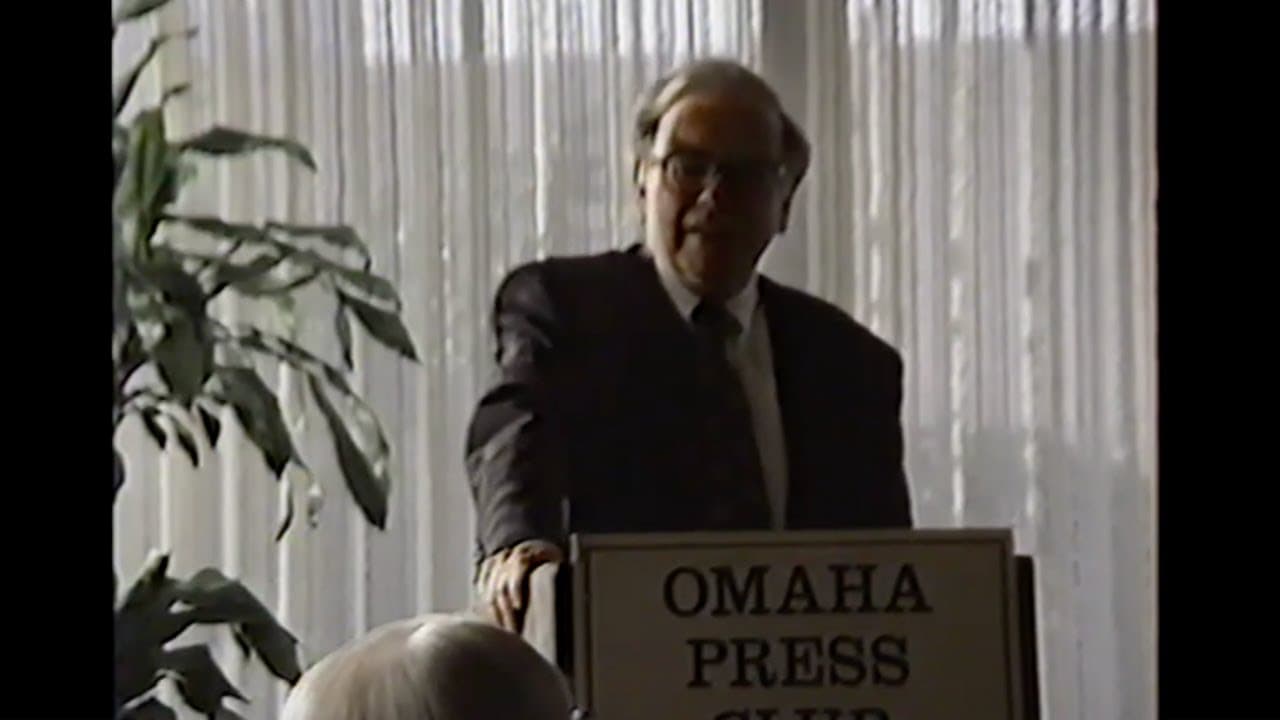
Warren Buffett | Lecture | Omaha Press Club | 1992
TL;DR
Warren Buffett shares insights on dealing with the media, emphasizing transparency and honesty, especially during crises. He discusses the challenges of media coverage, the importance of understanding a company's intrinsic value, and the role of newspapers and television in shaping public perception. Buffett also highlights the significance of long-term investment strategies over short-term market reactions.
Transcript
you want to get started right at six uh on behalf of the omaha press club education committee uh who include wendy callahan hugh cowden warren frankie ellen gast steve murphy eileen worth and myself chris olsen i'd like to welcome you to this first in a series of education seminars for the 1992-93 year this evening's format for the most part will b... Read More
Key Insights
- Warren Buffett emphasizes the importance of transparency and honesty when dealing with the media, especially during crises.
- Understanding a company's intrinsic value is crucial for long-term investment success, rather than focusing on short-term market fluctuations.
- Buffett highlights the role of newspapers and television in shaping public perception, noting the power of media narratives.
- The media often struggles to cover slow-developing stories, which can lead to underreporting significant long-term issues.
- Buffett advises that media coverage can influence market emotions, but investors should focus on fundamental analysis.
- He discusses the challenges journalists face in accurately reporting complex financial stories, often due to time constraints.
- Buffett notes that newspaper profitability is not necessarily linked to journalistic excellence, as market dynamics often favor established players.
- He suggests that journalists could benefit from applying their investigative skills to investment opportunities, potentially leading to financial gains.
Install to Summarize YouTube Videos and Get Transcripts
Explore YouTube Video Summarizer or Get YouTube Transcript Extractor
Questions & Answers
Q: How should companies handle media relations during a crisis?
During a crisis, companies should prioritize transparency and honesty in their media relations. Warren Buffett advises sharing all known facts and avoiding any form of deception. It's crucial to communicate clearly and consistently, providing updates as new information becomes available. This approach helps build trust with the public and media, potentially mitigating reputational damage.
Q: What challenges do journalists face in reporting financial news?
Journalists often face challenges in reporting financial news due to the complexity of the topics and time constraints. Financial stories can involve intricate details that require a deep understanding of the subject matter. Additionally, slow-developing stories may not receive adequate coverage because they lack immediate news hooks, making it difficult for reporters to convey their significance over time.
Q: How can media coverage influence market emotions?
Media coverage can significantly influence market emotions by shaping public perception and investor sentiment. Sensational headlines or incomplete information can lead to overreactions, causing short-term market volatility. However, Warren Buffett emphasizes the importance of focusing on a company's intrinsic value and long-term fundamentals rather than being swayed by transient media narratives.
Q: Why is it important to understand a company's intrinsic value?
Understanding a company's intrinsic value is crucial for making informed investment decisions. It allows investors to assess whether a stock is undervalued or overvalued, independent of market fluctuations or media hype. This approach helps investors focus on long-term potential rather than short-term market noise, aligning with Warren Buffett's investment philosophy of buying and holding fundamentally strong companies.
Q: What role do newspapers and television play in shaping public perception?
Newspapers and television play a significant role in shaping public perception by controlling the narrative around news stories. They have the power to influence public opinion and investor sentiment through the stories they choose to cover and how they present them. Warren Buffett notes that while media outlets can provide valuable information, they can also contribute to misinformation if not careful.
Q: How can journalists apply their skills to investment opportunities?
Journalists can leverage their investigative skills to identify and analyze potential investment opportunities. By conducting thorough research and understanding the fundamentals of companies, journalists can uncover undervalued stocks and make informed investment decisions. Warren Buffett suggests that journalists could benefit financially by applying their reporting skills to the world of investing.
Q: What is the relationship between newspaper profitability and journalistic excellence?
There is not always a direct correlation between newspaper profitability and journalistic excellence. Market dynamics often favor established players, allowing some newspapers to remain profitable despite producing lower-quality content. Warren Buffett points out that the economics of the industry can lead to monopolistic conditions, where profitability is driven more by market position than by the quality of journalism.
Q: Why do slow-developing stories often receive less media coverage?
Slow-developing stories often receive less media coverage because they lack the immediate news hooks that attract audience attention. These stories unfold gradually over time, making them less appealing for daily news cycles focused on breaking news and sensational events. As a result, significant long-term issues may be underreported, despite their potential impact on society and the economy.
Summary
Warren Buffett discusses his experiences with the news media and shares his thoughts on various aspects of journalism in this video. He talks about his family's history in the newspaper business, the challenges of covering slow-developing stories, the importance of accuracy in reporting, and the power of the media to shape public opinion. Buffett also comments on the economics of the newspaper and television industries and the role of anchorpersons in driving audience viewership. He concludes by discussing his views on journalistic books and their accuracy.
Questions & Answers
Q: How did Warren Buffett's family influence his interest in the newspaper business?
Warren Buffett's family had a strong interest in the newspaper business, with his grandfather buying a newspaper in West Point, Nebraska in 1905. Buffett's mother and her siblings grew up above the newspaper and his mother even worked for the newspaper, running a line of type at the age of 11. She went on to work for the University of Nebraska newspaper and later married Warren Buffett's father, who was the editor of the Daily Nebraskan.
Q: What advice does Warren Buffett give for dealing with the news media?
Warren Buffett compares dealing with the news media to making love to a porcupine - it should be done cautiously. He emphasizes the importance of accuracy in reporting, as inaccuracies can harm a person's reputation. Buffett also acknowledges that slow-developing stories and complex topics are challenging for the news media to cover, but he encourages journalists to take the time to understand the subject matter before writing about it.
Q: How does Warren Buffett view the fiscal imbalance at the national level?
Warren Buffett acknowledges the fiscal imbalance at the national level but believes that the government has more taxing power than it currently uses. He explains that the government has the ability to increase taxation in the future to cover its liabilities, as it owns a significant portion of American corporations. However, he also notes that the public may not be aware of the magnitude of the issue due to the slow, gradual impact it has on society over time.
Q: Does Warren Buffett think the media is missing important stories?
Warren Buffett explains that the media often struggles to cover stories that have a slow, gradual impact on society. He gives the example of population growth, which is a significant issue but doesn't attract immediate attention. He believes that the media is more inclined to cover stories that have a dramatic and immediate impact rather than those that develop over time. Furthermore, he acknowledges that some stories, especially those that are complex or intricate, may require specialized knowledge and expertise to properly cover.
Q: How does Warren Buffett view newspaper endorsements of political candidates?
Warren Buffett mentions that the Buffalo News, one of the newspapers his company owns, has a policy of endorsing candidates. He explains that the newspaper believes it should provide an opinion on various subjects, including political races. However, he also acknowledges that newspaper endorsements, particularly in presidential races, may not carry significant influence with the public, as the amount of interest in the race often diminishes the impact of endorsements.
Q: How does Warren Buffett approach interviews and media interaction?
Warren Buffett discusses his approach to interviews and media interactions. He emphasizes that he spends a significant amount of time with media personnel, often more than any other CEO he knows. However, he also acknowledges the limitations of his time and the desire to focus on those who possess a good understanding of the subject matter. Buffett explains that he prefers to talk to journalists who already have knowledge in the area and are looking for subtle nuances rather than those seeking a one-sentence quote to support their predetermined conclusion. He believes that giving interviews to unprepared journalists can lead to inaccurate reporting.
Q: What are Warren Buffett's thoughts on the portrayal of business in the media?
Warren Buffett believes that the media often has a negative bias towards business. He acknowledges that there are some unethical individuals in all fields, including business, but points out that the majority of people in business are trying to do their jobs well. He cautions against generalizing negative characteristics to the entire business community based on the actions of a few individuals. Buffett emphasizes that individual experiences with business can vary widely and urges people to consider the range of experiences and perspectives before forming opinions.
Q: How does Warren Buffett view the relationship between profitability and journalistic excellence in the newspaper industry?
Warren Buffett argues that there is no correlation between profitability and journalistic excellence in the newspaper industry. He points out that some newspapers with high-profit margins are perceived as poor in terms of journalistic quality. Conversely, some newspapers that are highly regarded for their journalism may not be as profitable. Buffett suggests that profitability in the newspaper industry depends on the publisher's desires and practices rather than excellence. He acknowledges that this may be a sensitive topic for publishers, as it challenges the notion that profitability is solely a result of journalistic excellence.
Q: What does Warren Buffett think of journalistic books, such as Michael Lewis's "Liar's Poker"?
Warren Buffett reads journalistic books and finds them interesting, even though he sometimes suspects that certain aspects may be dramatically inaccurate. He cites examples from various books, such as "Liar's Poker" by Michael Lewis and "JFK" by Oliver Stone, where he believes there may be inaccuracies or exaggerations. Buffett recognizes that once a story is written and reaches a large audience, many people will believe it to be true, even if it is not completely accurate. He acknowledges the power of storytelling and its ability to shape public opinion.
Q: How does Warren Buffett view the economics of the television industry compared to the newspaper industry?
Warren Buffett explains that the television industry operates differently from the newspaper industry. He notes that while people typically choose to read only one newspaper a day, they can easily switch between television channels. This dynamic creates a different competitive environment for television stations, as they must compete for viewership with multiple channels. Buffett also highlights the role of anchorpersons and local news broadcasts in the success of network nightly news shows. He attributes the success of these shows to the lead-in viewership provided by popular local news programs.
Q: How does Warren Buffett address the criticism that he manipulates the media?
Warren Buffet refutes the notion that he manipulates the media. He acknowledges that he spends a significant amount of time with journalists and is accessible to them. However, he attributes this to his desire to provide accurate information and share his thoughts on various subjects. Buffett believes that rumors of manipulation arise from the media itself and are not reflective of his actions. He emphasizes that he does not give interviews to profile-type pieces but is open to talking about specific subjects if the journalist is knowledgeable in that area.
Summary & Key Takeaways
-
Warren Buffett discusses the importance of transparency and honesty in media relations, particularly during crises. He advises focusing on a company's intrinsic value rather than short-term market reactions and highlights the role of newspapers and television in shaping public perception.
-
Buffett points out the challenges the media faces in covering slow-developing stories and suggests that journalists could apply their investigative skills to investment opportunities. He also notes that newspaper profitability is not necessarily linked to journalistic excellence.
-
The discussion includes insights into how media coverage can influence market emotions and the importance of fundamental analysis for investors. Buffett emphasizes the need for accuracy and fairness in financial reporting, acknowledging the pressures journalists face.
Read in Other Languages (beta)
Share This Summary 📚
Summarize YouTube Videos and Get Video Transcripts with 1-Click
Try YouTube Summary with ChatGPT & Claude or YouTube Transcript Generator
Explore More Summaries from Investor Archive 📚

Summarize YouTube Videos and Get Video Transcripts with 1-Click
Try YouTube Summary with ChatGPT & Claude or YouTube Transcript Generator