What Is Psycholinguistics and How Does It Relate to Language?
TL;DR
Psycholinguistics explores the relationship between language and the brain, focusing on how specific brain regions govern language acquisition and production. Key insights include neuroplasticity, which shows that the brain can adapt and reorganize after injury, and the occurrence of language errors, like 'Tip of the Tongue' experiences, which provide valuable information about linguistic processing.
Transcript
Hi, I'm Taylor and welcome to Crash Course Linguistics! Language happens thanks to the brain. This spongy thing sitting in our skull is responsible for our abilities to acquire complex linguistic skills like phonology, semantics, syntax and reading. It’s what helps us write poems and compose texts, or get the meaning of a raised eyebrow or a string... Read More
Key Insights
- 🧠 Language and the brain have a close relationship, with specific brain regions associated with language production and understanding.
- 🥺 Neuroplasticity allows the brain to adapt and reorganize, leading to recovery or compensation for language deficits.
- 🧠 Language errors, such as Tip of the Tongue experiences, provide valuable insights into how the brain processes and retrieves linguistic information.
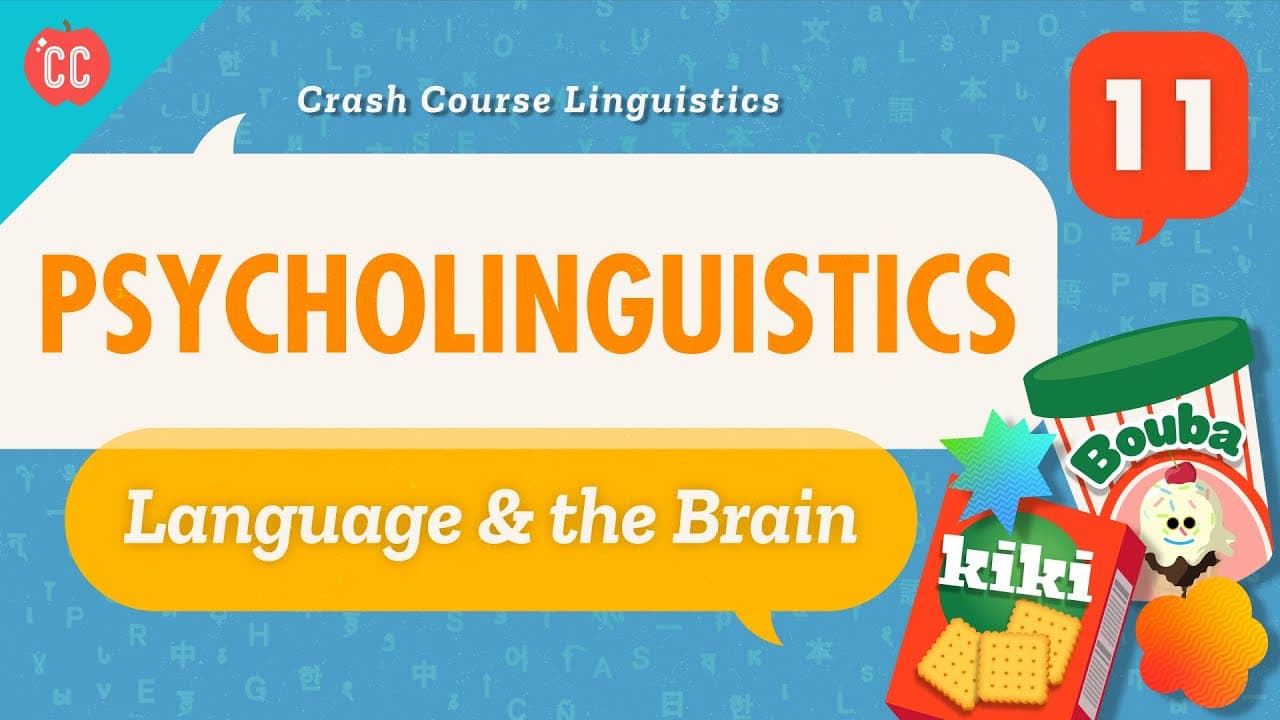
- 👂 The kiki/bouba experiment highlights the non-arbitrary nature of certain sounds and their association with sensory experiences.
- 🧠 Psycholinguists employ various methods, including priming experiments, gating experiments, eyetracking studies, EEG, and fMRI, to understand language processing in the brain.
- 🧠 Individual variation and language fluency in different languages introduce complexity to the study of the brain-language relationship.
Install to Summarize YouTube Videos and Get Transcripts
Explore YouTube Video Summarizer or Get YouTube Transcript Extractor
Questions & Answers
Q: What are aphasia and the two types of aphasia mentioned in the content?
Aphasia refers to language impairments caused by the brain's damage. Broca's aphasia is characterized by difficulties in producing fluent speech, while Wernicke's aphasia involves fluent, nonsensical speech.
Q: Can people with major damage to Broca's area still develop aphasia?
Recent research has shown that some individuals with significant damage to Broca's area do not experience aphasia, suggesting that other brain regions can compensate for the loss.
Q: Is language processing predominantly located in the left hemisphere of the brain?
While language areas are typically found in the left hemisphere, it is not uncommon for the language regions to be predominantly in the right hemisphere or spread across both sides, especially in left-handed or ambidextrous individuals.
Q: How do psycholinguists induce Tip of the Tongue or Finger experiences in the laboratory?
Psycholinguists can induce Tip of the Tongue or Finger experiences by asking individuals to translate words or recall proper nouns, enabling them to study the errors in a controlled setting.
Summary & Key Takeaways
-
Language abilities are dependent on the brain, which controls linguistic skills such as phonology, semantics, syntax, and reading.
-
In the 19th century, research on language disorders and brain injuries led to the discovery of areas like Broca's and Wernicke's, associated with speech production and language understanding.
-
Recent studies have shown neuroplasticity, the brain's ability to adapt and reorganize after injury or during learning, can affect language abilities and their neural representation.
Read in Other Languages (beta)
Share This Summary 📚
Summarize YouTube Videos and Get Video Transcripts with 1-Click
Try YouTube Summary with ChatGPT & Claude or YouTube Transcript Generator
Explore More Summaries from CrashCourse 📚





Summarize YouTube Videos and Get Video Transcripts with 1-Click
Try YouTube Summary with ChatGPT & Claude or YouTube Transcript Generator