How to Clone a Sales CRM With AI and No Code
TL;DR
Start by using AI to turn a narrowly defined customer problem into a product requirements document, a detailed build prompt, and a referenced design system. Build only the CRM’s essential deal-tracking workflow, review the platform’s plan before generating the app, test every core function, fix failures incrementally, and sync the generated code to GitHub for future portability.
Transcript
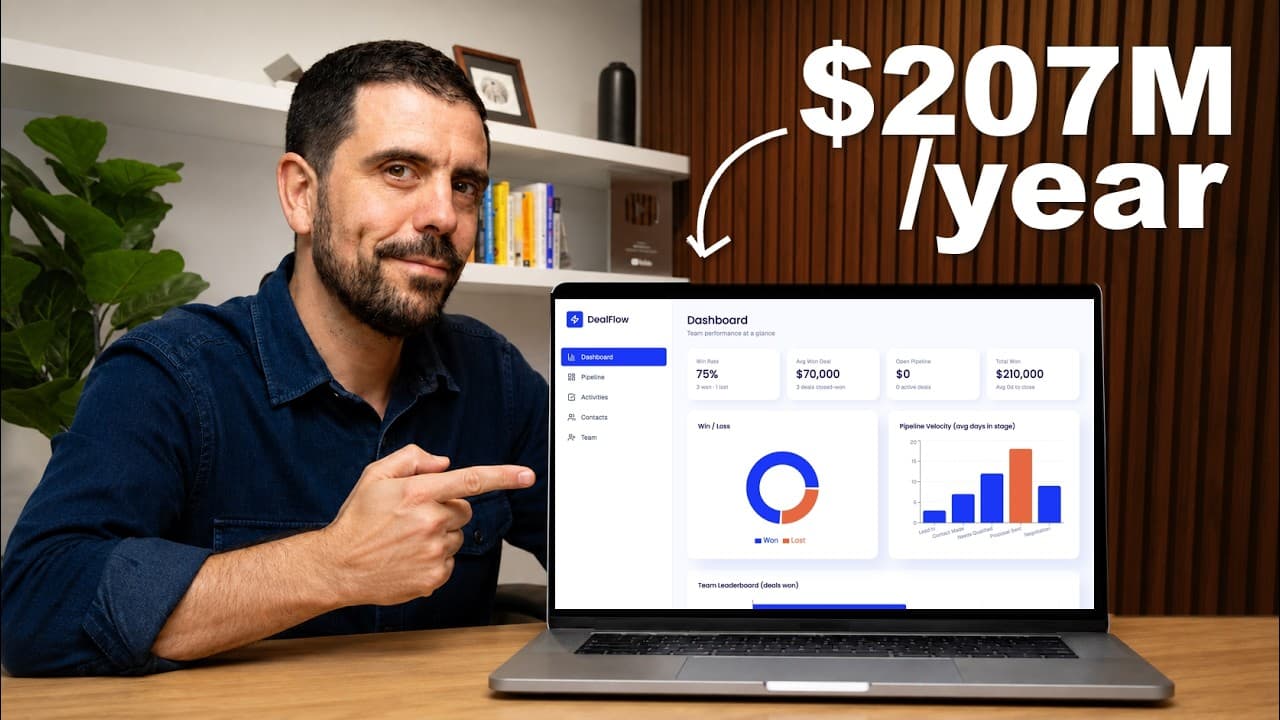
Today, I'm going to be cloning a $207 million app without writing a single line of code. And I know that sounds crazy, but I want to prove to you that you don't need an original idea to make an app that generates real revenue. So, in this video, I'm going to be building the full app from scratch. I'm going to break down the entire process so that y... Read More
Key Insights
- Planning is the foundation of the AI build because the coding platform creates what the prompt specifies. The workflow therefore begins with Claude producing a product requirements document, an initial Base44 prompt, and five ordered follow-up prompts before development starts.
- The minimum viable product is a lower-budget sales CRM for small and medium businesses. Its purpose is to preserve Pipedrive’s essential outcome, helping users track deal flow and increase conversions, without attempting to reproduce every feature added to the established product.
- The design system is derived from a Webflow template called Taskopia. Claude analyzes the reference site’s colors, fonts, gradients, containers, corner radiuses, and animations, while screenshots supplement the written specifications with visual evidence for the AI coding platform.
- Base44’s plan mode provides a review stage before application generation begins. The complete initial prompt is submitted there so the proposed scope and implementation can be checked, discussed, and changed before selecting the command to start building.
- The first generated version contains the CRM’s central pipeline workflow. Users can view individual deals, drag them between stages, create deals with a title, value, and predetermined stage, and open records to add activities or notes.
- Incremental inspection reveals requirements that the initial build missed. When the contacts area cannot create people or organizations or connect them, the next prompt requests that specific functionality instead of replacing the entire application or expanding the product indiscriminately.
- AI-generated testing validates the application through real browser interactions. The testing agent creates and runs tests, clicks controls, creates organizations, displays its browser activity, and reports whether each scenario passed or failed so defects can be identified.
- GitHub synchronization preserves access to the generated code beyond Base44. Keeping the project in a code library makes it possible to move the application, adapt it elsewhere, or continue development with custom coders after the AI-assisted build.
Install to Summarize YouTube Videos and Get Transcripts
Explore YouTube Video Summarizer or Get YouTube Transcript Extractor
Questions & Answers
Q: How do you plan an AI-built CRM before coding?
Begin by describing the target product, intended customers, budget position, essential user outcome, and minimum viable scope to an AI assistant. In this project, Claude is asked to research Base44 practices, write a product requirements document, and convert it into an initial build prompt. The resulting plan is reviewed for unnecessary scope before being submitted to the coding platform.
Q: How do you create an effective prompt for Base44?
Use an AI assistant to transform a precise product concept into a detailed product requirements document and an ordered prompt sequence. The initial prompt should define the overall build, essential features, target users, desired outcomes, and design direction. Submit that prompt in Base44’s plan mode first, then review the platform’s interpretation and request changes before starting the build.
Q: What features should a minimum viable sales CRM include?
The demonstrated minimum viable CRM centers on a visual deal pipeline rather than a large collection of secondary features. It includes individual deal records, drag-and-drop movement between stages, new-deal creation, titles, values, predetermined stages, activities, and notes. It also needs contact functionality for creating people and organizations and connecting those records to the relevant sales information.
Q: How can an existing website inspire an AI app design?
Choose a reference website with an appropriate visual style, then ask an AI assistant to reverse engineer its design system. For the Dealflow project, the analysis covers the color palette, fonts, gradients, containers, corner radiuses, and animations. Written specifications are combined with screenshots, then added to the product requirements and build prompt to guide the coding platform’s visual output.
Q: Why should Base44 plan mode be used before building?
Plan mode provides an opportunity to verify how Base44 understands the product before it starts generating the application. The full initial prompt can be submitted, the proposed implementation can be inspected, and changes can be discussed while the project remains in planning. Building begins only after the proposed scope and feature set appear consistent with the intended minimum viable product.
Q: How should missing features be fixed in an AI-generated app?
Inspect the generated application as a user and test each core workflow individually. When a missing capability is found, give the coding platform a focused request describing the exact gap. In the example, the contacts tab cannot create people or organizations or attach them to each other, so a targeted prompt requests that functionality before the process advances to broader testing.
Q: How does Base44 test an AI-generated application?
Base44 includes a testing agent that can generate tests with AI and run them against the application. Some tests display the browser while the agent clicks buttons and creates records as a human user would. Each test is then marked as passed or failed. Failed scenarios provide concrete evidence of defects that can be investigated and corrected during refinement.
Q: Why sync a Base44 project to GitHub?
Syncing the project to GitHub keeps the generated code available in a separate code library. That access supports future portability and continued development, including moving the project elsewhere, adapting its implementation, or handing it to custom coders. The recommendation is made while Base44 is generating the application so code ownership and future options are considered early.
Summary & Key Takeaways
-
The project begins by defining a minimum viable sales CRM for small and medium businesses with lower budgets. Claude researches Base44 practices, creates a product requirements document, and produces an initial build prompt plus five follow-up prompts focused on the core outcome of tracking deal flow and improving conversions.
-
A Webflow template supplies visual inspiration for the app’s design system. Claude analyzes its colors, fonts, gradients, containers, corner radiuses, and animations, while screenshots provide additional visual guidance. These design specifications are then incorporated into the product requirements and Base44 prompt before any application code is generated.
-
Base44 first evaluates the detailed prompt in plan mode, allowing the proposed implementation to be reviewed before building begins. The generated CRM includes a pipeline, draggable deals, deal creation, stages, values, activities, and notes. Missing contact features are added iteratively, followed by AI-generated browser tests that expose failures for correction.
Read in Other Languages (beta)
Share This Summary 📚
Summarize YouTube Videos and Get Video Transcripts with 1-Click
Try YouTube Summary with ChatGPT & Claude or YouTube Transcript Generator
Explore More Summaries from Christian Peverelli 📚


Summarize YouTube Videos and Get Video Transcripts with 1-Click
Try YouTube Summary with ChatGPT & Claude or YouTube Transcript Generator