Claude Opus 5.5 Review: Better Creative Builds
TL;DR
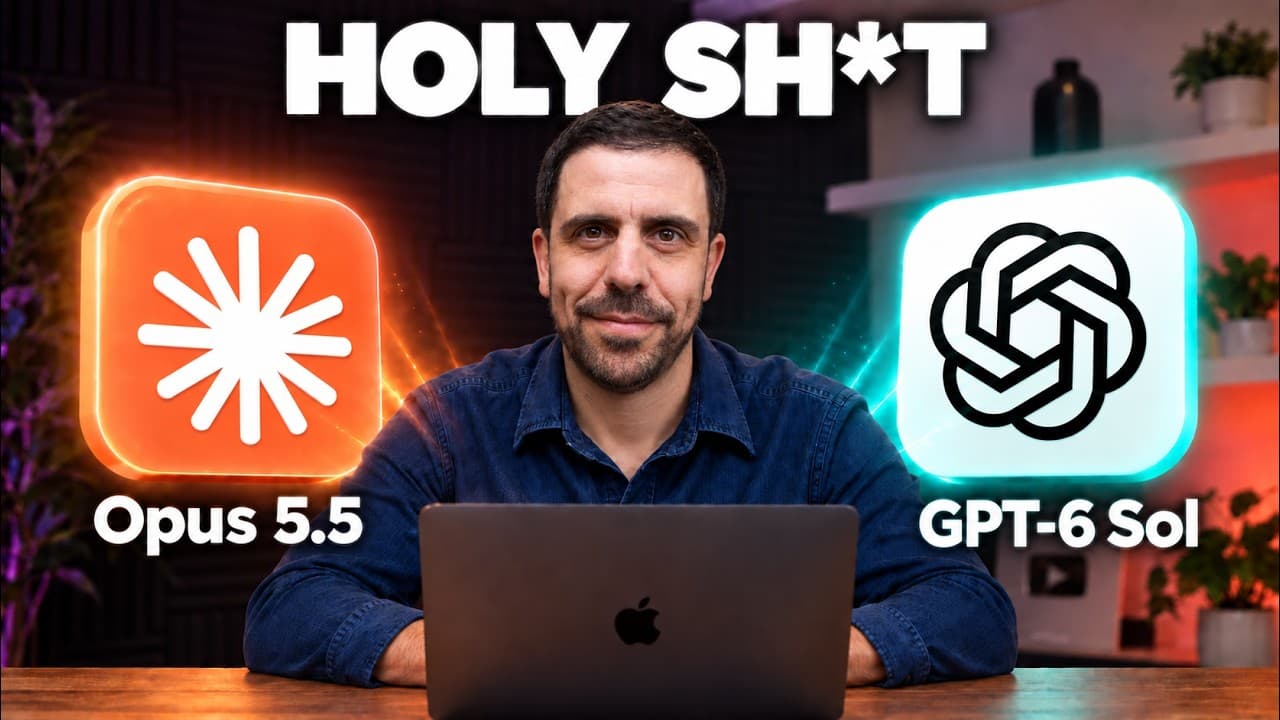
Claude Opus 5.5 produced the preferred result in all three demonstrated comparisons: a community website, an edited video hook, and an interactive flying world. The presenter found its outputs more polished, detailed, and usable than GPT6 Soul’s, although Soul completed the virtual-world task twice as fast and reportedly cost about half as much per million input tokens.
Transcript
Yesterday, Anthropic dropped their latest model, Claude Opus 5.5, and the internet naturally broke. You see, they're claiming that this model is faster and cheaper than prior models. I spent the past 24 hours building a bunch of different workflows, I want to show you the top three today, and to compare it to its closest chat GPT competitor model, ... Read More
Key Insights
- Claude Opus 5.5 was described in the release as 30% faster than Opus 5 and 60% cheaper to run. The quoted API prices were $4 per million input tokens and $20 per million output tokens, with the presenter noting that these were the company’s claims.
- The model’s advertised performance was said to match Claude Fable 5.1 on most work while costing 40% less than Opus 5. The presenter treated these statements as claims to evaluate through practical builds rather than accepting the marketing language without testing.
- The community website created with Opus 5.5 had a distinctive color palette, branded typography, motion effects, frequently asked questions, and interactive project demonstrations. The presenter considered it more elevated and less obviously templated than the comparison website generated by GPT6 Soul.
- The website demonstration communicated possible community projects through three categories: building a website, editing a video, and creating an interactive experience. One interactive section recommended a fiddle-leaf plant after asking about household light, watering frequency, and the presence of animals.
- Opus 5.5 produced the presenter’s preferred edit of a video introduction. The winning edit preserved more visual detail, avoided excessive simplification, and removed portions of speech that the presenter considered unnecessary, demonstrating stronger performance within his established video-editing workflow.
- GPT6 Soul executed the interactive virtual-world challenge twice as fast as Opus 5.5. However, its flight experience had less sophisticated graphics, unclear controls, limited gameplay, and an interface that left the presenter uncertain about how to operate the aircraft effectively.
- The Opus 5.5 flying world provided a more complete game experience through realistic flight, stronger graphics, birds, ocean scenery, destination switching, and transitions among daylight conditions. Details included a lighthouse, an observatory, progressive sunset effects, and lights that became visible in darker settings.
- The presenter selected Opus 5.5 as the winner in all three comparisons against GPT6 Soul. He nevertheless identified a clear tradeoff: Soul was faster in the complex virtual-world task and reportedly cost about $2 per million input tokens, compared with $4 for Opus 5.5.
Install to Summarize YouTube Videos and Get Transcripts
Explore YouTube Video Summarizer or Get YouTube Transcript Extractor
Questions & Answers
Q: How did Claude Opus 5.5 perform against GPT6 Soul?
Claude Opus 5.5 produced the presenter’s preferred output in all three demonstrated comparisons: the community website, the edited video hook, and the interactive flying world. Its work was judged more polished, detailed, and visually sophisticated. GPT6 Soul retained advantages in speed and price, completing the virtual-world task twice as fast and reportedly costing about $2 per million input tokens instead of $4.
Q: What are the claimed price and speed improvements of Claude Opus 5.5?
The release described Claude Opus 5.5 as 30% faster than Opus 5 and 60% cheaper to run. The quoted prices were $4 per million input tokens and $20 per million output tokens, with input and output pricing described as 20% lower than Opus 5. It was also said to deliver Claude Fable 5.1-level performance on most work.
Q: What kind of website did Claude Opus 5.5 create?
Claude Opus 5.5 created a website designed to show what members of the presenter’s free community could build and monetize. It included demonstrations for website construction, video editing, and interactive experiences. The presenter praised its color palette, typography, motion, branding, and personality, saying that the output felt elevated rather than completely templated or recognizably generated by AI.
Q: How did Claude Opus 5.5 handle video editing?
Claude Opus 5.5 was tested using a skill that the presenter had been developing to edit the opening hooks of his videos. Its resulting edit was preferred because it was more detailed and less simplified than the alternative. It also removed parts of the spoken introduction that the presenter considered excessive, producing a tighter edit while preserving more visual complexity.
Q: Why was the Opus 5.5 flying game judged better?
The Opus 5.5 flying experience had stronger graphics, more realistic flight behavior, and clearer gameplay than the competing build. It included birds, ocean scenery, an observatory, a lighthouse, selectable destinations, and visible lighting details. Its time-of-day controls created progressive sunset and darkness effects, while the aircraft could be flown through the environment and moved automatically between locations.
Q: What problems did the GPT6 Soul virtual world have?
The GPT6 Soul virtual world appeared less sophisticated and gave the presenter little guidance about its controls. Although he could move slightly, change locations, and adjust the lighting, he remained unsure how to fly the aircraft properly. He also found the graphics limited and the overall experience simplistic, with too little gameplay to function as a convincing flight simulation.
Q: Is Claude Opus 5.5 faster and cheaper than GPT6 Soul?
Not according to the comparison presented. GPT6 Soul completed the interactive virtual-world challenge twice as fast, and the presenter said Soul cost about $2 per million input tokens while Opus 5.5 cost $4. Opus 5.5 was instead described as 30% faster and 60% cheaper than the earlier Opus 5, so those improvements referred to its predecessor rather than Soul.
Q: What practical tasks were used to test Claude Opus 5.5?
The presenter tested Claude Opus 5.5 with three practical creative tasks. First, it built a promotional community website containing interactive project demonstrations. Second, it edited the opening hook of a video using a skill developed for that workflow. Third, it created an interactive flying world with navigable destinations, changing daylight, environmental graphics, and game-like flight controls.
Summary & Key Takeaways
-
Claude Opus 5.5 was presented as a faster and cheaper successor to Opus 5. The release claims included 30% greater speed, 60% lower cost, and pricing of $4 per million input tokens and $20 per million output tokens. The presenter tested those claims through three practical creative workflows.
-
The first two comparisons covered website creation and video editing. Opus 5.5 generated a polished community website with branded interactive demonstrations and created the presenter’s preferred video-hook edit. Its edit retained more detail, removed unnecessary spoken words, and appeared less simplified than the output produced by GPT6 Soul.
-
The final challenge involved building an interactive flying world. GPT6 Soul completed the task twice as fast, but its result had limited graphics, unclear controls, and little gameplay. Opus 5.5 produced richer scenery, realistic flight behavior, changing daylight, navigable destinations, birds, ocean views, and detailed lighting effects.
Read in Other Languages (beta)
Share This Summary 📚
Summarize YouTube Videos and Get Video Transcripts with 1-Click
Try YouTube Summary with ChatGPT & Claude or YouTube Transcript Generator
Explore More Summaries from Christian Peverelli 📚






Summarize YouTube Videos and Get Video Transcripts with 1-Click
Try YouTube Summary with ChatGPT & Claude or YouTube Transcript Generator