How To Calculate Displacement From a Velocity-Time Graph
TL;DR
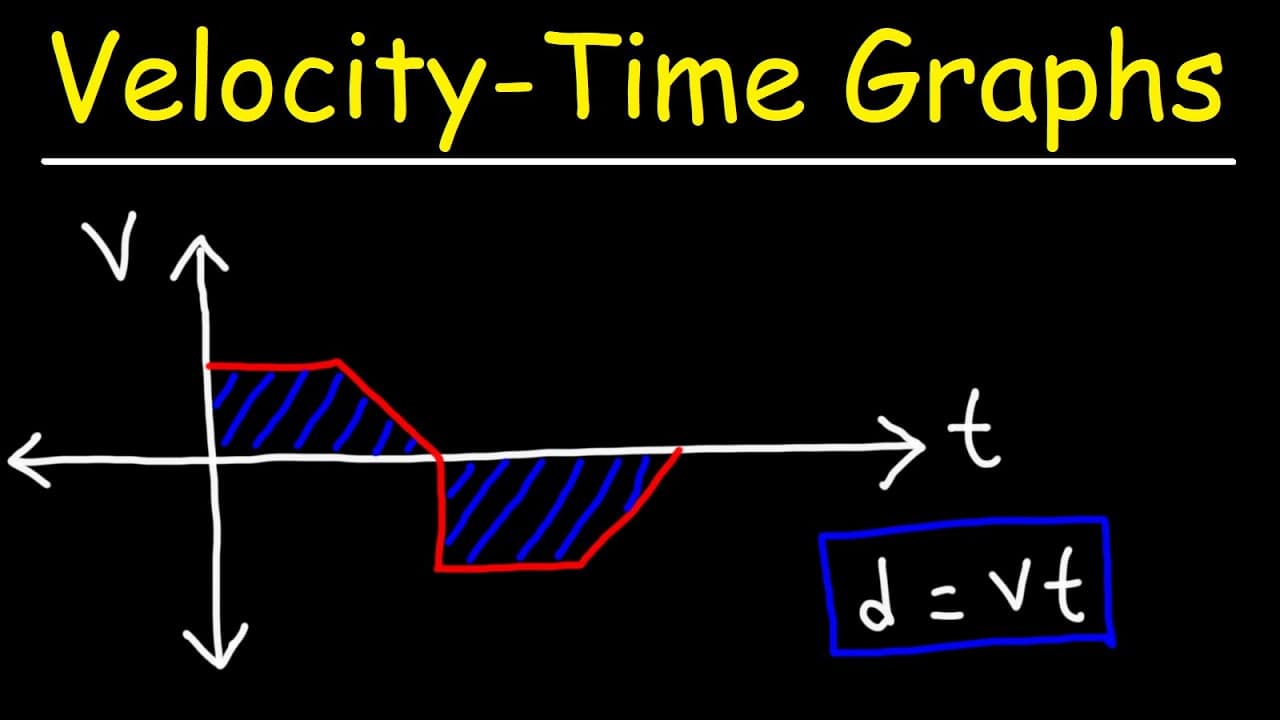
The displacement of a particle during a specific time period can be calculated by finding the area under the velocity-time graph, while the distance traveled is the sum of all positive areas.
Transcript
consider the velocity time graph of a particle shown below calculate the displacement of the particle during the first 12 seconds so how do we do that how do we find the displacement of a velocity time graph here's what you need to know the displacement or the change in position is equal to the area under the Curve let's say we have a rectangle the... Read More
Key Insights
- ⌛ Displacement during a specific time period can be calculated by finding the area under the velocity-time graph, considering rectangles and triangles.
- ❓ Displacement is a vector quantity, meaning it has magnitude and direction.
- 🍹 Distance traveled can be determined by summing all positive areas obtained from the velocity-time graph.
- ☺️ Negative areas on the velocity-time graph represent motion in the opposite direction or below the x-axis.
- ⌛ Displacement and distance calculations using velocity-time graphs are essential in physics for understanding a particle's motion.
- ⌛ The area under the curve method simplifies the calculation of displacement and distance using velocity-time graphs.
- ❓ Understanding the concept of displacement and distance is crucial for accurately analyzing the motion of particles.
Install to Summarize YouTube Videos and Get Transcripts
Explore YouTube Video Summarizer or Get YouTube Transcript Extractor
Questions & Answers
Q: How can the displacement of a particle be calculated using a velocity-time graph?
The displacement is obtained by finding the area under the curve of the velocity-time graph. By breaking the graph into rectangles and triangles and calculating their areas, the total displacement can be determined.
Q: Why is the area of rectangles and triangles on the velocity-time graph used to calculate displacement?
The area under the curve represents the change in position or displacement. By dividing the graph into simple geometric shapes, the calculation becomes easier and the total displacement can be accurately determined.
Q: Is displacement a vector quantity?
Yes, displacement is a vector quantity, meaning it has magnitude and direction. The direction can be positive or negative, depending on the direction of motion.
Q: How is the distance traveled during a specific time period calculated using a velocity-time graph?
The distance traveled is obtained by finding the total sum of all positive areas under the curve of the velocity-time graph. Any negative areas need to be converted into positive values.
Summary & Key Takeaways
-
Displacement is equal to the area under the curve of a velocity-time graph.
-
Displacement can be calculated by finding the area of rectangles and triangles formed on the graph.
-
Distance traveled is the sum of all positive areas calculated from the velocity-time graph.
Read in Other Languages (beta)
Share This Summary 📚
Summarize YouTube Videos and Get Video Transcripts with 1-Click
Try YouTube Summary with ChatGPT & Claude or YouTube Transcript Generator
Explore More Summaries from The Organic Chemistry Tutor 📚


Summarize YouTube Videos and Get Video Transcripts with 1-Click
Try YouTube Summary with ChatGPT & Claude or YouTube Transcript Generator