How to Plan for Extreme Cyberattack Scenarios
TL;DR
Cyber resilience requires increasing the mean time to failure while decreasing the mean time to recovery. Organizations can prepare by matching threat-actor motivations with assets at risk, defining catastrophic scenarios, mapping possible attack paths through fault tree analysis, and evaluating controls by type, implementation status, mitigation potential, and relative cost.
Transcript
Thank you. And, uh, good morning, everyone. You know, CIOs and CSOs often get asked, "So what keeps you up at night?" And common responses often are o-- revolve around security solutions, DLP, cloud security. And while these things are important, I'm not sure they really keep anyone up at night. If I was a CIO or a CSO, I think what would keep me u... Read More
Key Insights
- Cyber resilience is a combination of mean time to failure and mean time to recovery. Security professionals should therefore work to delay successful failures while also reducing the time required to restore systems and operations after a serious cyber incident.
- Extreme cyber scenario planning is built from threat-actor analysis and business-impact analysis. These inputs help an organization select a small set of catastrophic scenarios, analyze their attack paths, assess relevant controls, and plan how it would respond if those events occurred.
- Threat-actor motivation is a major differentiator among otherwise similar adversaries. A hacktivist group may seek to damage or embarrass a victim, while a nation-state actor may pursue technical advantage by copying valuable data or systems.
- An extreme scenario emerges when an attacker's desired outcome and operating method intersect with something the organization cares deeply about protecting. For a bank, organized crime stealing customer funds can trigger financial harm, customer impact, reputational damage, and legal or regulatory consequences.
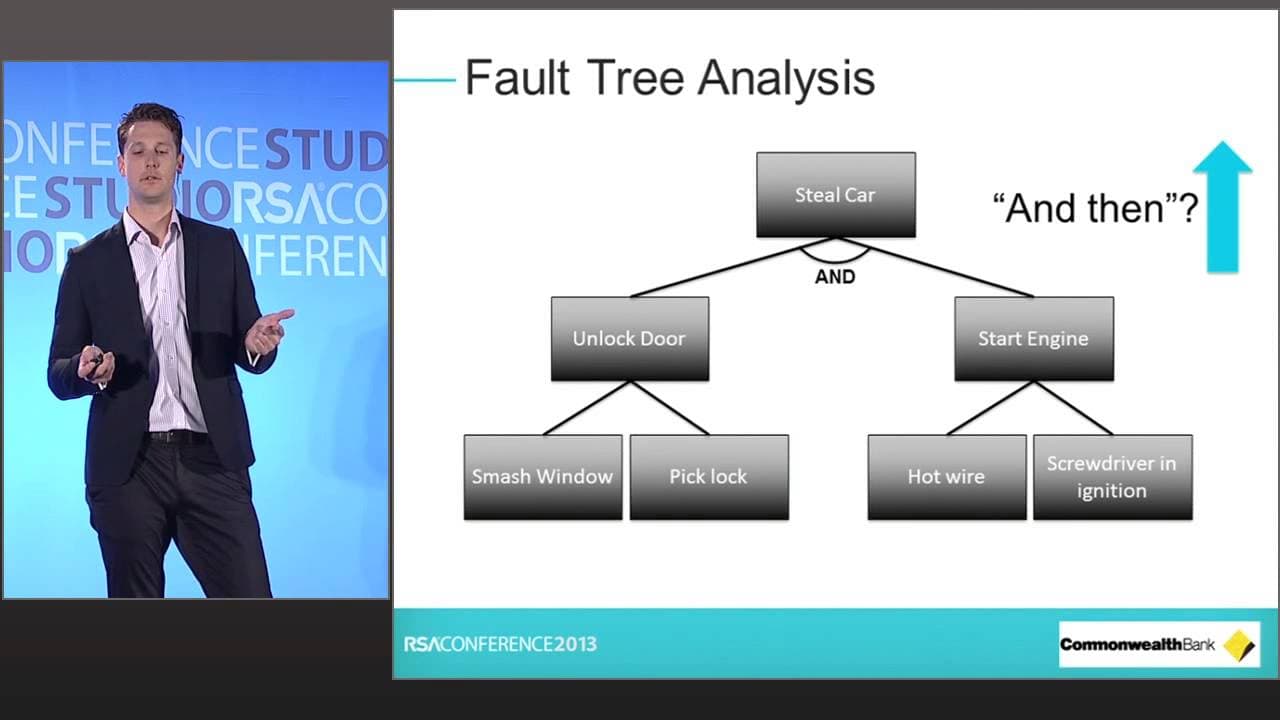
- Fault tree analysis works by breaking a harmful outcome into the events required to make it happen. Reading from the top downward answers how each event could occur, while reading from the bottom upward produces a sequential attack path.
- Control mapping makes a fault tree useful for security investment decisions. Each attack-path control can be classified as predictive, preventive, detective, or responsive, then evaluated according to implementation status, mitigation potential, and relative cost compared with other controls.
- A confidential-data exfiltration scenario can involve external reconnaissance, access to the corporate network, lateral movement, discovery and access of confidential data, and removal of that data. Each stage can be expanded into more detailed branches and control opportunities.
- Zero-day and unpatched-vulnerability branches require different control coverage. Patching, antivirus, and host intrusion prevention apply when a patch exists, while application whitelisting or operating-system exploit mitigation may cover both patched and true zero-day attack paths.
Install to Summarize YouTube Videos and Get Transcripts
Explore YouTube Video Summarizer or Get YouTube Transcript Extractor
Questions & Answers
Q: How do organizations plan for extreme cyberattack scenarios?
Organizations can begin by analyzing which threat actors pose significant risks and identifying the assets, services, or outcomes they most care about protecting. They then find intersections between attacker motivations and organizational value at risk, define the resulting catastrophic scenarios, construct fault trees for possible attack paths, assess controls against those paths, and plan responses for each event.
Q: What is cyber resilience in extreme scenario planning?
Cyber resilience is defined as a combination of mean time to failure and mean time to recovery. Because failures are considered unavoidable, resilience focuses on preventing those failures from causing complete system collapse. Security professionals support resilience by increasing the time before failure occurs and decreasing the time needed to recover systems and operations afterward.
Q: How are threat actors used to select cyber scenarios?
Threat actors are assessed through attributes that include their desired outcomes, objectives, and operating methods. Those motivations are compared with what the organization considers valuable and necessary to protect. When an actor's motivation intersects with an organizational asset at risk, the intersection identifies a potential extreme scenario that can be analyzed and prepared for.
Q: What makes a cyber scenario extreme?
A cyber scenario is extreme when its consequences could become catastrophic across important areas of the organization. The example of an organized crime group stealing customer funds creates direct financial loss and customer harm, while also potentially producing reputational, brand, legal, regulatory, and compliance effects. That broad impact makes the event suitable for extreme scenario planning.
Q: How does fault tree analysis model a cyberattack?
Fault tree analysis starts with an unwanted outcome and repeatedly asks how that outcome could happen. Each answer is decomposed into required or alternative events, producing increasingly detailed branches. Reading the completed tree from the bottom upward converts those branches into step-by-step attacker paths, which can then be matched with controls and response measures.
Q: How should security controls be evaluated in a fault tree?
Security controls can be mapped directly to the attack paths they are intended to mitigate. Each control can be classified as predictive, preventive, detective, or responsive. Its status can show whether it is absent, implemented with known gaps, or operating effectively. Analysts can also assign relative mitigation potential and cost to support remediation and investment decisions.
Q: What attack path can lead to confidential data exfiltration?
A confidential-data attack can begin with external reconnaissance, followed by access to the corporate network, lateral movement, discovery and access of confidential information, and eventual exfiltration. Initial access might result from malware installed through removable media, spear phishing, a malicious website, or a legitimate third-party website that has been infected with malware.
Q: Which controls can address both zero-day and unpatched vulnerabilities?
Controls such as patching operating systems and applications, antivirus, and host intrusion prevention are relevant when a vulnerability has an available patch that has not been applied. They do not address every true zero-day scenario. The analysis identifies application whitelisting and operating-system exploit mitigation as control options that may cover both sides of the fault tree.
Summary & Key Takeaways
-
Extreme cyber scenario planning begins by analyzing relevant threat actors and identifying what the organization truly values. When an actor's motivation intersects with an important asset, the result can define a catastrophic scenario. The Commonwealth Bank used this approach to identify seven extreme scenarios requiring detailed control and response planning.
-
Fault tree analysis decomposes a catastrophic outcome into the conditions and actions that could produce it. Reading downward answers how the outcome could occur, while reading upward reveals a step-by-step attack path. Mapping security controls to individual branches exposes missing, incomplete, or ineffective protections within the organization's defensive environment.
-
A confidential-data theft scenario can include reconnaissance, corporate-network access, lateral movement, discovery and access of confidential information, and exfiltration. Comparing alternative branches, such as patched vulnerabilities and true zero-days, helps decision-makers identify controls that address multiple paths and prioritize remediation according to coverage, effectiveness, mitigation potential, and relative cost.
Read in Other Languages (beta)
Share This Summary 📚
Summarize YouTube Videos and Get Video Transcripts with 1-Click
Try YouTube Summary with ChatGPT & Claude or YouTube Transcript Generator
Explore More Summaries from RSAC Cybersecurity 📚


Summarize YouTube Videos and Get Video Transcripts with 1-Click
Try YouTube Summary with ChatGPT & Claude or YouTube Transcript Generator