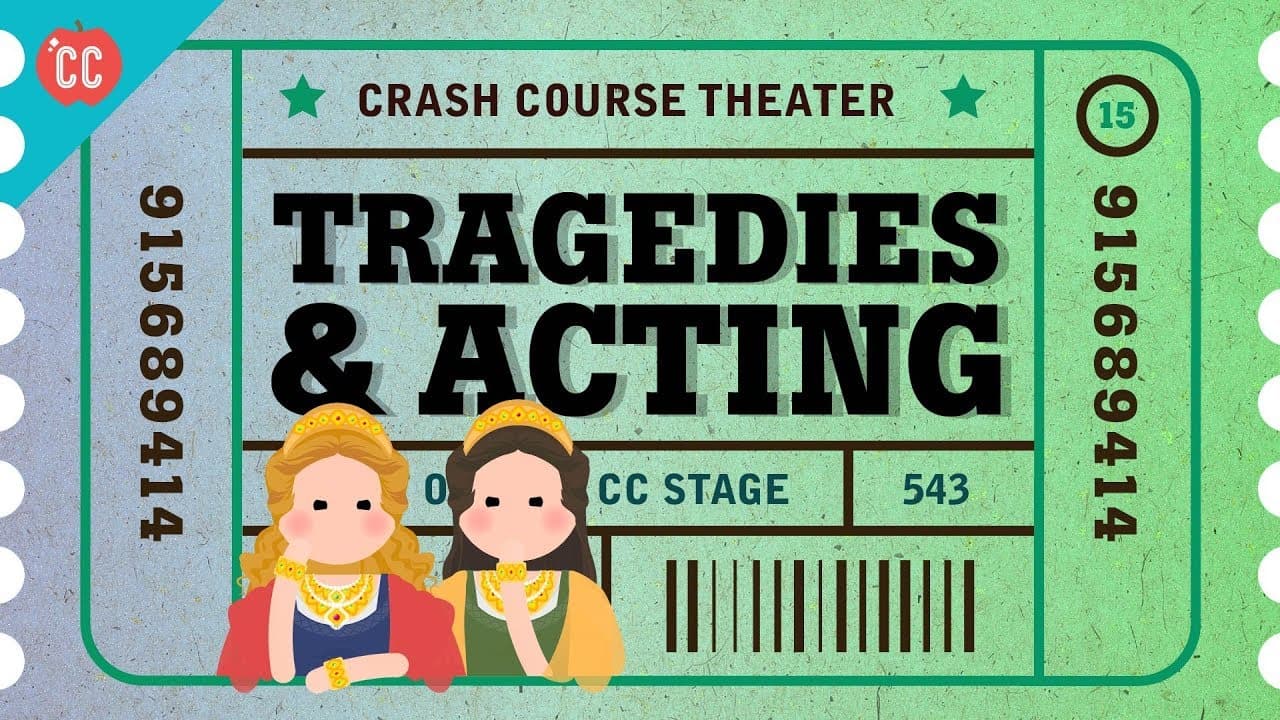
Shakespeare's Tragedies and an Acting Lesson: Crash Course Theater #15
TL;DR
Shakespearean tragedies blend humor and depth, revolutionizing the genre.
Transcript
Hey there, I’m Mike Rugnetta, this is Crash Course Theater, and today the bodies hit the floor: We’re talking about Shakespearean tragedy. Remember how the Greeks left the violence offstage? Well, Shakespeare goes another way, with poisoning, stabbing, strangling, and baking people into pies. Get in line, Sweeney Todd. There are already a couple of... Read More
Key Insights
- Shakespearean tragedy diverges from Greek norms by showcasing violence onstage, using vivid depictions of murder and chaos.
- Elizabethan actors were versatile, performing multiple roles weekly without full scripts, necessitating quick memorization and adaptability.
- Shakespeare's tragedies combine prose and verse, featuring ornate language and complex character psychology, setting them apart from contemporaries.
- Tragic heroes in Shakespeare's plays are deeply introspective, grappling with moral dilemmas and internal conflicts, unlike simpler Greek counterparts.
- Humor interspersed in tragedies, through fool characters, offers emotional relief, highlighting Shakespeare's skill in balancing moods.
- Shakespearean tragedies often explore themes of fate versus free will, individual desires clashing with societal duties, and moral consequences.
- The staging of Elizabethan drama relied heavily on costumes and minimal props, with actors projecting over noisy audiences in open-air theaters.
- King Lear exemplifies Shakespeare's tragic formula, with its complex plot, emotional depth, and exploration of human folly and redemption.
Install to Summarize YouTube Videos and Get Transcripts
Explore YouTube Video Summarizer or Get YouTube Transcript Extractor
Questions & Answers
Q: How did Shakespearean tragedies differ from Greek tragedies?
Shakespearean tragedies differ from Greek tragedies by incorporating onstage violence and humor, creating a more dynamic and engaging experience. While Greek tragedies often left violent acts offstage, Shakespeare vividly depicted them, adding an element of shock and realism. Additionally, Shakespeare's characters are more psychologically complex, exploring internal conflicts and moral dilemmas.
Q: What roles did Elizabethan actors play in Shakespearean drama?
Elizabethan actors were versatile performers, often playing multiple roles across different plays in a single week. They had to memorize lines quickly, as they were given only their parts and cues, not full scripts. Besides acting, they were expected to sing, dance, and perform stage combat, showcasing a wide range of talents essential for the varied demands of Shakespearean drama.
Q: What themes are commonly explored in Shakespearean tragedies?
Shakespearean tragedies commonly explore themes such as fate versus free will, the conflict between individual desires and societal duties, and the moral consequences of actions. These plays often feature characters struggling with internal conflicts and ethical dilemmas, highlighting the complexity of human nature and the tragic consequences of flawed decisions.
Q: How did Shakespeare incorporate humor into his tragedies?
Shakespeare incorporated humor into his tragedies by including fool characters who provided comic relief amidst the serious and often dark narratives. These characters, played by popular actors of the time, entertained audiences with witty remarks and humorous antics, offering a balance of emotions and preventing the tragedies from becoming overwhelmingly somber.
Q: What staging conventions were used in Elizabethan drama?
Elizabethan drama was performed in open-air theaters with minimal sets, relying heavily on costumes and props to convey the setting. Actors projected their voices to be heard over the noise of the audience, often performing in the afternoon to utilize natural light. The stage was typically bare, with only essential furniture like thrones or beds used for key scenes.
Q: How does King Lear exemplify Shakespearean tragedy?
King Lear exemplifies Shakespearean tragedy through its exploration of power, madness, and familial betrayal. The play's complex narrative and deep character development highlight the tragic consequences of Lear's decisions and the ensuing chaos. Shakespeare's use of language and emotional depth in portraying Lear's descent into madness showcases his innovative approach to tragedy.
Q: What innovations did Shakespeare bring to tragic heroes?
Shakespeare's tragic heroes are characterized by their psychological complexity and internal conflicts. Unlike Greek heroes, who were often straightforward in their motivations, Shakespeare's characters grapple with moral dilemmas and introspection. This innovation allows for a deeper exploration of human nature, making the characters more relatable and their downfalls more poignant.
Q: How did Shakespeare's tragedies impact the genre?
Shakespeare's tragedies revolutionized the genre by blending intense emotional depth, humor, and complex character psychology. His innovative approach to character development and narrative structure influenced subsequent playwrights, setting a new standard for tragic storytelling. The enduring popularity of his works demonstrates their profound impact on theater and literature.
Summary & Key Takeaways
-
Shakespearean tragedies broke away from Greek traditions by presenting onstage violence and integrating humor, creating a unique theatrical experience. These plays involve complex characters and intricate plots, blending action with introspection.
-
Elizabethan actors were highly skilled, performing various roles with limited rehearsal time and no full scripts, requiring them to be adaptable and quick learners. Shakespeare's plays demanded a balance of acting, singing, and sword fighting.
-
King Lear, a quintessential Shakespearean tragedy, delves into themes of power, betrayal, and madness. The play's intricate narrative and emotional depth illustrate Shakespeare's innovation in portraying human complexity and moral ambiguity.
Read in Other Languages (beta)
Share This Summary 📚
Summarize YouTube Videos and Get Video Transcripts with 1-Click
Try YouTube Summary with ChatGPT & Claude or YouTube Transcript Generator
Explore More Summaries from CrashCourse 📚


Summarize YouTube Videos and Get Video Transcripts with 1-Click
Try YouTube Summary with ChatGPT & Claude or YouTube Transcript Generator