What Is Google Jules 2.0 and How Does It Code for You?
TL;DR
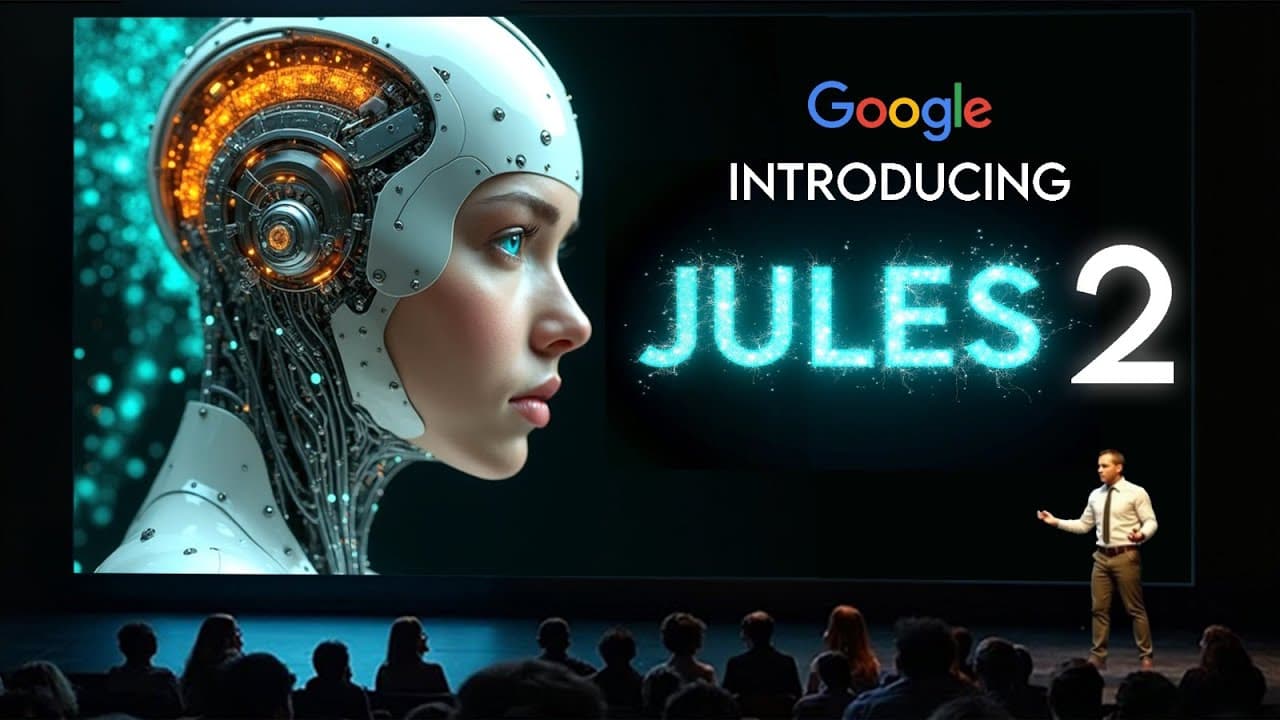
Google Jules 2.0 is an autonomous AI coding agent powered by Gemini 2.5 Pro that clones your entire codebase into a secure Google Cloud VM and handles full tasks in the background. It manages pull requests, reviews code, snapshots environments, and runs browser tests. Pricing starts bundled at $1.99 a month.
Transcript
Google has just dropped one of its most powerful AI tools yet, and it's not a demo. It's live, it's fast, and it's built to handle the kind of work most people thought only teams of humans could manage. Jules 2.0 can dive into massive projects, understand every detail, fix problems before you even spot them, plan your next moves, and keep running i... Read More
Key Insights
- Jules 2.0 is an autonomous AI coding agent that clones your entire codebase into a secure Google Cloud virtual machine, processes the full context of your project, and keeps running tasks in the background while you focus on other work.
- The critic agent is an AI powered code reviewer that uses reinforcement learning to spot bugs, inefficiencies, and edge cases in real time, flagging performance bottlenecks and logic that might break under certain conditions.
- Everything under the hood is powered by Gemini 2.5 Pro, Google's most advanced AI model, giving Jules the ability to handle complex reasoning, parse large codebases, and run multiple operations in parallel.
- Environment snapshots let you capture the exact state of your development environment, including VM configuration, dependencies, and settings, so you can freeze it in time and restore everything exactly later.
- Pull request management is built directly into the platform, so you can open, review, and merge pull requests, including merging a feature branch into main, without leaving Jules or switching between tools.
- Jules is asynchronous rather than a chat interface, so you can assign well-defined tasks like creating unit tests, adding a feature, updating dependencies, or fixing bugs, and move on while it works.
- Integrated web surfing for documentation lets Jules pull up the latest official docs, code examples, and guides when integrating an API or troubleshooting a dependency, keeping you inside the development environment.
- Jules is positioned differently from GitHub Copilot, which gives inline suggestions while you code, because Jules takes entire well-defined tasks off your plate and executes them in parallel in its own isolated VM.
Install to Summarize YouTube Videos and Get Transcripts
Explore YouTube Video Summarizer or Get YouTube Transcript Extractor
Questions & Answers
Q: What is Google Jules 2.0?
Google Jules 2.0 is an autonomous AI coding agent that works in the background to handle grunt work while you focus on the bigger picture. When given a task, it clones your entire codebase into a secure Google Cloud virtual machine, processes the full context of your project, and can keep running tasks in the background. It is designed to be both reactive and proactive, and it explains the logic behind the changes it makes.
Q: What AI model powers Jules 2.0?
Under the hood, everything is powered by Gemini 2.5 Pro, which Google calls its most advanced AI model so far. That is what gives Jules the ability to handle complex reasoning tasks, parse large codebases, and keep multiple operations running in parallel without tripping over itself. With the Ultra plan, you get priority access to the latest model version, so as Gemini keeps evolving, you stay current with it.
Q: How much does Jules 2.0 cost?
The basic option bundles Jules into a Google One plan for $1.99 a month, which gives you 100GB of cloud storage plus 15 daily tasks and three concurrent tasks. Google AI Pro at $19.99 a month offers 100 daily tasks with 15 running at once and more advanced model access. The Ultra tier at $249.99 a month provides 300 daily tasks, 60 concurrent, and top priority access to new models as they roll out.
Q: What is the critic agent in Jules 2.0?
The critic agent is an AI powered code reviewer that uses reinforcement learning to spot bugs, inefficiencies, and potential edge cases in real time. It goes beyond pointing out syntax errors by identifying performance bottlenecks, suggesting optimizations, and flagging logic that might break under certain conditions. Google compares it to having a senior developer walk through your code line by line, but delivered instantly without waiting for a human review cycle.
Q: How does Jules 2.0 handle pull requests?
Jules 2.0 lets you handle pull requests directly inside the platform, so you can open, review, and merge without leaving it. If you are in a feature branch, merging into the main branch is just a few clicks away. This removes the usual context switching between your IDE, GitHub, and internal review tools, which saves a lot of wasted motion for teams doing frequent merges.
Q: What are environment snapshots in Jules 2.0?
Environment snapshots let you capture the exact state of your development environment, including your VM configuration, dependencies, and settings, so you can freeze it in time. You can test a new library, switch to another project, then come back days or weeks later and restore everything exactly as it was. This saves the headache of recreating your setup and eliminates uncertainty about which package version you were using.
Q: How does Jules 2.0 compare to GitHub Copilot?
Jules operates in a different lane than GitHub Copilot. Copilot is great for inline suggestions while you code, whereas Jules is more about taking entire tasks off your plate and executing them in parallel. Compared to Anthropic's Claude for Code or Windsurf's editor, Google's advantage is deep integration with its own ecosystem, including Gemini, Google Cloud, and Google One, plus the ability to leverage massive infrastructure for speed and scale.
Q: Does Jules 2.0 replace a development team?
No, Google has been clear that Jules is not pretending to replace an entire dev team. It is more of an autonomous teammate that can handle specific, well-defined tasks on its own, such as creating and running unit tests, adding a feature, updating dependencies, or fixing bugs. It works asynchronously, and all code changes it proposes are presented for review, so you still get the final say before anything is merged.
Summary & Key Takeaways
-
Google Jules 2.0 is a live autonomous AI coding agent that clones your codebase into a secure Google Cloud VM, processes the full project context, and runs tasks in the background. It is both reactive and proactive, explains the logic behind its changes, and can generate spoken audio summaries of completed work.
-
New features include in-platform pull request management, environment snapshots that freeze and restore your setup, interactive real-time task planning, integrated documentation web search, Playwright browser testing with visual previews, and a reinforcement-learning critic agent that flags bugs, bottlenecks, and risky logic instantly.
-
Powered by Gemini 2.5 Pro with seamless GitHub integration, Jules presents all code changes for review before merging. Pricing runs from $1.99 a month bundled with Google One up to $249.99 a month for the Ultra tier, offering more daily and concurrent tasks.
Read in Other Languages (beta)
Share This Summary 📚
Summarize YouTube Videos and Get Video Transcripts with 1-Click
Try YouTube Summary with ChatGPT & Claude or YouTube Transcript Generator
Explore More Summaries from AI Revolution 📚




Summarize YouTube Videos and Get Video Transcripts with 1-Click
Try YouTube Summary with ChatGPT & Claude or YouTube Transcript Generator