How does knowledge representation drive AI reasoning?
TL;DR
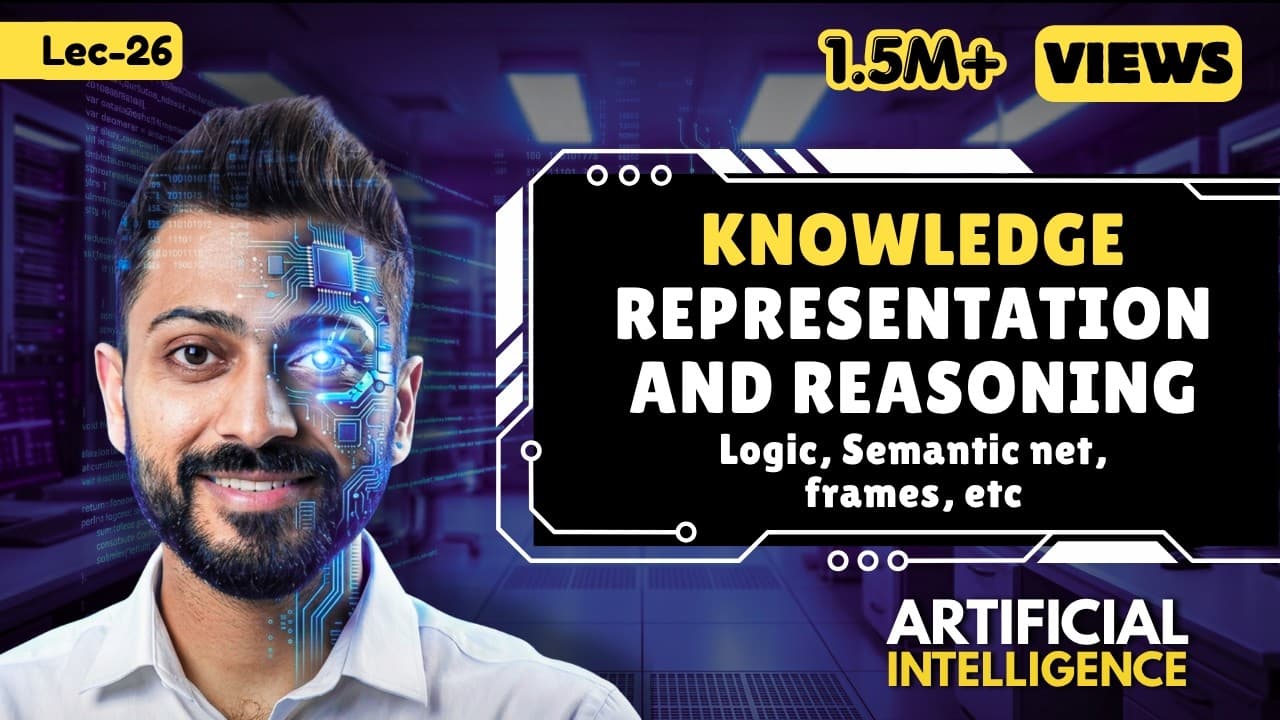
Knowledge representation is the main factor in making machines intelligent by storing knowledge in a usable form and guiding reasoning. If representation is correct, results are likely correct; if it is flawed, errors follow. Different methods like logic, semantic nets, frames, and scripts shape how machines interpret and act on knowledge.
Transcript
Hello friends! Welcome to Gate Smashers. In this video, we are going to discuss knowledge representation and reasoning. As we always say in artificial intelligence, we have to make the agents and machines intelligent. To make the machines, one of the major key factors is knowledge. How does a human being accumulate knowledge? Knowledge is facts and... Read More
Key Insights
- Knowledge representation is the main factor for proper machine reasoning and decision making.
- Wrong knowledge representation leads to incorrect machine interpretation and results, due to syntax or semantic errors.
- Syntax errors are grammatical mistakes, while semantic errors relate to the meaning of statements and their implications.
- Semantic nets are a method to represent meaning through interconnected graphs of concepts and relationships.
- Frames use slots and fillers to define objects and attributes, offering a structured data representation.
- Scripts extend frames by providing a more complete and executable sequence of events and roles, enabling better decision making.
- Logic, including propositional and predicate logic, is a foundational method for encoding rules and conditions in AI systems.
- Machines rely on the representation chosen by programmers, since they do not learn or experience on their own.
Install to Summarize YouTube Videos and Get Transcripts
Explore YouTube Video Summarizer or Get YouTube Transcript Extractor
Questions & Answers
Q: A real search query question about the video (e.g. 'How to...', 'What is...'). Question 1
What is knowledge representation and why is it crucial for AI reasoning, according to the video? Knowledge representation is defined as the method of storing knowledge so machines can understand and use it at the right time. It underpins intelligent behavior because decisions and inferences are drawn from how information is organized. Poor representation leads to misinterpretation and incorrect actions, making it essential to minimize ambiguities and errors.
Q: Question 2
How do syntax and semantic errors differ in knowledge representations, and what impact do they have on machine behavior? Syntax errors are grammatical mistakes that prevent correct interpretation, such as incorrect verb forms. Semantic errors concern the meaning of statements, leading to actions based on incorrect or nonsensical interpretations. Both types of errors can cause machines to act wrongly if not addressed during design.
Q: Question 3
What are the main methods used to represent knowledge in AI as described in the video? The video mentions logic (propositional and predicate logic), semantic nets, frames, and scripts. Logic provides rules and true/false conditions, semantic nets form meaningful graphs of relationships, frames organize data with slots and fillers, and scripts capture extended sequences of events for decision making.
Q: Question 4
How does a semantic net function in AI systems, and what is an example given? A semantic net is a graph that encodes meaning by connecting objects with relationships. The video uses a simple cow example, where attributes like four legs and a tail might be linked to the concept of cow. This structure supports inference and knowledge retrieval for AI systems.
Q: Question 5
What is the difference between a frame and a script in knowledge representation, as explained in the video? Frames provide a basic, slot-based structure for objects and their attributes, similar to a template. Scripts extend frames by representing more complex sequences of actions, roles, and context like a movie, enabling a machine to understand and predict outcomes more comprehensively.
Q: Question 6
Why is knowledge representation described as the main point in making intelligent machines, and what are the consequences of focusing on the root level only? The main point is that how knowledge is represented determines how machines use it to reason and act. If the representation is correct, the machine can infer valid conclusions; if not, it may produce incorrect results regardless of other capabilities.
Q: Question 7
What role does logic play in knowledge representation and how is it categorized? Logic is the basic fundamental method used to reason about facts and rules, including propositional logic for true/false statements and predicate logic with quantifiers like for all or exists. These forms guide how machines apply rules to derive conclusions from stored knowledge.
Q: Question 8
How do models like semantic nets and frames complement each other in a knowledge base, according to the video? Semantic nets provide a meaningful structure of relationships across a graph, while frames organize data with concrete attributes via slots and fillers. Together, they offer layered representations where nets capture meaning and frames provide precise attributes, enabling robust inference and decision making.
Summary & Key Takeaways
-
Knowledge representation is the central factor enabling machines to understand and use stored knowledge for timely decisions, impacting overall intelligence.
-
Different representation methods provide varying structures for storing facts and rules, which in turn affect how machines infer new conclusions.
-
Avoiding syntax and semantic errors, and reducing ambiguities, is essential to ensure machines interpret information correctly and act as intended.
Read in Other Languages (beta)
Share This Summary 📚
Summarize YouTube Videos and Get Video Transcripts with 1-Click
Try YouTube Summary with ChatGPT & Claude or YouTube Transcript Generator
Explore More Summaries from Gate Smashers 📚



Summarize YouTube Videos and Get Video Transcripts with 1-Click
Try YouTube Summary with ChatGPT & Claude or YouTube Transcript Generator