How Does Data Travel Securely Through IoT?
TL;DR
IoT data must be protected for integrity as well as privacy throughout its journey from creation and capture to transmission, aggregation, analysis, and storage. Secure communication channels alone are insufficient because manipulated sensor data can mislead connected systems and trigger dangerous physical actions, particularly when devices include actuators such as vehicle steering or acceleration controls.
Transcript
Hey guys. Thank you very much. I'm Greg Hoffer, VP of engineering at GlobalSCAP. First and foremost, you have my permission to record if you want. I honestly don't think I'm that interesting, but if you're like my kids, you record everything and post it on YouTube and try to make millions of dollars. So have at it. Um, thank you for taking the next... Read More
Key Insights
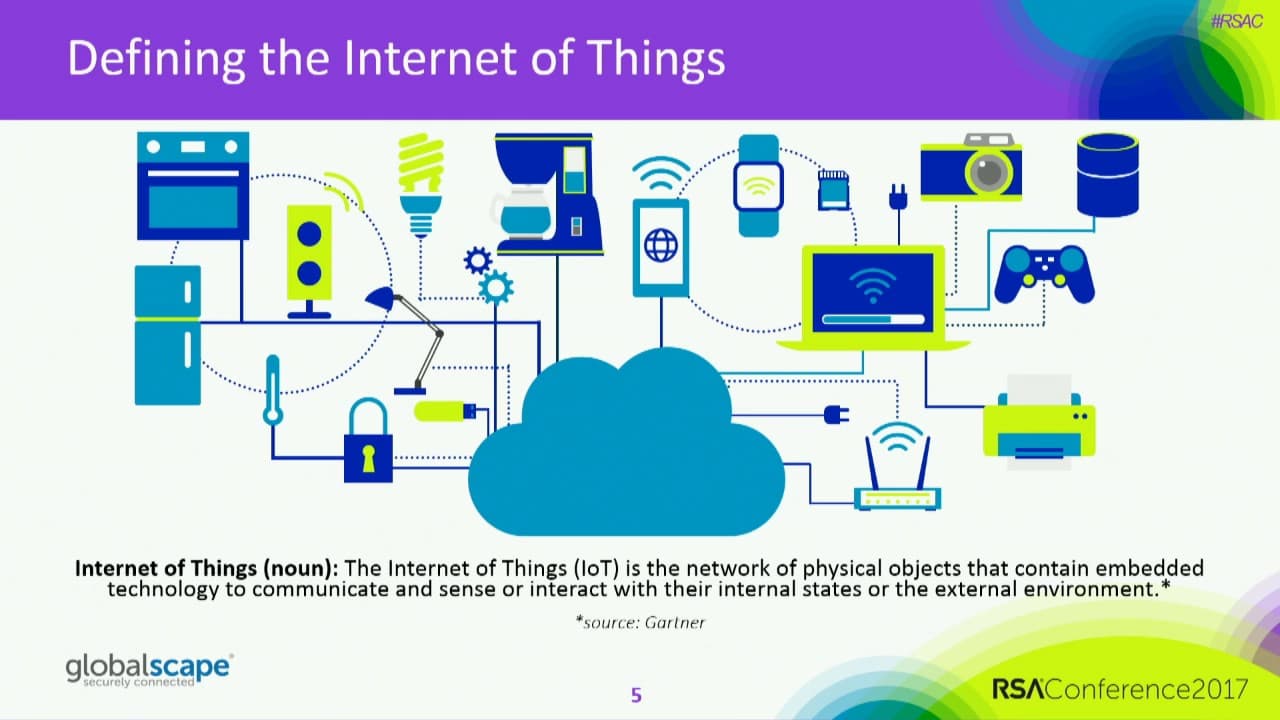
- IoT is a network of physical objects containing embedded technology that can communicate with internal states or external environments, sense conditions, and sometimes interact with the physical world. Its defining components generally include computational power, sensors, radio signaling, and optional actuators.
- IoT connectivity is broader than direct internet or Wi-Fi access. Devices may send information indirectly through Bluetooth-connected smartphones, cellular networks, Zigbee, or other radio signaling protocols before their data reaches an internet service, vendor, or cloud environment.
- IoT data is important because it is generated for people, generated by them, and capable of affecting them. Its security requirements extend beyond keeping private information confidential to preserving integrity and preventing altered or malicious information from being used against people.
- Weaponized sensor data can cause physical harm without directly taking control of an actuator. Malicious information injected into a vehicle's sensor system could falsely indicate an impending collision and influence an avoidance system to steer toward a supposedly clear but dangerous direction.
- IoT encompasses consumer, civic, agricultural, and industrial systems. Examples include smart refrigerators, thermostats, cameras, watches, streetlights, gunfire locators, irrigation systems, drones, smartphones, autonomous vehicles, and drill bits that repeatedly measure velocity, rotation, pressure, gas flow, and water flow.
- The volume of generated data grows alongside the number of connected devices and the speed of global connectivity. The presentation cites an older estimate of 2.5 quintillion bytes created daily and notes that an autonomous vehicle can generate 4,000 gigabytes in one day.
- IoT data commonly includes location awareness, payment information, behavioral records, walking and driving routes, transportation activity, purchases, and the credit cards used. These details make connected-device data significant to both individual consumers and the businesses responsible for processing it.
- The IoT data lifecycle extends from creation and capture through transmission, aggregation, analysis, and storage. Protecting only the device or its SSL communication channel leaves unanswered questions about how information is governed, processed, preserved, and secured throughout the rest of that journey.
Install to Summarize YouTube Videos and Get Transcripts
Explore YouTube Video Summarizer or Get YouTube Transcript Extractor
Questions & Answers
Q: What is the Internet of Things?
The Internet of Things is a network of physical objects containing embedded technology that communicates with internal states or the external environment. In general, an IoT object combines computational power with a sensor that gathers data and radio signaling that sends it elsewhere. Some objects also contain actuators that change physical conditions, such as lighting, temperature, steering, or acceleration.
Q: How does data travel through an IoT system?
IoT data begins at a connected device, where sensors create and capture information. It may travel directly to an internet service or indirectly through an intermediary such as a Bluetooth-connected smartphone using cellular connectivity. Web services, microservices, containers, and cloud infrastructure can then receive, aggregate, analyze, store, and return information to the device or another connected component.
Q: Why is data integrity important in IoT security?
Data integrity is important because connected systems may make decisions and physical changes based on the information they receive. If an attacker alters sensor readings, a system can respond correctly to false input and still produce a dangerous result. The presentation illustrates this with a vehicle avoidance system that could steer incorrectly after receiving a malicious collision warning and false environmental data.
Q: What kinds of information do IoT devices collect?
IoT devices can collect location information, payment details, behavioral records, walking routes, driving routes, transportation activity, purchases, and the credit cards used for transactions. Industrial devices may also record velocity, rotation, gas flow, water flow, and pressure many times per second. The exact information depends on the device, its sensors, and the service it supports.
Q: Why is encrypted communication insufficient for IoT security?
Encrypted communication, including SSL, can secure a channel between a device and its supporting service, but the data still passes through a broader lifecycle. Information is created, captured, transmitted, aggregated, analyzed, and stored. Security therefore must address privacy and integrity at every stage, including the possibility that malicious information enters the system before protected transmission or affects later processing.
Q: What devices and systems can qualify as IoT?
IoT includes familiar consumer products such as smart refrigerators, thermostats, IP cameras, smartwatches, smartphones, drones, and connected lighting. It also includes less obvious civic, agricultural, and industrial systems, such as smart streetlights, gunfire locators, irrigation controls, hydraulic-fracturing equipment, and instrumented drill bits. Direct internet access is not required because devices can communicate through intermediary networks.
Q: How can manipulated IoT data affect physical devices?
Manipulated data can cause a connected system to activate its physical controls based on false conditions. In the vehicle example, malicious sensor input could report an imminent collision while indicating that the left side is clear. The avoidance system might then turn left into oncoming traffic, even though its actuator and decision logic operate exactly as designed.
Q: What steps should organizations consider when protecting IoT data?
Organizations should examine the complete data journey rather than focusing only on endpoint protection or encrypted transmission. The relevant stages include creation, capture, transmission, aggregation, analysis, and storage. At each stage, they should consider privacy, integrity, governance, compliance, and security, while recognizing that inaccurate or malicious data can be as consequential as unauthorized access to the device itself.
Summary & Key Takeaways
-
IoT includes physical objects with computational power, sensors, radio communication, and sometimes actuators that affect their surroundings. The category extends beyond familiar devices such as smartwatches, thermostats, cameras, and refrigerators to streetlights, gunfire locators, irrigation systems, industrial drill bits, drones, smartphones, and autonomous vehicles.
-
Connected things generate large quantities of sensitive data, including locations, payments, behaviors, movements, purchases, and device measurements. Faster connectivity, expanding device adoption, and people creating digital footprints at younger ages accelerate this growth. The resulting security challenge concerns what data reveals and whether its contents remain accurate and trustworthy.
-
The data journey covers creation, capture, transmission, aggregation, analysis, and storage, often involving devices, intermediary smartphones, web services, microservices, containers, and cloud infrastructure. Encryption protects communication channels, but organizations must also manage risks affecting data privacy, integrity, governance, compliance, and security across the complete lifecycle.
Read in Other Languages (beta)
Share This Summary 📚
Summarize YouTube Videos and Get Video Transcripts with 1-Click
Try YouTube Summary with ChatGPT & Claude or YouTube Transcript Generator
Explore More Summaries from RSAC Cybersecurity 📚





Summarize YouTube Videos and Get Video Transcripts with 1-Click
Try YouTube Summary with ChatGPT & Claude or YouTube Transcript Generator