How does Google's CARBON coding AI compare to Argon
TL;DR
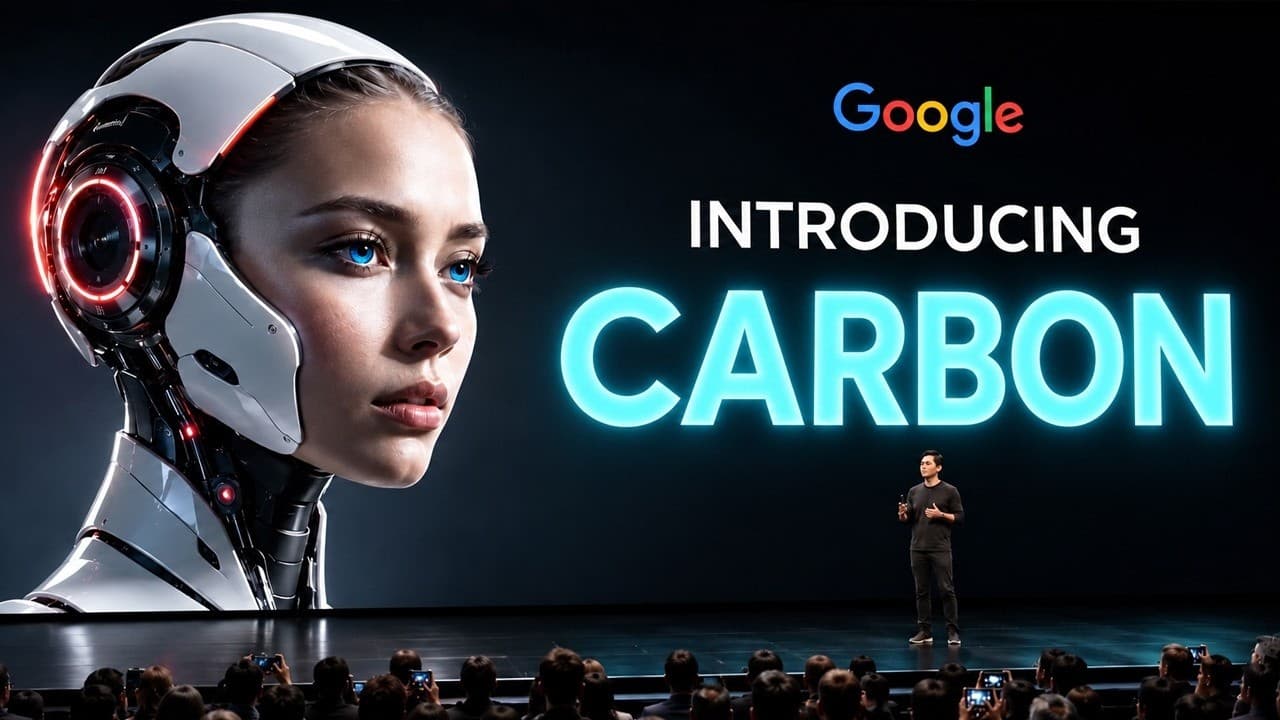
CARBON is a secret Google model that testers say codes like Claude Opus 5.5, potentially outperforming Gemini 4 Argon in coding tasks. The story notes RSI chatter, internal checkpoints, and questions about how quickly it could roll out publicly. Microsoft meanwhile launches a speed oriented decision model called Decision-1.
Transcript
Google has a secret AI model called carbon running inside the company right now and the engineers testing it say it codes like claude opus 5.5. Gemini 4 argon the flagship Google announced less than 2 weeks ago [music] hasn't even reached regular users yet and it has already been outclassed by something sitting on Google's own servers. And if the l... Read More
Key Insights
- CARBON is described as a secret Google model tested inside Jet and linked to antigravity, the in house coding tool.
- CARBON reportedly matches Claude Opus 5.5 in coding capability, according to Google staff and Business Insider reports.
- Argon is part of Gemini 4 family and has internal names like barium, with external rollout still delayed and varied by context options.
- Checkpoints like Carbon are saved model states during training, raising questions about whether Carbon becomes a separate update or a new Argon release.
- RSI or recursive self improvement is discussed as a potential reason Carbon improved, though not officially confirmed by Business Insider.
- Google’s Argon launch faces skepticism due to public access delays and the gap between benchmarks and real use, prompting internal and external scrutiny.
- Microsoft announces Decision-1, a small model designed to make fast, structured decisions in tests and real use cases.
- Decision-1 demonstrates high accuracy, speed, and robustness across multiple tests, highlighting a shift toward decision models in AI tooling.
Install to Summarize YouTube Videos and Get Transcripts
Explore YouTube Video Summarizer or Get YouTube Transcript Extractor
Questions & Answers
Q: How does CARBON compare to Claude Opus 5.5 in coding ability?
CARBON is described by internal Google testers as coding at a level comparable to Claude Opus 5.5, suggesting a significant upgrade in coding capability relative to earlier models. The reported similarity to Opus 5.5 indicates a potential leap in autonomous coding performance, though Business Insider notes that RSI claims are based on leaks rather than official confirmation.
Q: What is the relationship between Argon and CARBON in Google's Gemini 4 family?
Argon is the public facing Gemini 4 model, while CARBON is a checkpoint or hidden version that testers say is catching up to or surpassing Argon in certain tasks. Internal documents show a naming mismatch where a model labeled barium externally becomes Argon, suggesting CARBON sits within the same Gemini 4 family but may be a separate checkpoint or update.
Q: What role does RSI play in CARBON’s progress according to the leaks?
RSI, or recursive self improvement, is cited as a potential driver behind CARBON’s rapid upgrade by allowing the AI to improve its own code and solutions. The idea is that each cycle yields a smarter, faster model, which would accelerate progress, though the Business Insider report itself does not confirm RSI.
Q: What is Antigravity and how is it related to CARBON and Argon?
Antigravity is described as Google's internal coding platform, tied to the agentic coding tool used for testing models like Argon and CARBON. It provides a context for testing and deploying models within Google, including context options and governance around model usage, indicating where CARBON and Argon are evaluated.
Q: What are the context size options mentioned for Argon, and why do they matter?
The internal testing mentions context sizes of 256,000 tokens, 512,000 tokens, and 900,000 tokens. Higher context sizes allow the model to consider more information at once, which can affect reasoning, task handling, and performance, especially for long or complex coding tasks.
Q: What has been the public reception to Argon’s rollout according to the transcript?
Public rollout has been slow and delayed, with early access limited to partners and a broader consumer release still not available in regular user environments. This has led to criticism that Google is showcasing a PPT release, meaning claims exist on slides but practical access is limited.
Q: How does Microsoft’s Decision-1 differ from GPT-6 Sol in function and speed?
Decision-1 is a specialized decision model focused on producing structured outputs and actionable results, such as routing and verification, rather than traditional text generation. In testing, it is reported to be significantly faster than GPT-6 Sol, handling certain tasks up to 35 times quicker, which has implications for real time decision making in agents.
Q: What benchmarks and outcomes are cited to support Decision-1’s performance?
Decision-1 reportedly achieved the highest accuracy across 36 benchmarks and nearly 150,000 questions, with high speed demonstrated on simple demos like sorting queries and assisting with computer use. It also showed stability under paraphrasing and safe content handling, making it a strong contender for production use.
Summary & Key Takeaways
-
CARBON is a checkpoint inside Google described as matching or surpassing Opus 5.5 in coding, according to internal testers.
-
Argon is Google’s public Gemini 4 model, with upcoming updates and context options that may be eclipsed by CARBON in capabilities.
-
Microsoft releases Decision-1, a small model focused on decision making to speed up agent actions and improve routing and safety.
Read in Other Languages (beta)
Share This Summary 📚
Summarize YouTube Videos and Get Video Transcripts with 1-Click
Try YouTube Summary with ChatGPT & Claude or YouTube Transcript Generator
Explore More Summaries from AI Revolution 📚
Summarize YouTube Videos and Get Video Transcripts with 1-Click
Try YouTube Summary with ChatGPT & Claude or YouTube Transcript Generator