How to Build Codex Skills That Beat 99 Percent
TL;DR
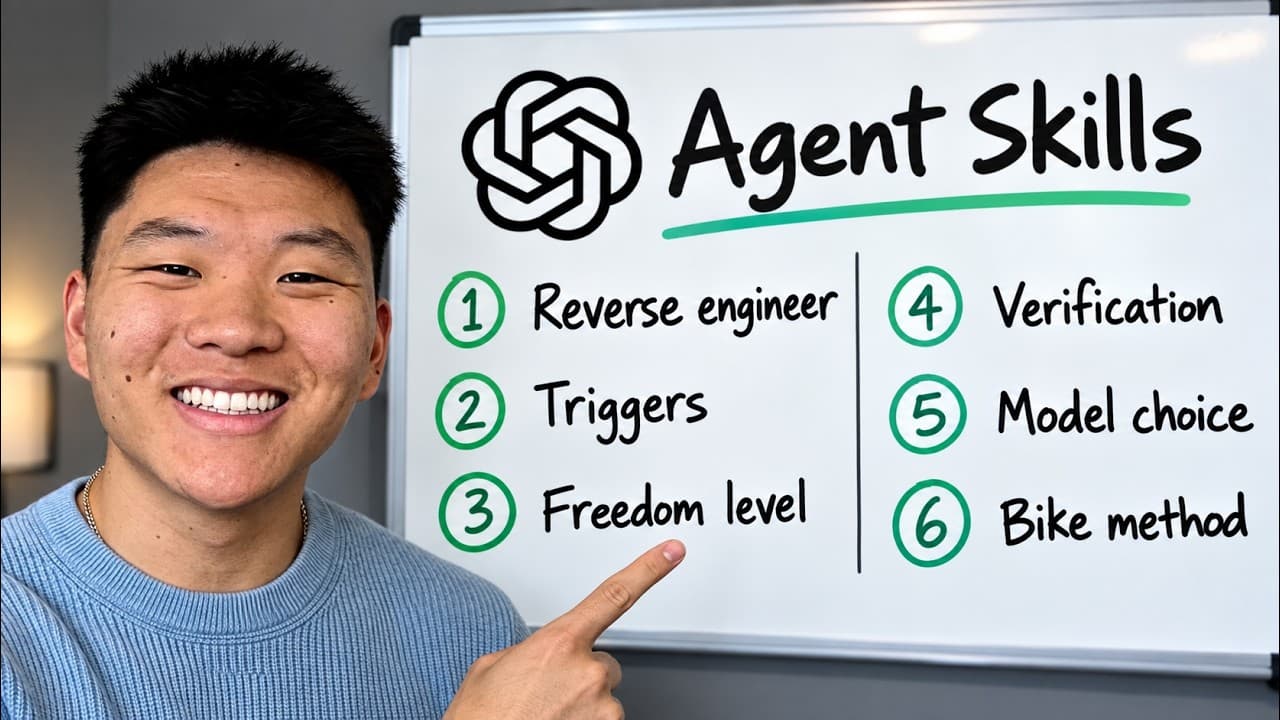
The method hinges on a six step framework that turns processes into single purpose skills. Start by reverse engineering the output, then assign one job and one trigger per skill, choose a suitable freedom level, build verification loops, test cheaper models, and improve the skill after every run. This yields consistent, repeatable agent behavior.
Transcript
Today, I've got this proven six-step process for building codec skills better than 99% of people. So, let's not waste any time and just get straight into this one. All right, so these are the six steps that I'm going to go over. I'm going to explain each of these and tell you why they're so important and then we're going to get into Codex and actua... Read More
Key Insights
- The key to building reliable skills is reverse engineering the output first.
- Each skill should have a single clearly defined job for consistency.
- Every skill needs one explicit trigger to minimize ambiguity.
- Freedom level choice determines how deterministic or flexible the skill is.
- Verification loops catch errors before they propagate.
- Testing cheaper models can reveal cost effective performance gains.
- Continuous improvement happens after every run and is essential for mastery.
- Skills should be modular and can be chained to build complex workflows.
Install to Summarize YouTube Videos and Get Transcripts
Explore YouTube Video Summarizer or Get YouTube Transcript Extractor
Questions & Answers
Q: What is a Codex skill and why is it important to define the output first
A Codex skill is a reusable, task focused instruction that lets an agent repeat a process exactly as defined. Defining the output first creates a north star for the skill, reducing misinterpretation and ensuring the agent produces the desired result every time. This approach also enables easier debugging and improvement over time by anchoring to a concrete end state.
Q: Why should a skill have one job and one trigger
Having one job and one trigger keeps each skill simple and predictable. It makes it easier to automate, to test, and to reuse in different scenarios. When a skill is tightly scoped, you can ensure the agent executes it consistently, reduces errors, and can be invoked automatically without needing to manage a complex multi step prompt.
Q: How do you decide the right freedom level for a skill
The right freedom level depends on how deterministic the task is. If the task is data processing, a deterministic approach with strict steps is best. If the task requires judgment, like writing an X article, a higher freedom level allows the model to adapt to different inputs while staying aligned with the definition of done.
Q: What are verification loops and why are they important
Verification loops are checks that confirm the output matches the defined criteria before proceeding. They catch errors early, prevent cascading mistakes, and provide feedback for improvement. They are essential for maintaining quality as you scale, especially when using AI that can interpret inputs in unexpected ways.
Q: Why test cheaper models in this framework
Testing cheaper models helps identify cost effective configurations that still meet quality standards. By comparing performance across models, you can find the most efficient balance of cost and accuracy. This ensures projects stay within budget while delivering reliable results and faster iteration cycles.
Q: What does it mean to build each skill as a small leaf in a larger tree
Treating each skill as a leaf means breaking down complex processes into simple, composable units. Each leaf performs a discrete task, making it easy to combine skills into larger workflows. This modularity enhances reusability, reduces risk, and enables gradual improvement through targeted refinements.
Q: How does one iteration improve a Codex skill
Iteration improves a Codex skill by refining the output definition, adjusting triggers, and updating verification checks after each run. By analyzing results across models and inputs, you identify gaps, optimize prompts, and tighten the process. Repeated iteration builds robustness and expands the skill library over time.
Q: What is the practical takeaway from applying all six steps in the video
The practical takeaway is that turning complex workflows into modular, well defined skills enables repeatable automation. Start with the end goal, separate tasks into single purpose skills with clear triggers, assess the appropriate level of autonomy, verify outputs, test cost effective models, and iterate based on results to improve performance over time.
Summary & Key Takeaways
-
In this video a six step framework is introduced to reverse engineer outputs and create focused skills. The approach emphasizes starting from the desired end result, breaking tasks into discrete skills and defining precise triggers. The process also covers model selection, verification, and incremental improvement with each iteration.
-
A practical demonstration shows applying the framework to an X Article skill across multiple models, comparing results, and learning what works best. The speaker stresses iteration and testing cheaper models to optimize performance.
-
The content closes with applying all six steps to real tasks and reflecting on the outcomes for continuous improvement and better agent automation across projects.
Read in Other Languages (beta)
Share This Summary 📚
Summarize YouTube Videos and Get Video Transcripts with 1-Click
Try YouTube Summary with ChatGPT & Claude or YouTube Transcript Generator
Explore More Summaries from Nate Herk | AI Automation 📚






Summarize YouTube Videos and Get Video Transcripts with 1-Click
Try YouTube Summary with ChatGPT & Claude or YouTube Transcript Generator