How Nuclear Powered Planes Were Developed
TL;DR
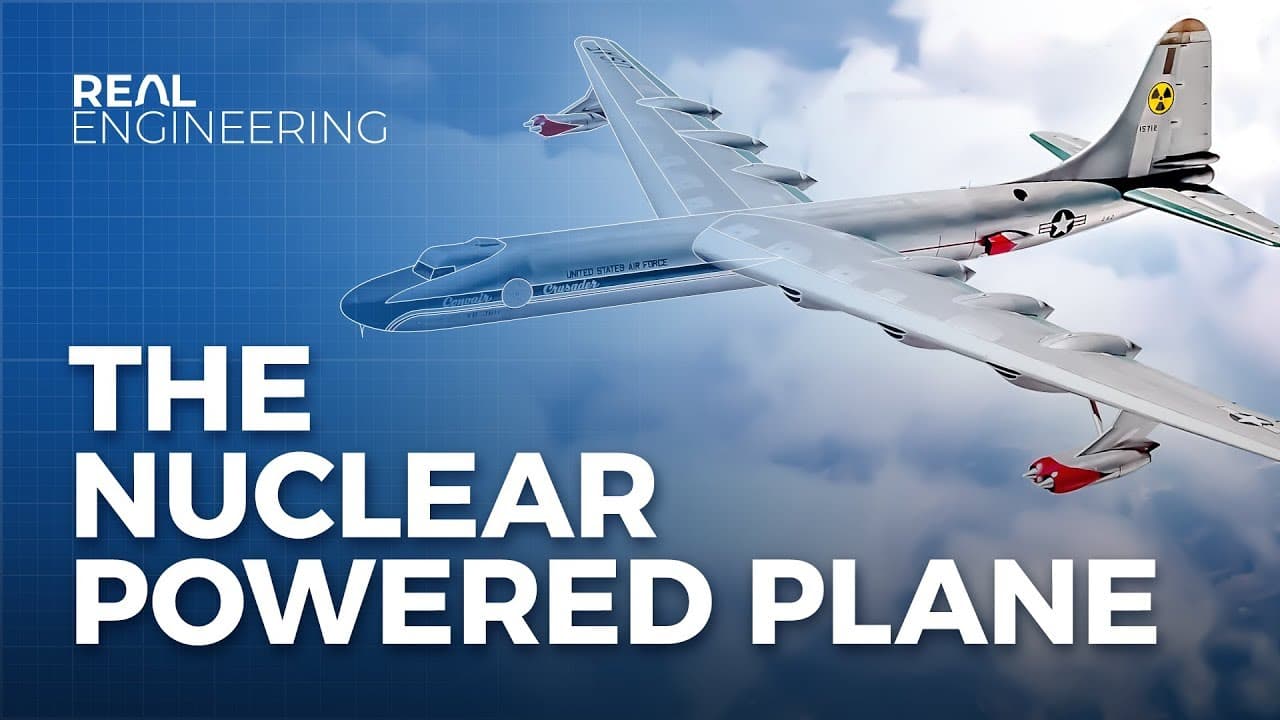
During the Cold War, the U.S. explored nuclear-powered planes to achieve long-range flight without refueling. Despite successful tests, issues like radioactive exhaust and reactor weight hindered progress. Technological advances like aerial refueling and ICBMs made the concept obsolete, leading to its cancellation in 1961.
Transcript
This episode of Real Engineering is brought to you by CuriosityStream, watch over 2,400 documentaries for free for 31 days at curiositystream.com/realengineering. Some crazy things happened during the Cold War. Dogs were put into orbit, bears were fired out of supersonic jets, and humans landed on the moon. Needless to say, humans were going throug... Read More
Key Insights
- Nuclear energy was considered for aviation to enable long-range flights without refueling.
- The HTRE-3 engine was developed to convert nuclear fission heat into thrust.
- Direct cycle systems contaminated air with radioactivity, posing significant safety challenges.
- Molten salt reactors were explored to reduce radioactive exhaust but had efficiency drawbacks.
- The NB-36H Crusader tested shielding methods for nuclear reactors on planes.
- Shadow shielding was used to protect crew and instruments from radiation.
- Technological advances like aerial refueling and ICBMs rendered nuclear planes unnecessary.
- The program was canceled in 1961 due to safety concerns and technological redundancy.
Install to Summarize YouTube Videos and Get Transcripts
Explore YouTube Video Summarizer or Get YouTube Transcript Extractor
Questions & Answers
Q: How did the U.S. plan to use nuclear power in aviation?
The U.S. aimed to use nuclear power in aviation to enable long-range flights without the need for refueling. The concept involved using nuclear reactors to generate heat through fission, which would then be converted into thrust for aircraft propulsion. This approach was explored to enhance military capabilities during the Cold War.
Q: What were the main challenges of nuclear-powered planes?
The main challenges of nuclear-powered planes included managing radioactive exhaust, overcoming the heavy weight of reactors, and ensuring adequate shielding for crew safety. Direct cycle systems contaminated the air, while the reactor's weight made it difficult to achieve sufficient thrust. These issues, combined with technological advancements, led to the program's cancellation.
Q: What was the HTRE-3 engine, and how did it work?
The HTRE-3 engine was a nuclear-powered engine developed to convert nuclear fission heat into thrust. It used a direct cycle system where air was ducted through the reactor core, heated, and then expanded to provide propulsion. Despite successful tests, the engine's radioactive exhaust and weight posed significant challenges for practical application in aviation.
Q: Why was the NB-36H Crusader significant in nuclear aviation research?
The NB-36H Crusader was significant because it tested shielding methods for nuclear reactors on aircraft. It featured shadow shielding to protect the crew and instruments from radiation, using water tanks and lead shields. Although the reactor provided no power to the engines, the Crusader's flights demonstrated the feasibility of reactor shielding in aviation.
Q: What role did molten salt reactors play in the nuclear plane project?
Molten salt reactors were explored as a solution to reduce radioactive exhaust in nuclear-powered planes. They used a closed cycle system with molten uranium tetrafluoride salt as fuel and a secondary loop for cooling. While this approach decreased exhaust radioactivity, it required complex plumbing and had lower efficiency, ultimately not tested with jet engines.
Q: How did technological advancements affect the nuclear plane program?
Technological advancements, such as aerial refueling and intercontinental ballistic missiles (ICBMs), made the concept of nuclear-powered planes redundant. These technologies provided alternative solutions for long-range flight and military capabilities, reducing the need for nuclear aviation. Consequently, the program was deemed unnecessary and canceled in 1961.
Q: What was the outcome of the nuclear-powered plane program?
The nuclear-powered plane program was ultimately canceled in 1961 due to safety concerns and technological redundancy. Despite successful tests of engines like the HTRE-3 and aircraft like the NB-36H Crusader, challenges like radioactive exhaust and reactor weight persisted. Advances in aerial refueling and ICBMs rendered the concept obsolete, leading to its termination.
Q: Why was the idea of nuclear-powered planes considered insane?
The idea of nuclear-powered planes was considered insane due to the inherent risks of combining nuclear reactors with aviation. The potential for radioactive contamination, the heavy weight of reactors, and the complexity of shielding posed significant safety challenges. Additionally, the concept became redundant with advancements in aerial refueling and ICBMs, leading to its eventual cancellation.
Summary & Key Takeaways
-
During the Cold War, the U.S. investigated nuclear-powered planes to extend flight range without refueling. The HTRE-3 engine converted nuclear fission heat into thrust, but radioactive exhaust and reactor weight were major issues. Technological advances like aerial refueling and ICBMs eventually made the concept unnecessary, leading to its cancellation in 1961.
-
The development of nuclear-powered aircraft involved testing engines like the HTRE-3, which used nuclear fission heat for propulsion. Safety concerns, such as radioactive exhaust and the reactor's weight, posed significant challenges. As aerial refueling and ICBMs advanced, the need for nuclear-powered planes diminished, resulting in the program's cancellation.
-
Nuclear-powered planes were explored during the Cold War to eliminate refueling needs for long-range flights. The HTRE-3 engine and NB-36H Crusader tested propulsion and shielding methods. However, radioactive exhaust and heavy reactors were problematic. With advancements in aerial refueling and ICBMs, the project was deemed redundant and canceled in 1961.
Read in Other Languages (beta)
Share This Summary 📚
Summarize YouTube Videos and Get Video Transcripts with 1-Click
Try YouTube Summary with ChatGPT & Claude or YouTube Transcript Generator
Explore More Summaries from Real Engineering 📚





Summarize YouTube Videos and Get Video Transcripts with 1-Click
Try YouTube Summary with ChatGPT & Claude or YouTube Transcript Generator