How to Make Social Media Algorithms Promote You
TL;DR
Help the algorithm identify your ideal audience, then publish content that those viewers will watch and engage with. For authority-driven conversion, define the target buyer precisely, apply strict topic filters, combine broad and narrow ideas, use credible visual signals, maintain strong production quality, and present information one sophistication level above the buyer’s current knowledge.
Transcript
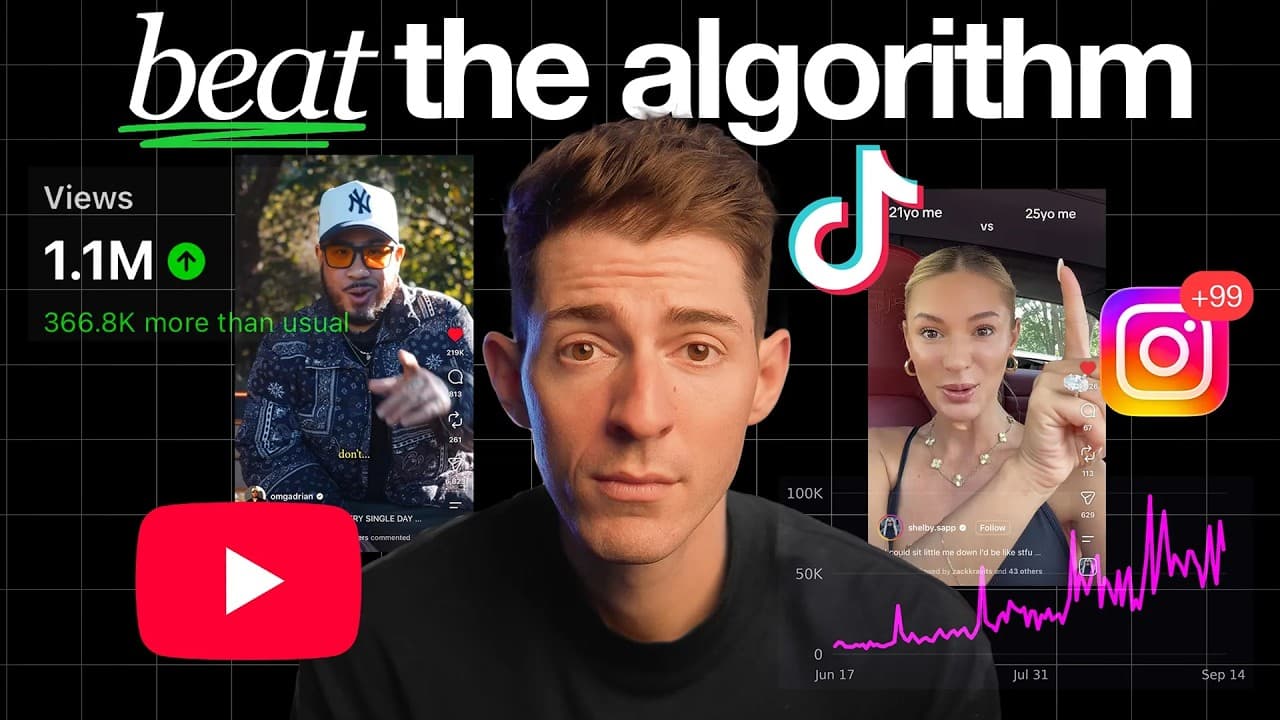
Today we're talking about how social media algorithms actually work. If you want to get more views with less effort, the easiest way is to get the algorithms to push you more for free. Now, 5 months ago, I made this video on the basics of how algorithms work. It has over 800,000 views. So, in this video, I'm going to go much deeper on the tactics a... Read More
Key Insights
- The algorithm’s stated objective is to keep viewers on the platform longer by matching each video with people likely to enjoy it. It evaluates the video, transcript, and audio to create a digital fingerprint that informs its audience-fit prediction.
- Initial distribution begins with a small test audience of about 200 people, according to the creator’s explanation. Some recipients are followers and others are non-followers, and their viewing and engagement behavior influences whether the platform stops, retests, or expands distribution.
- Viral distribution works through progressively larger audience tests in the creator’s model. A video can move from roughly 200 viewers to 2,000, 20,000, and 200,000, continuing until the platform runs out of people expected to want the content.
- Authority-driven conversion treats revenue as the primary outcome. Views and follower counts matter only when they contribute to trust, qualified leads, and sales, so deliberately targeted videos may be more valuable than videos that attract millions of poorly matched viewers.
- Target-buyer clarity is the foundation of conversion content. Every topic should provide new value to that buyer and demonstrate strong expertise, making a written audience positioning statement a practical filter for selecting or rejecting future content ideas.
- A broad-and-narrow topic mix helps the algorithm find buyers without weakening relevance. Broad topics address nearly everyone who could plausibly buy, while narrow topics use the precise language, examples, needs, and pain points of the creator’s exact customer profile.
- Trust-supporting formats reinforce professional authority before the viewer evaluates the full message. The creator recommends showing role-relevant environments or clothing, such as a surgeon’s office and lab coat, while avoiding highly viewed formats that leave little memory of the person behind them.
- Content sophistication should sit one level above the target buyer’s current knowledge. Beginners rated around two or three out of ten should receive material around four or five, while audiences at seven or eight require information closer to eight or nine.
Install to Summarize YouTube Videos and Get Transcripts
Explore YouTube Video Summarizer or Get YouTube Transcript Extractor
Questions & Answers
Q: How do social media algorithms decide who sees a video?
The creator says an algorithm watches the video, examines its transcript, and listens to its audio to form a digital fingerprint of the subject. It then creates a fit score that predicts which viewers are most likely to enjoy the post. The content is initially shown to a small mixture of followers and non-followers with high predicted fit.
Q: Why do some posts remain stuck at about 200 views?
In the creator’s model, being stuck near 200 views means the initial test audience did not respond strongly enough. The platform first shows a post to about 200 people, observes their viewing and engagement behavior, and then decides whether to stop distribution, conduct another test, or amplify the content to progressively larger groups of viewers.
Q: How can creators improve a video’s initial algorithm test?
Creators should help the platform build an accurate fit score and make content that the selected audience genuinely watches and engages with. This requires clear topic signals, a precise understanding of the intended viewer, and useful material tailored to that person. Strong performance from the initial sample gives the platform a reason to continue distributing the video.
Q: What metrics matter most for authority-driven content?
Dollars generated is the central metric in the authority-driven conversion strategy described by the creator. Views and followers remain useful, but only insofar as they build trust, attract suitable buyers, collect leads, and produce sales. A smaller audience containing many potential customers can therefore be more commercially valuable than a much larger but poorly matched audience.
Q: How should creators choose topics that generate conversions?
Each proposed topic should pass two filters: it should deliver new value to the target buyer, and it should make that viewer perceive substantial expertise in the creator’s field. Applying these filters requires a clearly defined buyer profile. Without that clarity, creators are largely guessing whether their topics and supporting information will be useful to potential customers.
Q: Why should a content strategy mix broad and narrow topics?
Broad topics can reach nearly everyone who might become a buyer, including people the algorithm has not identified yet. Narrow topics directly address the exact buyer through familiar words, examples, and pain points. Combining both creates what the creator calls a Goldilocks zone, preserving commercial relevance while expanding the opportunities to discover additional qualified viewers.
Q: How can video format increase professional authority?
The setting, clothing, and visual layout can communicate credibility before the viewer fully processes the message. The creator suggests that surgeons appear in a lab coat or office, accountants work at a desk, and real estate professionals show properties or relevant offices. Clear audio and 4K recording can also signal care, particularly for unknown creators selling high-ticket offers.
Q: How advanced should educational social media content be?
The information should be approximately one level above the target buyer’s current sophistication. If beginners sit around two or three out of ten, the material should be around four or five. If the audience is already at seven or eight, the substance should reach eight or nine. Greater sophistication means better information and depth, not unnecessary confusion.
Summary & Key Takeaways
-
Social platforms seek to keep viewers active by matching videos with people predicted to enjoy them. According to the creator’s model, each video receives a digital fingerprint and fit score before reaching an initial sample of about 200 people. Their response determines whether distribution stops, gets retested, or expands to larger groups.
-
Authority-driven content should prioritize revenue, leads, trust, and relevant buyers instead of maximizing raw reach. The creator reports growing one Instagram page from nearly zero to 95,000 followers in about five months, while generating 40,000 emails and more than 100,000 in attributable profit during its first three months.
-
A conversion strategy requires a clear buyer profile, disciplined topic selection, and a combination of broad and narrow ideas. Credible settings, role-appropriate clothing, strong video and audio quality, and information slightly above the audience’s sophistication level can strengthen perceived expertise while helping the algorithm locate more suitable potential buyers.
Read in Other Languages (beta)
Share This Summary 📚
Summarize YouTube Videos and Get Video Transcripts with 1-Click
Try YouTube Summary with ChatGPT & Claude or YouTube Transcript Generator
Explore More Summaries from Kallaway 📚

Summarize YouTube Videos and Get Video Transcripts with 1-Click
Try YouTube Summary with ChatGPT & Claude or YouTube Transcript Generator