How to Build a Personal Brand That Survives AI
TL;DR
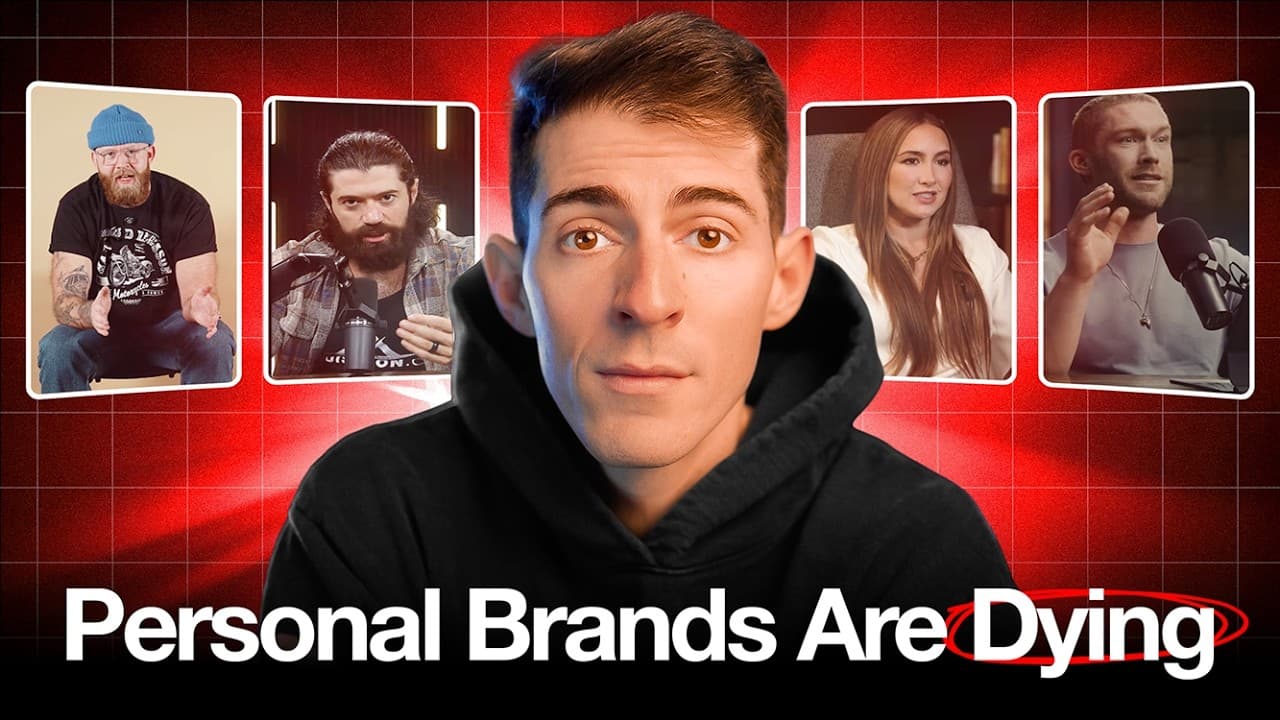
A durable personal brand needs unique positioning built around at least one defensible strength: premium packaging, original thinking, tactical usefulness, rare capabilities, or distinctive personality. Content should pair data-validated topics with original takes, because AI makes common information easy to copy while audiences still reward differentiated ideas, practical transformation, strong presentation, and memorable people.
Transcript
The most valuable thing you could build right now in 2026 is a premium personal brand. One that will actually survive and keep winning in the AI era. If you run a business, this should be your number one priority because it will give you a massive unfair advantage in the future. Now, the biggest personal brand building question everybody's focused ... Read More
Key Insights
- Unique positioning is the first required attribute of a premium personal brand because AI tools make ordinary information increasingly easy to reproduce. Creators need to own a recognizable lane instead of relying on advice that competitors can copy shortly after publication.
- Premium packaging is the complete visual experience surrounding content, including its polish, production quality, and on-screen presentation. It can differentiate a creator because reproducing that experience consistently requires both strong taste and disciplined execution, even when individual production techniques are technically replicable.
- Originality is the consistent production of new, non-obvious, or contrarian ideas. A creator who becomes a reliable source of original thought can remain visible in a crowded category because audiences receive perspectives that generic AI-generated content and copycat creators do not readily provide.
- Tactical usefulness is content that tells viewers exactly what they can do next to move toward a desired result. It creates differentiation through practical transformation, giving audiences a reason to seek out the creator rather than consume interchangeable information from numerous competing sources.
- Rarity is a defensible combination of background, skills, achievements, and proof that is uncommon within a category. The individual components do not necessarily need to be unique, but their combination can create a personal position that competitors cannot easily reproduce.
- Aura is the differentiated personality that makes audiences want to spend time with a creator. It allows a personal brand to scale through personal appeal, especially when viewers value the creator's presence and conversational character in addition to the information being shared.
- Durable personal brands often stack multiple positioning pillars over time. A creator may combine premium visual packaging with aura, or combine original ideas with tactical usefulness, creating a stronger competitive position than dependence on a single distinguishing quality.
- Data-driven creativity uses evidence to choose topics and originality to develop takes. Topic data reduces the risk of producing excellent content about something viewers do not want, while a distinctive perspective prevents the result from becoming another copied contribution to an already crowded category.
Install to Summarize YouTube Videos and Get Transcripts
Explore YouTube Video Summarizer or Get YouTube Transcript Extractor
Questions & Answers
Q: How can a personal brand remain valuable in the AI era?
A personal brand can remain valuable by establishing unique positioning that does not depend solely on information. AI tools and copycat creators can reproduce common advice quickly, so the brand should become recognized for premium packaging, original thinking, tactical usefulness, a rare combination of abilities, or distinctive personality. Combining several of these qualities can strengthen durability further.
Q: What makes personal brand positioning defensible against AI content?
Defensible positioning comes from qualities that are difficult to reproduce consistently, even when the underlying information can be copied. These include high-quality visual packaging, a continuing stream of original or contrarian ideas, exceptionally useful instructions, an uncommon combination of skills and proof, and a personality that audiences specifically want to experience. At least one is necessary for differentiation.
Q: What are the five pillars of premium brand positioning?
The five positioning pillars are premium packaging, originality, tactical usefulness, rarity, and aura. Premium packaging concerns the content experience, originality concerns new and non-obvious ideas, and tactical usefulness provides clear actions. Rarity combines unusual skills, background, and proof, while aura represents the distinctive personality that attracts people to the creator.
Q: How does premium packaging differentiate a personal brand?
Premium packaging differentiates a brand through the visuals, polish, production quality, and overall experience people encounter when consuming its content. It is broader than a title or thumbnail. Although competitors may reproduce individual elements, delivering a consistently refined experience requires taste and sustained execution, which can help one creator occupy the premium position in a niche.
Q: Why is tactical usefulness important for content creators?
Tactical usefulness turns information into an immediate path toward a result. Viewers should finish the content knowing exactly what action to take next and how that action moves them closer to their objective. When a creator repeatedly enables measurable progress through free content, audiences can view that creator as a transformation agent rather than another source of generic advice.
Q: How can creators find unique positioning in their niche?
Creators can map the important people in their niche, evaluate where each person stands across the five positioning pillars, and identify unoccupied space. They can then choose a suitable vector, such as packaging, originality, or tactical usefulness, and execute against it consistently. In smaller niches, becoming excellent on one vector may be relatively accessible because strong competitors are limited.
Q: What is data-driven creativity in content strategy?
Data-driven creativity separates content into a topic and a take. The creator uses performance data to identify topics audiences have already shown they want, then applies creativity to produce an original, non-obvious, or contrarian perspective. This reverses the weak approach of guessing which topic will work and copying another person's interpretation after selecting it.
Q: Why should content topics be selected with data?
Topics should be selected with data because creators, including experienced ones, cannot reliably predict what their audiences most want to hear. A creator may produce 30 pieces and still be surprised by the strongest performers. When the topic lacks demand, excellent execution may still fall flat, so validated audience interest provides a stronger starting point for creative work.
Summary & Key Takeaways
-
AI is reducing the defensibility of information because creators can quickly copy common advice and original posts. A premium personal brand therefore needs a recognizable position within its category. The recommended approach is to map competing creators, identify open space, and deliberately choose a dimension on which to become unusually strong.
-
Unique positioning can come from premium packaging, originality, tactical usefulness, rarity, or aura. A creator needs at least one of these qualities to stand apart, while durable brands often combine several over time. Smaller niches may offer accessible opportunities because few participants demonstrate excellence across any single positioning dimension consistently.
-
Data-driven creativity separates topic selection from the creator's take. Audience data should identify topics with demonstrated demand because even experienced creators cannot reliably predict which ideas will perform. Creativity should then shape an original or contrarian perspective, avoiding the weak pattern of guessing topics and copying someone else's conclusions or presentation.
Read in Other Languages (beta)
Share This Summary 📚
Summarize YouTube Videos and Get Video Transcripts with 1-Click
Try YouTube Summary with ChatGPT & Claude or YouTube Transcript Generator
Explore More Summaries from Kallaway 📚
Summarize YouTube Videos and Get Video Transcripts with 1-Click
Try YouTube Summary with ChatGPT & Claude or YouTube Transcript Generator