How to Build a Trustworthy AI Consulting Practice
TL;DR
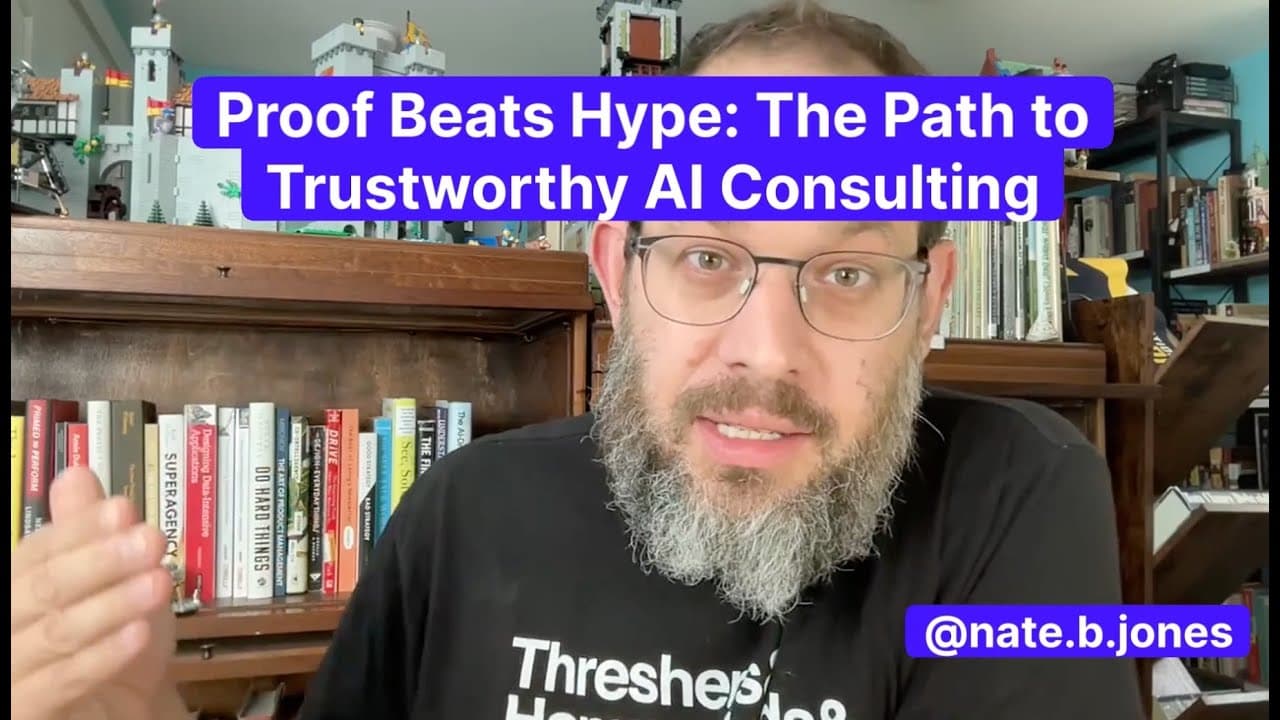
Trustworthy AI consultants combine deep domain expertise with substantive AI knowledge, specific service offerings, and publicly demonstrated proof of their abilities. Existing client relationships can accelerate growth, but long-term retention depends on avoiding vague AI claims, explaining appropriate technical choices clearly, and building a trusted network of specialists who can cover the wider client value chain.
Transcript
We need to talk about what it takes to be an actual A+ AI consultant because I see a lot of people who are either considering that as a career path or actively pursuing it who aren't able to deliver the kind of extraordinary value that would let them retain clients over the long term. In this video, I'm going to talk about what I see as positive be... Read More
Key Insights
- Distribution is the primary advantage of established consultants because existing client relationships provide immediate access to buyers. That advantage creates sustainable value only when the consultant adds substantive AI expertise instead of merely inserting AI terminology into existing proposals and services.
- AI washing is the practice of presenting an offering as AI-driven without possessing the knowledge needed to explain or deliver it. Buzzwords may attract initial attention, but consultants lose credibility when they cannot answer practical questions, such as when RAG is appropriate.
- Specificity is the foundation of a credible AI consulting proposal because clients need to understand what will actually be built or changed. Clear descriptions of deliverables are more persuasive than vague terms such as “AI-powered” or invented concepts that lack operational meaning.
- Domain expertise is necessary because AI is a general-purpose technology rather than a self-contained consulting specialty. A consultant becomes more believable by applying AI to a field where prior experience supports informed opinions, recognizable authority, and a practical understanding of client problems.
- A strong AI service grows around existing professional experience instead of replacing it. The consultant’s established domain supplies the foundation, while a deeply considered AI layer expands what that expertise can accomplish and creates a more valuable service offering.
- Several focused AI offerings are stronger than one general AI offering because each package gives clients a clear reason to choose the consultant. Specific services also increase pricing power by connecting credible expertise, defined client problems, and practical methods for producing results.
- Trusted specialist networks are essential because consultants who work in specific domains usually control only part of the client value chain. Reliable partners allow them to assemble broader engagements, address adjacent needs, and recommend the right expert without pretending to possess every capability.
- Public proof builds consulting pipelines because detailed explanations help others understand and remember a consultant’s specialty. Even when client work is protected by nondisclosure agreements, consultants can discuss their methods and types of work specifically enough to demonstrate credible expertise and earn referrals.
Install to Summarize YouTube Videos and Get Transcripts
Explore YouTube Video Summarizer or Get YouTube Transcript Extractor
Questions & Answers
Q: How do you build a trustworthy AI consulting practice?
Build the practice around a domain in which you already have meaningful experience, then develop enough AI knowledge to explain and deliver specific improvements in that domain. Package the work as clear offerings, publish detailed evidence of your thinking, and cultivate specialist partners. Trust comes from plausible promises, informed technical judgments, visible proof, and consistently delivered client value.
Q: Why is domain expertise important for AI consultants?
Domain expertise gives clients a reason to believe an AI consultant’s recommendations. Because AI can support development, marketing, product work, process change, and many other fields, general familiarity with AI does not establish authority in any particular business problem. Prior experience lets the consultant connect AI capabilities to real workflows, make informed judgments, and propose changes that clients can evaluate clearly.
Q: What is AI washing in consulting?
AI washing occurs when a consultancy adds AI terminology to its branding, proposals, or existing services without developing the knowledge required to provide substantive advice. It often appears as vague, buzzword-heavy language that cannot be translated into concrete work. The weakness becomes visible when consultants cannot answer reasonable questions about choices such as when RAG should or should not be used.
Q: Why should AI consulting services be specific?
Specific services make the consultant’s proposed work clear, credible, and easier to compare with competing proposals. Rather than offering general AI transformation, a consultant can define several focused offerings tied to a known domain, such as SEO in the age of AI. Specificity demonstrates authority, clarifies expected delivery, creates stronger reasons to buy, and can provide additional pricing power.
Q: Can someone become an AI consultant without existing clients?
Yes, but someone starting from scratch lacks the distribution advantage enjoyed by established consultants with existing client relationships. The new consultant should compensate by building stronger AI knowledge, choosing a domain where prior experience creates authority, defining specific offerings, and publishing detailed proof of expertise. Existing consultancies may also need such specialists when their current teams lack substantive AI capabilities.
Q: How can AI consultants prove credibility publicly?
AI consultants can publish detailed explanations of the work they perform, the problems they address, and the principles guiding their recommendations. Client confidentiality does not prevent all useful discussion. Even when a specific case study is restricted by a nondisclosure agreement, consultants can describe their methods and service category precisely enough for potential clients and referral partners to remember their expertise.
Q: Why do AI consultants need a network of specialists?
AI affects many parts of an organization, while a credible consultant is usually strongest in only a few specific areas. A trusted network allows the consultant to bring qualified specialists into engagements that extend beyond those areas. These partnerships help cover more of the client value chain, support larger or multiple engagements, and avoid unsupported claims of universal expertise.
Q: How do existing consultants gain an advantage in AI consulting?
Existing consultants already possess distribution through established client relationships and ongoing knowledge of client needs. Because AI can enhance many forms of consulting, they can introduce relevant services to buyers who already trust them. However, this advantage lasts only if they develop substantive AI knowledge and connect it to their domain expertise, rather than relabeling old services with vague AI language.
Summary & Key Takeaways
-
Demand for AI consulting is growing across large enterprises, smaller businesses, and individual operators. Existing consultancies possess a distribution advantage because they already have client relationships, but simply adding AI language to established proposals is insufficient. Consultants must develop enough substantive knowledge to answer reasonable questions and deliver credible results.
-
Successful AI consulting begins with a specific domain rather than AI expertise alone. Consultants should apply AI to areas where their experience already gives them authority, such as product management, marketing, development, process improvement, or SEO. Combining these strengths produces clearer proposals, stronger differentiation, greater pricing power, and more plausible promises.
-
No individual consultant can cover every part of the AI value chain, so trusted specialist relationships are essential. Consultants can strengthen their pipelines by publishing detailed, NDA-safe explanations of their work. Clear public evidence makes their expertise memorable and helps other consultants confidently bring them into engagements requiring their specific capabilities.
Read in Other Languages (beta)
Share This Summary 📚
Summarize YouTube Videos and Get Video Transcripts with 1-Click
Try YouTube Summary with ChatGPT & Claude or YouTube Transcript Generator
Explore More Summaries from AI News & Strategy Daily | Nate B Jones 📚






Summarize YouTube Videos and Get Video Transcripts with 1-Click
Try YouTube Summary with ChatGPT & Claude or YouTube Transcript Generator