How Does Advanced AI Change Mathematics?
TL;DR
AI can now solve Olympiad problems, assist professional mathematicians, and contribute to research-level proofs, although its work still requires careful verification. OpenAI researchers describe progress from unreliable everyday calculations to solving a 42-year-old optimization problem, and they argue that mathematics is a valuable benchmark for reasoning, longer thinking processes, and progress toward AGI.
Transcript
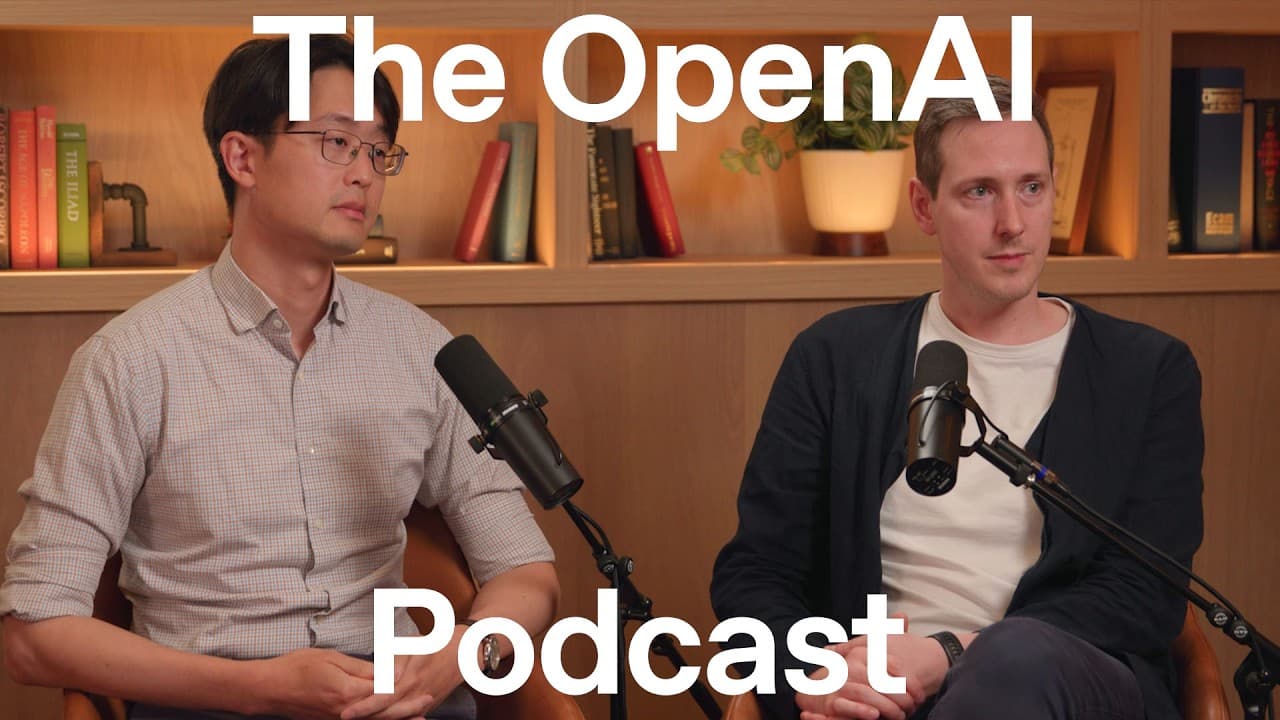
Hello, I'm Andrew Mayne, and this is the OpenAI podcast. Today, our guests are researchers Sebastian Bubeck and Ernest Ryu, and we're going to talk about math, how it went from almost laughable to Olympiad level, and why you need math to reach AGI. The progress of the last few years has been nothing short of miraculous. We will be able to have LLMs... Read More
Key Insights
- AI mathematics capability is advancing unusually quickly, moving within a few years from basic coordinate calculations and unreliable everyday arithmetic to Olympiad-level performance and early contributions to research-level mathematics.
- Reasoning models are central to recent mathematical progress because models two years earlier could not prove difficult theorems, while current systems can assist Fields Medalists in their day-to-day work.
- International Math Olympiad success demonstrates top human high-school competition performance, but it does not by itself prove research ability because competition problems are prepared, already have solutions, and are designed for resolution within a few hours.
- ChatGPT helped resolve a 42-year-old optimization problem by working interactively with Ernest Ryu, who spent about 12 hours correcting mistakes, suggesting novel directions, checking the proof, and asking the model to verify it again.
- The Nesterov accelerated gradient question concerned whether an algorithm known to converge in most cases could display divergent behavior in a sufficiently bad case, and the AI-assisted investigation found that it could.
- AI improvement in mathematics resulted from multiple areas of research progressing together, according to Sebastian Bubeck, so the change cannot be attributed to model scaling, calculator access, or any single breakthrough alone.
- ChatGPT can handle the mathematics needed by many STEM users, including relatively complicated subjects such as differential equations and differential geometry, provided they are applying mathematics rather than necessarily inventing entirely new fields.
- Human verification remains necessary because mathematical models can still make mistakes, so users should check conclusions and, where appropriate, run simulations before relying on an AI-generated calculation, argument, or proof.
Install to Summarize YouTube Videos and Get Transcripts
Explore YouTube Video Summarizer or Get YouTube Transcript Extractor
Questions & Answers
Q: How good is AI at mathematics now?
AI has progressed from failing moderately complicated everyday tasks, such as splitting 17 camping expenses or coordinating a meeting across Korea, Paris, and California, to achieving top human performance at the International Math Olympiad. The researchers also report that current models can support professional mathematicians and show early signs of contributing to genuinely new, research-level mathematics.
Q: Can ChatGPT solve open mathematical problems?
ChatGPT helped Ernest Ryu resolve a 42-year-old open problem in optimization theory concerning the Nesterov accelerated gradient method. The result did not come from a single prompt. Ryu worked with the model for about 12 hours across three days, corrected its errors, guided it toward approaches he considered novel, checked the completed proof, and requested an additional model check.
Q: What was the 42-year-old optimization problem solved with AI?
The question asked whether the Nesterov accelerated gradient method could show divergent behavior in a bad case. Researchers already knew that the algorithm behaved well and converged in most cases, but they did not know whether a worst-case instance could diverge. Ernest Ryu's work with ChatGPT produced a proof that the answer was yes, and he checked that proof.
Q: What role did the mathematician play in the AI-assisted proof?
Ernest Ryu acted as the verifier and research guide throughout the interaction. Whenever ChatGPT made a mistake, he corrected it, and he steered the discussion toward approaches that he believed were novel. After a proof emerged, he personally checked it and also asked ChatGPT to check it again. The process therefore combined model generation with sustained human judgment and verification.
Q: Why is Olympiad-level performance different from mathematical research?
International Math Olympiad problems are competition problems with relatively short solutions because contestants must solve them within a few hours. They are also not novel research questions, since someone created each problem and already has a solution. A gold-medal-level result therefore demonstrates strong mathematical reasoning, but research mathematics additionally requires progress on questions whose answers are genuinely unknown.
Q: Why did AI suddenly become much better at math?
Sebastian Bubeck says there is no single element that fully explains the improvement. OpenAI conducts multiple forms of innovative research, and several areas had to progress together. The change was not presented as the result of scaling language models alone, nor merely as calculator or tool use, because the models became capable of solving mathematical problems through their own reasoning.
Q: Who can use ChatGPT for advanced mathematics?
The researchers say ChatGPT can address the mathematical needs of many people who use advanced mathematics without necessarily inventing new mathematics. Examples include physicists and chemists working with relatively complicated subjects such as differential equations and differential geometry. Ernest Ryu estimates that the models can solve the desired mathematics for 99% of the population, while still requiring appropriate caution.
Q: How should users verify AI-generated mathematics?
Users should exercise caution because the models can make mistakes even when their overall capabilities are strong. The researchers recommend checking whether results are correct and running simulations when that provides an additional test. In research work, Ernest Ryu corrected errors during the conversation, reviewed the final proof himself, and asked ChatGPT to perform another check before accepting the conclusion.
Summary & Key Takeaways
-
AI mathematical ability progressed rapidly from struggling with ordinary scheduling, expense splitting, and basic coordinate problems to achieving top human performance at the International Math Olympiad. The researchers attribute this improvement to multiple lines of innovative research advancing together, rather than to model scaling or calculator access alone.
-
Ernest Ryu tested ChatGPT on an open question about whether the Nesterov accelerated gradient method could diverge in a bad case. Across about 12 hours over three days, he corrected errors, directed the model toward promising approaches, verified the resulting proof, and concluded that divergence was possible.
-
The researchers describe AI as increasingly useful across mathematics and STEM, including work involving differential equations and differential geometry. They also stress that users should remain cautious by checking answers and running simulations. Mathematics provides a clear benchmark for evaluating reasoning, original discovery, proof verification, and the longer work needed for automated research.
Read in Other Languages (beta)
Share This Summary 📚
Summarize YouTube Videos and Get Video Transcripts with 1-Click
Try YouTube Summary with ChatGPT & Claude or YouTube Transcript Generator
Explore More Summaries from OpenAI 📚


Summarize YouTube Videos and Get Video Transcripts with 1-Click
Try YouTube Summary with ChatGPT & Claude or YouTube Transcript Generator