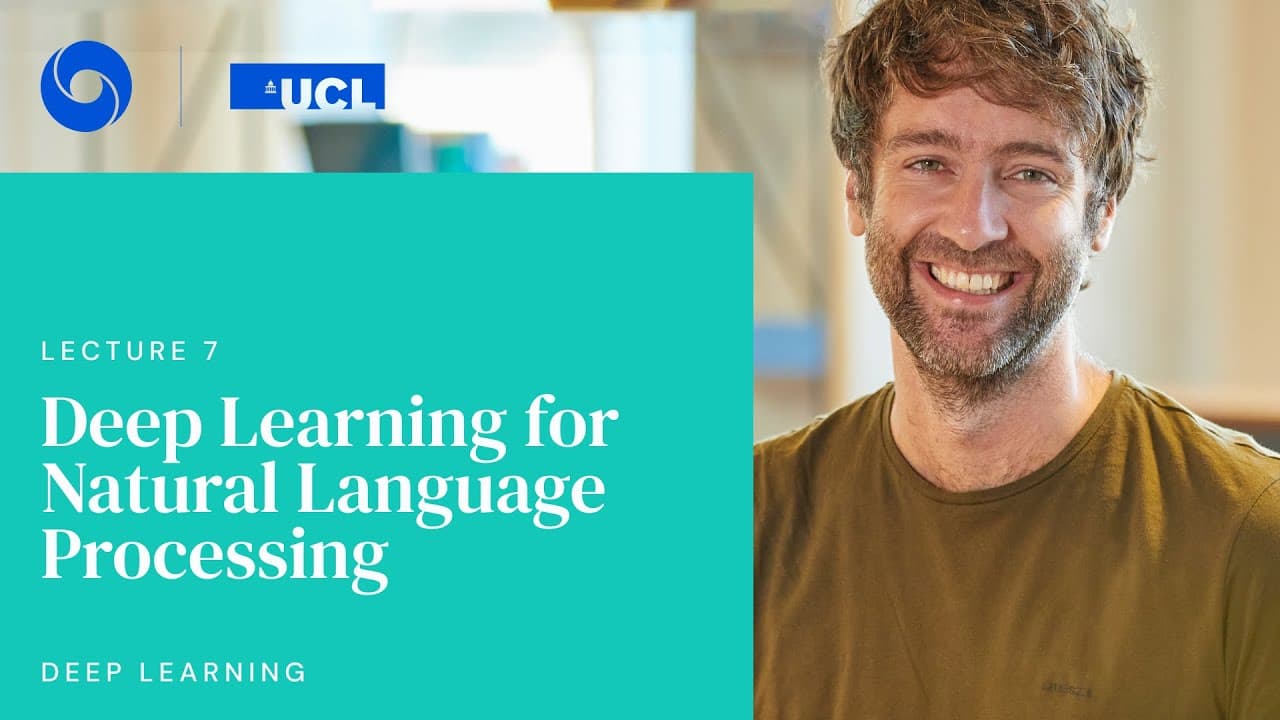
DeepMind x UCL | Deep Learning Lectures | 7/12 | Deep Learning for Natural Language Processing
TL;DR
The lecture discusses deep learning's impact on natural language processing, focusing on structures like transformers and BERT.
Transcript
hello and welcome to the UCL and deepmind lecture series my name's Felix Hill and I'm going to be talking to you about deep learning and language understanding so here's an overview of the structure of today's talk it's going to be divided into four sections so in the first section I'll talk a little bit about neural computation in general and lang... Read More
Key Insights
- 🥰 The convergence of deep learning and natural language has led to tremendous advancements in language processing, with models achieving state-of-the-art results.
- 🔑 Neural networks are shifting towards architectures that balance discrete word meanings and their contextual dependencies, producing more nuanced language representations.
- 🧡 The self-attention mechanism in transformers enables the model to dynamically prioritize relevant words, providing superior understanding of long-range sentence structures.
- 🌥️ BERT demonstrates the effectiveness of unsupervised learning, showcasing the ability of large language models to transfer learned knowledge to specific tasks efficiently.
- 🅰️ As language understanding models evolve, incorporating broader types of knowledge, such as visual and experiential, may further enhance their capabilities.
- 🔑 Avoiding overly reliant individual word representations, effective language models focus on distributed embeddings emphasizing contextual understanding and relational meaning.
- 💁 Future advancements in language processing should target not only textual information but also the integration of broader contextual knowledge and human-like interactive capabilities.
Install to Summarize YouTube Videos and Get Transcripts
Explore YouTube Video Summarizer or Get YouTube Transcript Extractor
Questions & Answers
Q: What is the significance of the transformer model in natural language processing?
The transformer model revolutionized natural language processing by introducing self-attention mechanisms that enable the model to weigh the importance of different words in a sentence simultaneously, thereby capturing complex relationships and context more effectively than previous models like RNNs or LSTMs.
Q: How does BERT differ from traditional language models?
BERT utilizes a bidirectional approach to language representation, processing context from both directions in a sentence simultaneously. This allows it to understand nuances and meanings more effectively, making it particularly powerful for various language tasks compared to traditional unidirectional models.
Q: Can you explain the masked language model training in BERT?
In masked language model training, random words from a sentence are masked and the model is trained to predict these missing words based on the surrounding context. This approach allows BERT to learn rich contextual embeddings without requiring labeled data, making it effective for pre-training on vast text corpora.
Q: What role does self-attention play in the transformer architecture?
Self-attention allows the transformer to evaluate the importance of each word in relation to others within a sentence, enabling it to capture long-range dependencies and relationships that are crucial for understanding language contextually and semantically.
Q: Why is general knowledge important for language understanding in AI models?
General knowledge helps language models contextualize information, make inferences, and better understand relationships in language. It empowers models like BERT to interpret sentences accurately by leveraging vast amounts of pre-learned context from various sources of text.
Q: How does positional encoding enhance the transformer's understanding of language?
Positional encoding is added to the input embeddings to impart information about word order, which is crucial for understanding sentence structure. It enables the transformer to recognize the significance of the sequence of words in determining meaning.
Q: What are some of the applications of the BERT model?
BERT is widely used for various natural language processing tasks, including sentiment analysis, question answering, named entity recognition, and any task requiring an understanding of language nuances due to its robust contextual embeddings.
Q: How can deep learning address the social aspects of language understanding?
Although current models like BERT excel at basic language processing, deeper insights into social dynamics, intentions, and implications in language still need exploration. Future research can enhance understanding by integrating more complex features related to interpersonal communication and contextual subtleties.
Summary & Key Takeaways
-
The lecture provides an overview of deep learning's role in enhancing natural language processing capabilities over recent years, highlighting significant models like transformers and BERT.
-
Key components of the transformer architecture, including self-attention and multi-head attention, are explained, showcasing their effectiveness in understanding context and word relationships in language.
-
The lecture also introduces BERT, an unsupervised language model, and its training objectives, emphasizing its ability to transfer knowledge and improve performance on various language tasks.
Read in Other Languages (beta)
Share This Summary 📚
Summarize YouTube Videos and Get Video Transcripts with 1-Click
Try YouTube Summary with ChatGPT & Claude or YouTube Transcript Generator
Explore More Summaries from Google DeepMind 📚

Summarize YouTube Videos and Get Video Transcripts with 1-Click
Try YouTube Summary with ChatGPT & Claude or YouTube Transcript Generator