How Does DNA Structure and Replication Work?
TL;DR
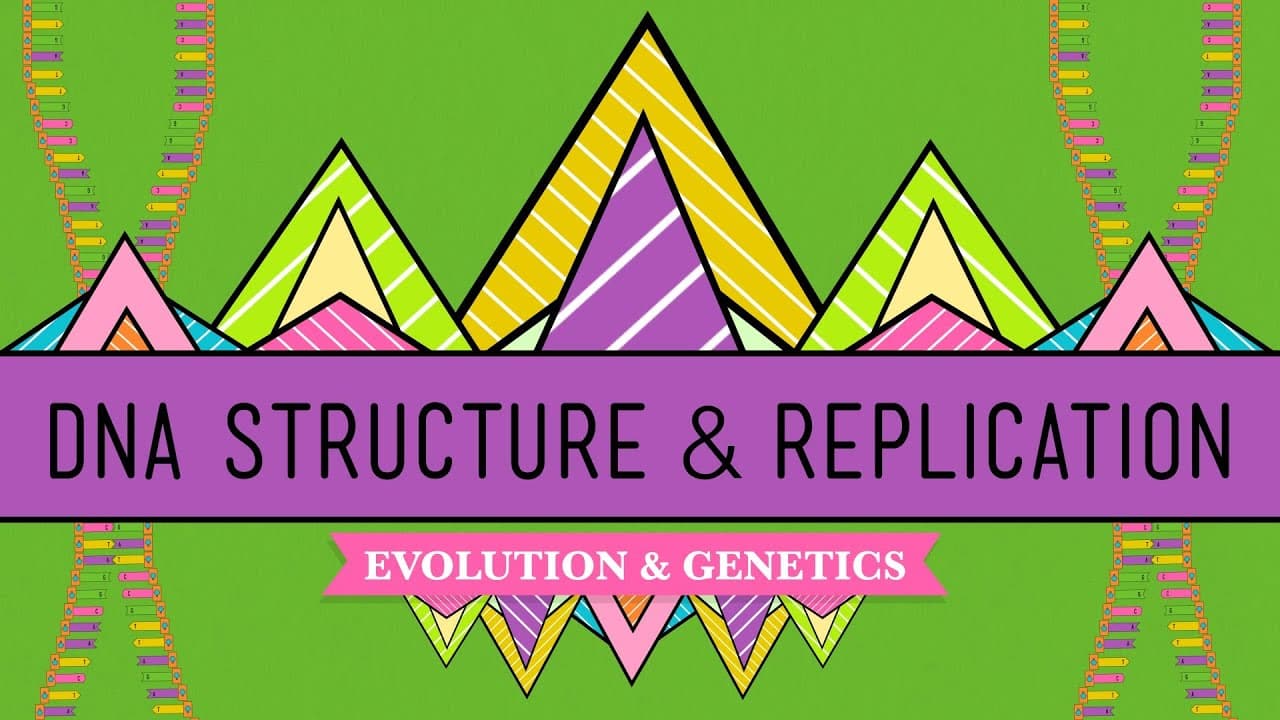
DNA is a complex molecule that stores genetic instructions and replicates itself in cells. It consists of two strands forming a double helix, with base pairs of adenine-thymine and guanine-cytosine. Replication involves unzipping the helix and using enzymes like helicase and DNA polymerase to create new strands. Mistakes occur rarely due to proofreading mechanisms.
Transcript
It's just beautiful, isn't it? It's just mesmerizing. It's double hel-exciting! You really can tell, just by looking at it, how important and amazing it is. It's pretty much the most complicated molecule that exists, and potentially the most important one. It's so complex that we didn't even know for sure what it looked like until about 60 years ag... Read More
Key Insights
- DNA is a double helix structure composed of two strands held together by base pairs.
- The four nitrogenous bases in DNA are adenine, thymine, cytosine, and guanine.
- DNA replication is essential for cell division and involves enzymes like helicase and DNA polymerase.
- DNA polymerase requires a primer to start adding nucleotides during replication.
- The leading strand is synthesized continuously, while the lagging strand is synthesized in segments called Okazaki fragments.
- RNA differs from DNA by being single-stranded and having uracil instead of thymine.
- Rosalind Franklin's work was crucial in confirming the helical structure of DNA, though she was not credited during her lifetime.
- Replication errors are rare due to DNA polymerase's proofreading ability.
Install to Summarize YouTube Videos and Get Transcripts
Explore YouTube Video Summarizer or Get YouTube Transcript Extractor
Questions & Answers
Q: How does DNA replication occur?
DNA replication starts with the unwinding of the double helix by helicase, creating a replication fork. The leading strand is synthesized continuously by DNA polymerase, while the lagging strand is synthesized in short segments called Okazaki fragments. RNA primase lays down primers for DNA polymerase to initiate synthesis. DNA ligase later joins the fragments.
Q: What are the key differences between DNA and RNA?
DNA is double-stranded with a deoxyribose sugar and uses thymine as one of its bases. RNA is single-stranded, has a ribose sugar, and uses uracil instead of thymine. RNA is crucial for protein synthesis and plays a role in DNA replication, while DNA stores genetic information.
Q: Who contributed to the discovery of DNA's structure?
Friedrich Miescher first discovered DNA, but its structure was later elucidated by several scientists, including Rosalind Franklin, who used X-ray diffraction to confirm the helical structure. James Watson and Francis Crick are often credited with the discovery, though Franklin's contributions were significant.
Q: What is the function of DNA polymerase in replication?
DNA polymerase is responsible for synthesizing new DNA strands by adding nucleotides complementary to the template strand. It requires a primer to start synthesis and works continuously on the leading strand, while on the lagging strand, it synthesizes short segments. It also has proofreading abilities to correct errors.
Q: Why is the lagging strand synthesized in fragments?
The lagging strand is synthesized in fragments because DNA polymerase can only add nucleotides in the 5' to 3' direction, opposite to the lagging strand's orientation. RNA primase lays down primers at intervals, allowing DNA polymerase to synthesize short segments, which are later joined by DNA ligase.
Q: What role does helicase play in DNA replication?
Helicase plays a crucial role in DNA replication by unwinding the double helix and breaking the hydrogen bonds between base pairs, creating the replication fork. This allows the two strands to separate and serve as templates for the synthesis of new complementary strands by DNA polymerase.
Q: How does DNA ensure accurate replication?
DNA ensures accurate replication through the proofreading ability of DNA polymerase, which checks and corrects mismatched bases during synthesis. This reduces the error rate to about one mistake per 10 billion nucleotides, maintaining genetic fidelity across cell divisions.
Q: What are Okazaki fragments and their significance?
Okazaki fragments are short DNA segments synthesized on the lagging strand during replication. They are necessary because DNA polymerase can only synthesize DNA in one direction, requiring multiple starting points provided by RNA primers. These fragments are later joined by DNA ligase to form a continuous strand.
Summary & Key Takeaways
-
DNA stores genetic instructions and is structured as a double helix, with adenine pairing with thymine and guanine pairing with cytosine. Replication involves unzipping the helix and synthesizing new strands using enzymes like helicase and DNA polymerase. The leading strand is synthesized continuously, while the lagging strand forms in segments.
-
Rosalind Franklin played a key role in discovering DNA's helical structure, though her contributions were overshadowed by Watson and Crick. DNA replication is remarkably accurate due to proofreading by DNA polymerase, ensuring genetic information is preserved across cell divisions.
-
RNA, a cousin of DNA, differs by being single-stranded and having uracil instead of thymine. It plays a critical role in protein synthesis and DNA replication. The process of replication involves complex enzymatic actions, but errors are minimized by proofreading mechanisms.
Read in Other Languages (beta)
Share This Summary 📚
Summarize YouTube Videos and Get Video Transcripts with 1-Click
Try YouTube Summary with ChatGPT & Claude or YouTube Transcript Generator
Explore More Summaries from CrashCourse 📚




Summarize YouTube Videos and Get Video Transcripts with 1-Click
Try YouTube Summary with ChatGPT & Claude or YouTube Transcript Generator