What Is Cu Wire Bonding and Why Is It Used?
TL;DR
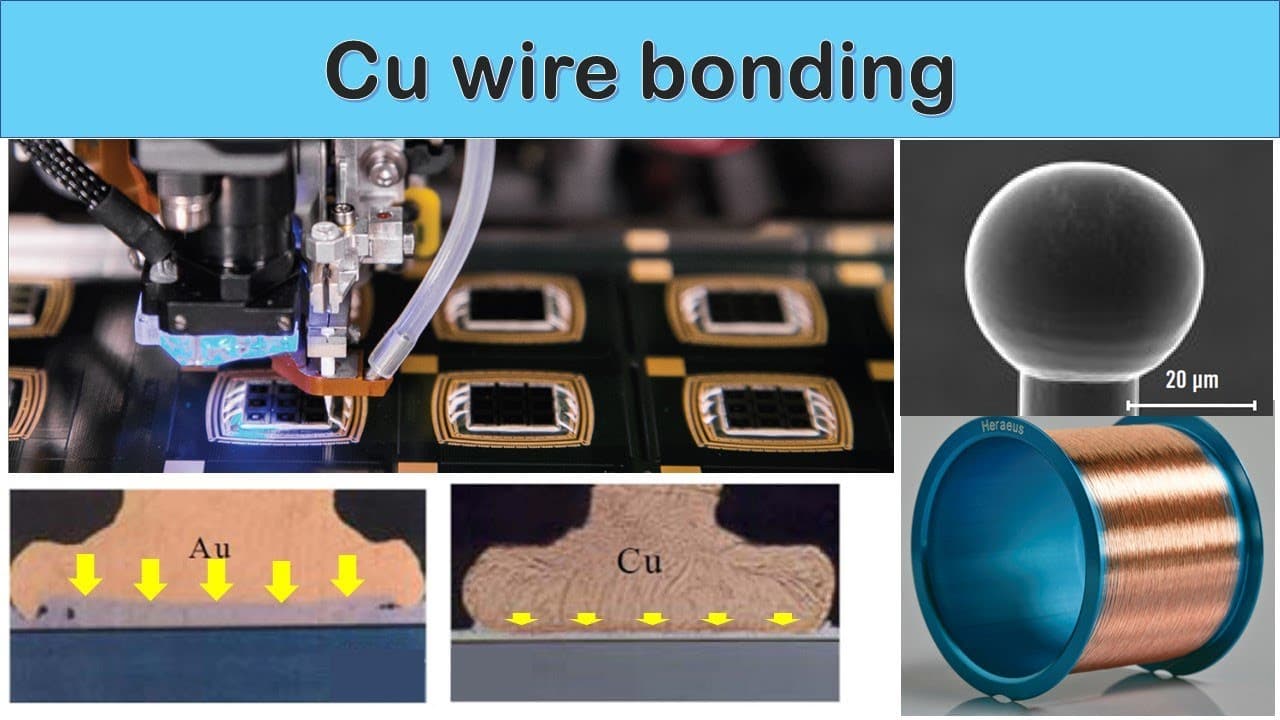
Cu wire bonding replaces gold wire bonding due to its cost-effectiveness and superior electrical and thermal conductivity. Despite challenges like oxidation and potential damage to bond pads, Cu's lower price makes it an attractive alternative, with proper process control ensuring reliability in applications.
Transcript
Hello everyone, welcome to Semicon Talk. Today’s topic is Cu wire bonding. Let’s talk about it. Cu Wire bonding is a wire bonding technology to use Cu instead of the Au. Compared to Au, Cu wire bonding has better electrical conductivity, better thermal conductivity, better reliability with slower intermetallic growth. It also has some drawbacks.... Read More
Key Insights
- Cu wire bonding offers better electrical and thermal conductivity than Au, with improved reliability due to slower intermetallic growth.
- The primary advantage of Cu over Au is cost, as Cu is significantly cheaper, making it a more economical choice for wire bonding.
- Cu wire is prone to oxidation, which can compromise reliability and integrity, necessitating tight control over bonding parameters.
- Cu's hardness compared to Au can damage bond pads and underlying circuitry, requiring careful handling during the bonding process.
- Pd-coated Cu wire provides better corrosion resistance than pure Cu, though it is still cheaper than Au.
- Forming gas, a mixture of 95% nitrogen and 5% hydrogen, is used in Cu wire bonding to prevent oxidation during the free-air-ball formation.
- The Cu wire bonding process is similar to Au wire bonding, with critical steps involving electric flame-off and free ball formation.
- Cu wire bonding machines utilize forming gas to create an inert atmosphere, crucial for preventing oxidation and ensuring bond reliability.
Install to Summarize YouTube Videos and Get Transcripts
Explore YouTube Video Summarizer or Get YouTube Transcript Extractor
Questions & Answers
Q: What are the main advantages of Cu wire bonding over Au wire bonding?
Cu wire bonding offers several advantages over Au wire bonding, primarily in terms of cost and performance. Cu is significantly cheaper than Au, making it a more economical choice. Additionally, Cu provides better electrical and thermal conductivity, as well as improved reliability due to slower intermetallic growth.
Q: What are the challenges associated with using Cu wire for bonding?
The main challenges of using Cu wire for bonding include its susceptibility to oxidation and its hardness compared to Au. Oxidation can degrade the reliability and integrity of the bond, while the hardness of Cu can damage bond pads and underlying circuitry. These issues require tight control of bonding parameters and careful handling during the process.
Q: How does Pd-coated Cu wire compare to pure Cu wire?
Pd-coated Cu wire offers better corrosion resistance than pure Cu wire, which can enhance the reliability of the bond. Although Pd-coated Cu wire is more expensive than pure Cu, it is still cheaper than Au wire. This makes it a popular alternative for applications requiring enhanced performance without the high cost of Au.
Q: What role does forming gas play in the Cu wire bonding process?
Forming gas, a mixture of 95% nitrogen and 5% hydrogen, is crucial in the Cu wire bonding process. It prevents oxidation during the free-air-ball formation, which is essential for creating a symmetrical and reliable bond. The use of forming gas ensures an inert atmosphere, preventing oxidation and degradation of the bond's performance.
Q: What are the critical steps in the Cu wire bonding process?
The critical steps in the Cu wire bonding process include wire feeding into the capillary, electric flame-off (EFO) to create an electric spark, and free ball formation. These steps are vital for ensuring a reliable bond. The process also involves forming gas to prevent oxidation and maintain bond integrity.
Q: Why is Au wire considered more expensive than Cu wire?
Au wire is considered more expensive than Cu wire due to the high cost of gold. Gold prices are significantly higher than copper, making Au wire a less economical choice for wire bonding. This cost difference is a major factor driving the adoption of Cu wire bonding in various applications.
Q: How does Cu wire bonding compare to Au wire bonding in terms of reliability?
Cu wire bonding generally offers better reliability than Au wire bonding due to slower intermetallic growth. This results in a more stable bond over time. However, the potential for oxidation in Cu wire bonding requires careful process control to maintain this reliability advantage.
Q: What are the available diameters for Pd-coated Cu wire and their benefits?
Pd-coated Cu wire is available in diameters ranging from 0.6mil to 2mils. The Pd coating enhances corrosion resistance, making it a preferred choice for applications requiring improved durability and performance. Despite its higher cost than pure Cu, it remains a cost-effective alternative to Au wire.
Summary & Key Takeaways
-
Cu wire bonding is a cost-effective alternative to Au, offering better electrical and thermal conductivity. Despite its advantages, Cu is prone to oxidation, requiring careful process control. The hardness of Cu can also damage bond pads, necessitating precise handling during the bonding process.
-
Pd-coated Cu wire offers enhanced corrosion resistance compared to pure Cu, making it a popular choice despite its higher cost than uncoated Cu. The bonding process involves forming gas to prevent oxidation, ensuring reliable bond formation and performance.
-
The Cu wire bonding process involves several critical steps, including electric flame-off and free ball formation. Forming gas is essential for creating an inert atmosphere, preventing oxidation, and ensuring the reliability of the first ball bond. Proper control of bonding parameters is crucial for successful Cu wire bonding.
Read in Other Languages (beta)
Share This Summary 📚
Summarize YouTube Videos and Get Video Transcripts with 1-Click
Try YouTube Summary with ChatGPT & Claude or YouTube Transcript Generator
Explore More Summaries from Semicon Talk 📚




Summarize YouTube Videos and Get Video Transcripts with 1-Click
Try YouTube Summary with ChatGPT & Claude or YouTube Transcript Generator