How to Move AI Agents From Prototype to Production
TL;DR
Moving AI agents from prototype to production requires automated evaluation, automated CI/CD deployment, comprehensive observability, and strong security and governance. Roughly 80% of development effort goes into infrastructure, security, and constant validation rather than core AI capabilities. Evaluation-gated releases test both results and behavior before agents reach users; read on for the roles, pipeline phases, and rollout safeguards involved.
Transcript
So, you know, you can whip up an AI agent prototype really fast these days. Maybe just minutes, right? Fetch some data, make a basic decision. It looks great. Uh, the demo is always impressive. But here's the kicker, the sort of um reality check from people actually deploying these things. Getting that cool demo into production, making it something... Read More
Key Insights
- The last-mile production gap is the real challenge with AI agents, because a demo that fetches data and makes a basic decision can be built in minutes, but making it a robust, business-reliable system is a completely different task.
- Roughly 80% of development effort is not the core AI smarts but the infrastructure, security, and constant validation needed to make an agent safe and dependable, shifting focus from tweaking prompts to building a robust surrounding system.
- Traditional MLOps falls short for agents because standard ML models are predictable (input X gives output Y), while agents are dynamic, remember things, use dynamic tool orchestration, and may never take the same execution path twice.
- Evaluation-gated deployment is the core pre-production principle: no agent touches real users until it passes rigorous checks proving it is effective and safe against a trusted golden data set.
- Evaluating an agent means judging the whole process, not just the final output, asking whether it chose the right tool, used it correctly, and followed the intended reasoning path, in addition to whether it hallucinated.
- The CI/CD pipeline is a progressive funnel with three phases: pre-merge integration (fast CI), post-merge validation and staging (heavier load and integration tests), and gated deployment to production using the same validated build artifact.
- Safe rollout strategies avoid flipping the switch for everyone at once, using canary releases to 1% of users, blue-green deployments with two identical environments for zero downtime and instant rollback, and A/B testing on business metrics.
- Google's secure AI agents approach based on SIF uses three defense layers: policy definition through system instructions, guard rails and filtering (input filtering via Perspective API and output filtering via Vertex AI safety filters), and human-in-the-loop escalation.
Install to Summarize YouTube Videos and Get Transcripts
Explore YouTube Video Summarizer or Get YouTube Transcript Extractor
Questions & Answers
Q: How do you move AI agents from prototype to production?
Build the operational system around the agent using three pillars: automated evaluation, automated deployment through CI/CD, and comprehensive observability. Start with clear team responsibilities, then require the agent to pass effectiveness and safety checks before reaching real users. Use controlled rollout strategies and meticulous versioning so releases can be monitored and rolled back.
Q: What is the last-mile production gap for AI agents?
The last-mile production gap is the difference between creating an impressive prototype and delivering a robust system that a business can reliably use. A prototype that fetches data and makes a basic decision may take only minutes, but production requires infrastructure, security, validation, state management, and operational controls.
Q: Why does about 80% of AI agent development effort go beyond the core AI?
Roughly 80% of the effort goes into infrastructure, security, constant validation, and other systems needed to make an agent safe and dependable. Production work therefore focuses less on adjusting prompts and more on building a reliable system around them.
Q: Why is traditional MLOps insufficient for autonomous AI agents?
Standard ML models are relatively predictable, while agents interact, remember information, select tools dynamically, and may follow different execution paths each time. Their memory also creates scalable state-management challenges, and variable numbers of steps and tool calls make cost and latency unpredictable.
Q: What are the three pillars of production AI agent operations?
The three foundational pillars are automated evaluation, automated deployment through CI/CD pipelines, and comprehensive observability. Together, they validate agent quality and safety, make releases repeatable, and support monitoring after deployment.
Q: What is evaluation-gated deployment for AI agents?
Evaluation-gated deployment prevents an agent from reaching real users until it passes rigorous effectiveness and safety checks. Evaluation covers the whole process, including whether the agent selected the right tool, used it correctly, followed the intended reasoning path, and avoided hallucination. A CI/CD gate can block deployment when performance falls below a threshold against a trusted golden data set.
Q: Which specialized roles are needed to productionize generative AI agents?
The whitepaper highlights prompt engineers and AI engineers. Prompt engineers define system instructions, safety boundaries, and context-specific standards for good and bad answers. AI engineers build scalable backends, integrate guard rails, connect tools, set up RAG when needed, and maintain automated evaluation systems.
Q: How does the three-phase CI/CD pipeline for AI agents work?
The pipeline begins with pre-merge integration, where fast CI checks catch errors early. Post-merge validation and staging then run heavier load and integration tests, including dogfooding. Production uses the same validated build artifact and requires a final human sign-off before deployment.
Summary & Key Takeaways
-
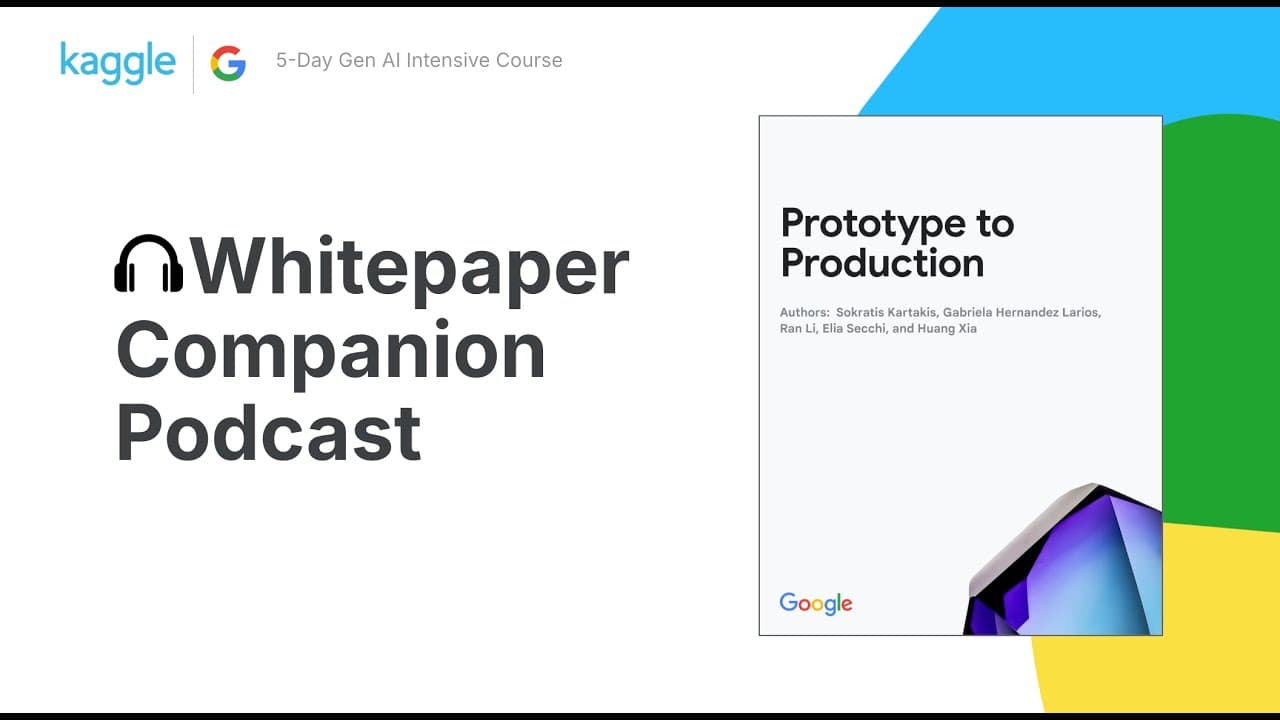
AI agent prototypes can be built in minutes, but closing the last-mile production gap is a far harder task. The Day 5 Google X Kaggle whitepaper, titled deploying, scaling, productionizing, and A2A, treats this operational lifecycle as agent ops, aimed at AI engineers, MLOps staff, and system architects.
-
About 80% of effort goes to infrastructure, security, and validation rather than core AI. Traditional MLOps cannot handle agents because they are dynamic, use on-the-fly tool orchestration, need scalable state management, and have unpredictable cost and latency, so success rests on automated evaluation, automated deployment, and observability.
-
Success starts with people and process, adding prompt engineers who define the agent's rules and AI engineers who build robust scalable backends. Evaluation-gated deployment, a three-phase CI/CD funnel, safe rollout strategies, meticulous versioning, and SIF's three defense layers protect against prompt injection, data leakage, and memory poisoning.
-
The pipeline shifts left to catch errors early: pre-merge CI runs fast tests, staging runs load and integration tests including dogfooding, and production deployment is gated by a final human sign-off. Canary, blue-green, and A/B strategies plus versioning of code, prompts, schemas, and memory enable instant rollback.
-
Security defenses follow Google's secure AI agents approach based on SIF. Layer one defines policy via system instructions, layer two adds guard rails with input filtering through the Perspective API and output filtering through Vertex AI safety filters, and it also includes human-in-the-loop escalation to keep agents safe.
Read in Other Languages (beta)
Share This Summary 📚
Summarize YouTube Videos and Get Video Transcripts with 1-Click
Try YouTube Summary with ChatGPT & Claude or YouTube Transcript Generator
Explore More Summaries from Kaggle 📚
Summarize YouTube Videos and Get Video Transcripts with 1-Click
Try YouTube Summary with ChatGPT & Claude or YouTube Transcript Generator