How to Build AI Agents: 5-Day Intensive Course Overview
TL;DR
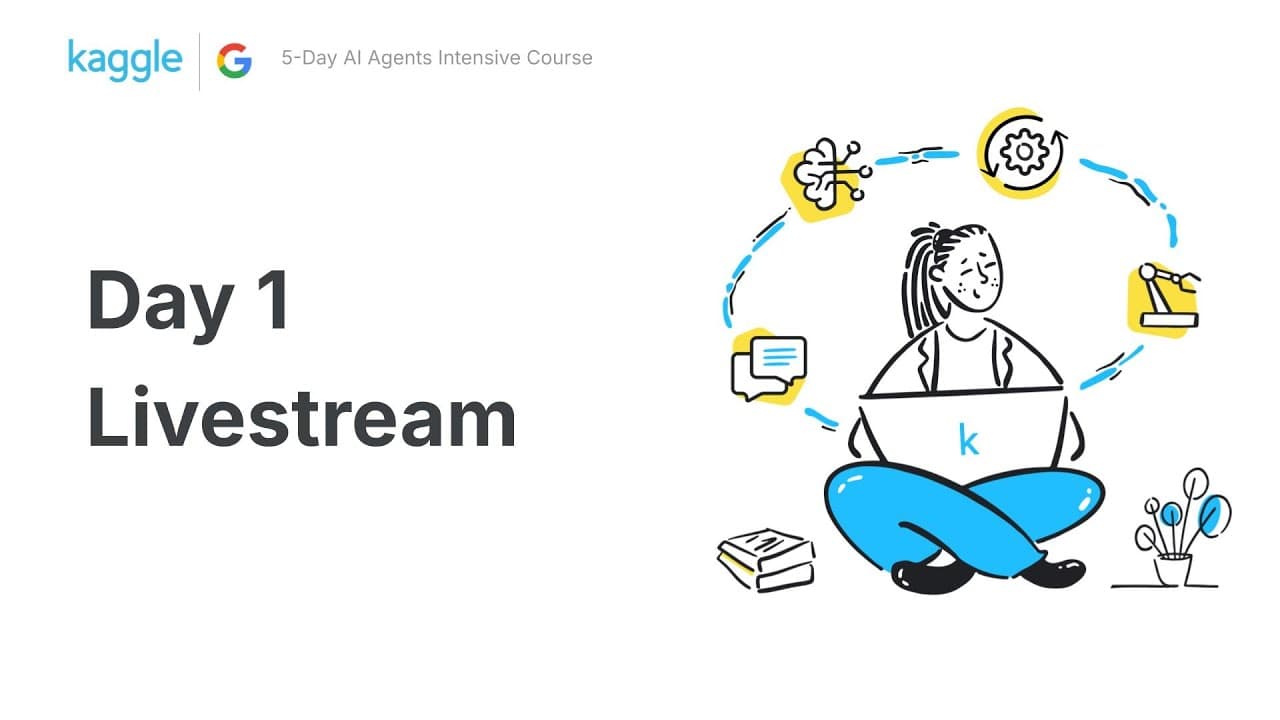
The course introduces participants to AI agents, focusing on building and understanding their architecture. It covers essential components like models, tools, and orchestration layers, and includes practical exercises using the Agent Development Kit (ADK). Participants will learn to create both single and multi-agent systems, gaining insights into their practical applications and future potential.
Transcript
Welcome everyone. We are super thrilled and excited to have you all here for the Kaggle Google uh 5day AI agents intensive course. Um I'm Ka Parlola. I'm one of the co-hosts with Anand Nalgria on the rest of the five days in this course. Thank you for being here. Anand do you want to say hi? Hi everyone. U thanks K. I'm Anand. uh uh I'm seeing you ... Read More
Key Insights
- AI agents are defined by their model, tools, and orchestration layer.
- The course emphasizes hands-on learning with the Agent Development Kit (ADK).
- Participants will build single and multi-agent systems using ADK.
- AI agents move beyond simple chatbots, enabling complex task automation.
- Interoperability and open-source frameworks are key design principles of ADK.
- Multi-agent systems can follow sequential, parallel, or loop workflows.
- ADK supports real-time, bi-directional streaming and multi-agent communication.
- Security and governance are critical for integrating AI agents with enterprise systems.
Install to Summarize YouTube Videos and Get Transcripts
Explore YouTube Video Summarizer or Get YouTube Transcript Extractor
Questions & Answers
Q: How to build an AI agent using the Agent Development Kit (ADK)?
To build an AI agent using ADK, start by defining the model, tools, and orchestration layer. The model serves as the brain, the tools act as the hands and feet, and the orchestration layer manages the think-act-observe loop. Use ADK's framework to create modular, testable, and version-controlled agents, leveraging its open-source and interoperable design.
Q: What is the difference between an AI agent and a simple chatbot?
An AI agent is more sophisticated than a simple chatbot, as it includes a model, tools, and an orchestration layer that together enable the agent to perform complex tasks autonomously. Unlike chatbots, AI agents can interact with external tools, manage state, and execute multi-step workflows, making them suitable for production-level applications.
Q: Why are multi-agent systems important in AI development?
Multi-agent systems are important because they allow for the distribution of tasks among specialized agents, increasing efficiency and scalability. They can follow different workflow patterns, such as sequential, parallel, or loop, enabling complex task coordination and execution. This architecture is crucial for solving large-scale problems and enterprise-level challenges.
Q: What are the key design principles of the Agent Development Kit (ADK)?
The key design principles of ADK include interoperability, open-source accessibility, and support for multiple programming languages. ADK emphasizes modularity, allowing developers to build agents with clear separation of concerns. It supports real-time streaming and multi-agent communication, making it suitable for both prototyping and production deployment.
Q: How do AI agents handle real-time data and interactions?
AI agents handle real-time data and interactions through tools like the Model Context Protocol (MCP) and agent-to-agent (A2A) communication. These tools enable agents to access external data sources, process information in real-time, and interact with other agents or systems. This capability is enhanced by ADK's support for real-time, bi-directional text, audio, and video streaming.
Q: What challenges do developers face when integrating AI agents with enterprise systems?
Developers face challenges like ensuring robust security, managing data governance, and maintaining interoperability when integrating AI agents with enterprise systems. It is crucial to implement best practices such as defense-in-depth, least access principles, and continuous monitoring to protect data and ensure compliance with corporate policies.
Q: How can AI agents be used to improve enterprise workflows?
AI agents can improve enterprise workflows by automating repetitive tasks, enhancing decision-making processes, and facilitating collaboration among team members. They can be used in various domains, such as compliance, research and development, and customer support, to streamline operations, reduce costs, and increase productivity.
Q: What future developments are expected in AI agent technology?
Future developments in AI agent technology include advancements in self-improving systems, enhanced multi-agent collaboration, and more sophisticated task planning and execution capabilities. These advancements will enable agents to autonomously optimize their workflows, create new tools, and adapt to changing environments, further expanding their applicability in enterprise and consumer domains.
Summary & Key Takeaways
-
The course introduces AI agents, focusing on their architecture and practical applications. Participants will learn to build agents using the Agent Development Kit (ADK), exploring both single and multi-agent systems. The course covers essential components like models, tools, and orchestration layers, emphasizing hands-on learning and real-world applications.
-
Participants will gain insights into multi-agent systems and their workflows, including sequential, parallel, and loop patterns. The course highlights the importance of interoperability, open-source frameworks, and security in developing robust AI agents for enterprise use.
-
The course provides a comprehensive overview of AI agents, emphasizing practical exercises and real-world applications. Participants will explore the potential of AI agents in automating complex tasks, with a focus on building production-ready systems using ADK.
Read in Other Languages (beta)
Share This Summary 📚
Summarize YouTube Videos and Get Video Transcripts with 1-Click
Try YouTube Summary with ChatGPT & Claude or YouTube Transcript Generator
Explore More Summaries from Kaggle 📚
Summarize YouTube Videos and Get Video Transcripts with 1-Click
Try YouTube Summary with ChatGPT & Claude or YouTube Transcript Generator