How Do AI Agents Work in Production Systems?
TL;DR
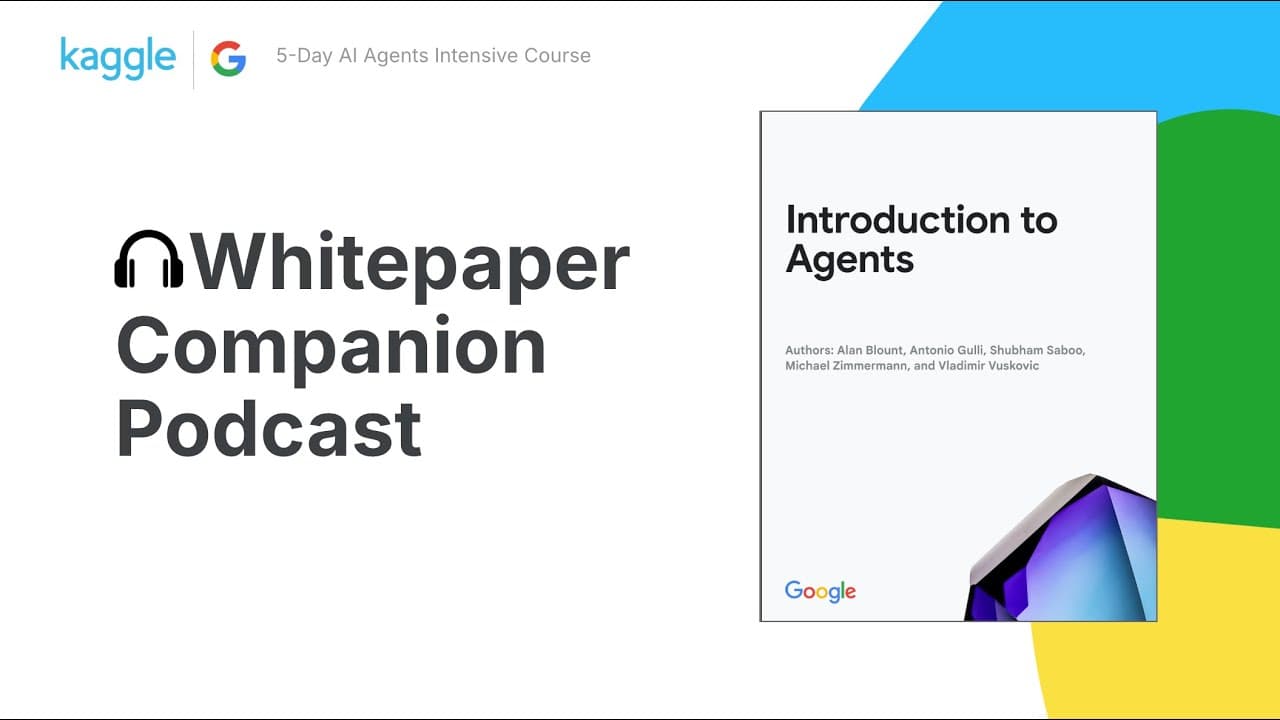
AI agents are evolving from passive responders to autonomous, goal-oriented systems capable of planning, acting, and solving complex problems. They comprise a model, tools, and an orchestration layer, working together to execute tasks. Success hinges on robust engineering, including governance, security, and testing, to ensure reliable production-ready systems.
Transcript
Welcome to the deep dive. Today we're really getting into something exciting. The architecture for AI agents. That's right. We're focusing on the day one white paper from that 5day of AI agents intensive course by Google X Kaggle. Exactly. This feels like the guide for anyone building with generative AI moving you know beyond just simple demos. Abs... Read More
Key Insights
- AI agents are autonomous systems that plan and act to achieve goals without constant human direction.
- The anatomy of an AI agent includes a model (reasoning engine), tools (action executors), and an orchestration layer (process manager).
- Context management is crucial for AI agents, allowing them to decide which information is relevant for each task.
- AI agents operate in a loop of thinking, acting, observing, and iterating to accomplish tasks.
- Agents can be categorized into levels based on their capabilities, from simple problem solvers to self-evolving systems.
- Security and governance are essential for managing AI agents, especially when they have the power to act using tools.
- Testing and debugging AI agents require new approaches, such as using language models for evaluation and observability tools for tracing.
- AI agents can learn and evolve by analyzing runtime experiences and user feedback to improve over time.
Install to Summarize YouTube Videos and Get Transcripts
Explore YouTube Video Summarizer or Get YouTube Transcript Extractor
Questions & Answers
Q: How do AI agents operate autonomously?
AI agents operate autonomously by integrating a reasoning model, tools for action, and an orchestration layer to manage tasks. They follow a loop of thinking, acting, observing, and iterating, which allows them to plan and execute tasks without human intervention. This autonomy enables them to solve complex, multi-step problems efficiently.
Q: What are the core components of an AI agent?
The core components of an AI agent include the model, tools, and orchestration layer. The model acts as the reasoning engine, the tools serve as action executors, and the orchestration layer manages the entire process. Together, they enable the agent to perform tasks autonomously, adapting to new information and challenges.
Q: Why is context management important for AI agents?
Context management is crucial for AI agents as it allows them to determine which information is relevant for each task. By managing context, agents can prioritize inputs from their mission, memory, and tools, ensuring they make informed decisions at every step. This capability enhances their problem-solving efficiency and effectiveness.
Q: How do AI agents learn and evolve over time?
AI agents learn and evolve by analyzing runtime experiences, user feedback, and external signals like updated policies. This feedback loop helps refine their system prompts, context engineering, and tool use, leading to continuous improvement. Over time, agents become more robust and capable of handling complex tasks autonomously.
Q: What are the security challenges in deploying AI agents?
Deploying AI agents poses security challenges due to their ability to act using tools. Ensuring safe operations requires implementing defense-in-depth strategies, including hard-coded guardrails and AI-based guard models to detect and prevent risky actions. Secure, verifiable identities for agents are also essential to manage permissions effectively.
Q: How does testing differ for AI agents compared to traditional software?
Testing AI agents differs from traditional software due to their non-deterministic nature. Instead of asserting expected outputs, quality is evaluated using language models as judges. Observability tools like open telemetry traces provide detailed logs of the agent's thought process, helping pinpoint issues and improve performance.
Q: What is the role of the orchestration layer in AI agents?
The orchestration layer in AI agents manages the operational loop, including planning, memory tracking, and executing reasoning strategies. It defines the agent's persona and operating rules, ensuring consistent behavior. Additionally, it handles memory management, distinguishing between short-term and long-term memory for effective task execution.
Q: How do AI agents handle complex multi-agent systems?
In complex multi-agent systems, AI agents collaborate by delegating tasks to specialized agents. This involves treating other agents as tools, allowing for goal delegation and autonomous execution of multi-step plans. A central control plane or gateway ensures governance, monitoring, and policy enforcement across the entire agent network.
Summary & Key Takeaways
-
AI agents are transforming from passive to autonomous systems capable of complex problem-solving. They consist of a model for reasoning, tools for action, and an orchestration layer to manage processes. This architecture enables them to plan, act, and iterate independently, making them valuable in production environments.
-
The development of AI agents involves categorizing them into levels based on capabilities, from basic problem solvers to self-evolving systems. Security and governance are critical to ensure safe operations, while testing and debugging require innovative approaches like using AI for evaluation.
-
AI agents continuously learn and adapt by analyzing runtime data and user feedback, driving optimization and improvement. They hold potential as collaborative partners in complex tasks, emphasizing the importance of robust engineering and architecture for successful deployment.
Read in Other Languages (beta)
Share This Summary 📚
Summarize YouTube Videos and Get Video Transcripts with 1-Click
Try YouTube Summary with ChatGPT & Claude or YouTube Transcript Generator
Explore More Summaries from Kaggle 📚
Summarize YouTube Videos and Get Video Transcripts with 1-Click
Try YouTube Summary with ChatGPT & Claude or YouTube Transcript Generator