How Does Machine Code Work in Computers?
TL;DR
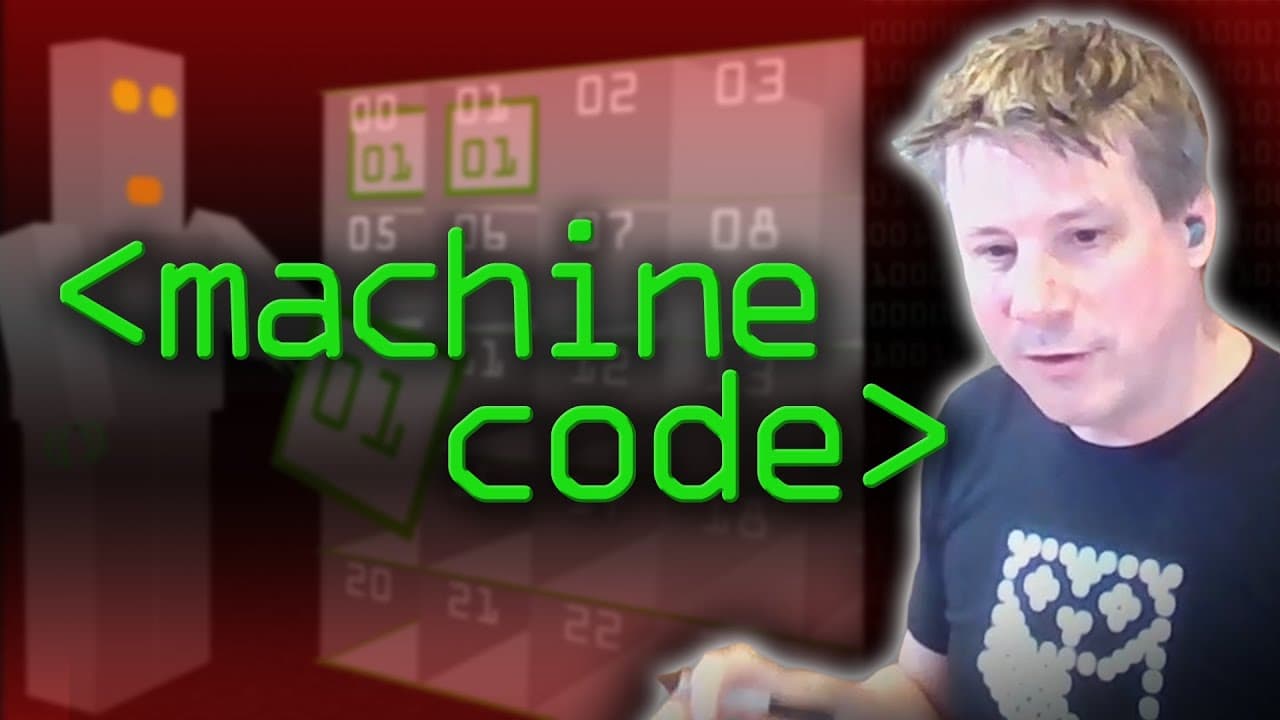
Machine code remains fundamentally unchanged since the 80s, serving as the essential language of computers. This video provides an accessible breakdown of programming using a mental model involving a robot, an abacus, and memory slots, illustrating how these simple operations form the basis for complex modern computing tasks.
Transcript
so I wanted to talk about how I learned how the fundamentals of computers sort of fit together how computers work really um there's a sort of a mental model that I picked up in the 80s that has stuck with me for now 40 odd years and even now when I sit down and try and solve computer problems especially performance and sort of very sort of techy th... Read More
Key Insights
- 🏪 The fundamentals of computer programming, like loading, storing, and performing calculations, have remained consistent over the years.
- 🤖 The mental model of a robot with an abacus and memory pigeon holes provides a simplified visualization of a computer system.
- 💁 Machine code instructions, represented by numbers, form the basis of computer programs and dictate how the CPU executes tasks.
- 💻 Understanding the basics of computer architecture helps in comprehending complex concepts like memory management and optimization.
- 💻 The scale and complexity of modern computer systems have increased, but the underlying principles remain the same.
- 😄 Higher-level programming languages provide abstractions and ease of use, but they ultimately translate into machine code for execution.
- ❓ Overwriting a program's own instructions in memory can cause crashes and unexpected behavior, highlighting the importance of memory management and error handling.
Install to Summarize YouTube Videos and Get Transcripts
Explore YouTube Video Summarizer or Get YouTube Transcript Extractor
Questions & Answers
Q: How do the concepts learned from programming 8-bit CPUs apply to modern computer systems?
The fundamentals of programming, including loading data into memory, performing calculations, and storing results, still hold true in modern computer systems. The basic operations may be the same, but the scale and complexity have increased.
Q: How does the mental model of the robot with an abacus and memory pigeon holes explain how a computer works?
The abacus represents the accumulator, where calculations are performed. The memory pigeon holes represent the RAM, where data is stored. The robot's instructions, such as loading, storing, adding, and jumping, simulate the actions of a computer's CPU.
Q: Can machine code be translated into a higher-level programming language?
Yes, machine code instructions can be translated into higher-level programming languages. Higher-level languages provide abstractions and an easier-to-understand syntax, but ultimately, they are translated into machine code for the computer to execute.
Q: What happens if a program overwrites its own instructions in memory?
When a program overwrites its own instructions in memory, it can lead to crashes or unexpected behavior. Modern operating systems have safeguards in place to handle such situations and prevent the program from damaging critical system functions.
Summary & Key Takeaways
-
The speaker shares their personal experience of learning the fundamentals of computers from an Usborne computer book in the 80s.
-
They explain how the concepts they learned about programming 8-bit CPUs still apply to modern computer systems.
-
The video introduces the mental model of a robot with an abacus and memory pigeon holes to visualize how a computer program works.
Read in Other Languages (beta)
Share This Summary 📚
Summarize YouTube Videos and Get Video Transcripts with 1-Click
Try YouTube Summary with ChatGPT & Claude or YouTube Transcript Generator
Explore More Summaries from Computerphile 📚


Summarize YouTube Videos and Get Video Transcripts with 1-Click
Try YouTube Summary with ChatGPT & Claude or YouTube Transcript Generator