How to Build AI Agents Step by Step: A Complete Guide
TL;DR
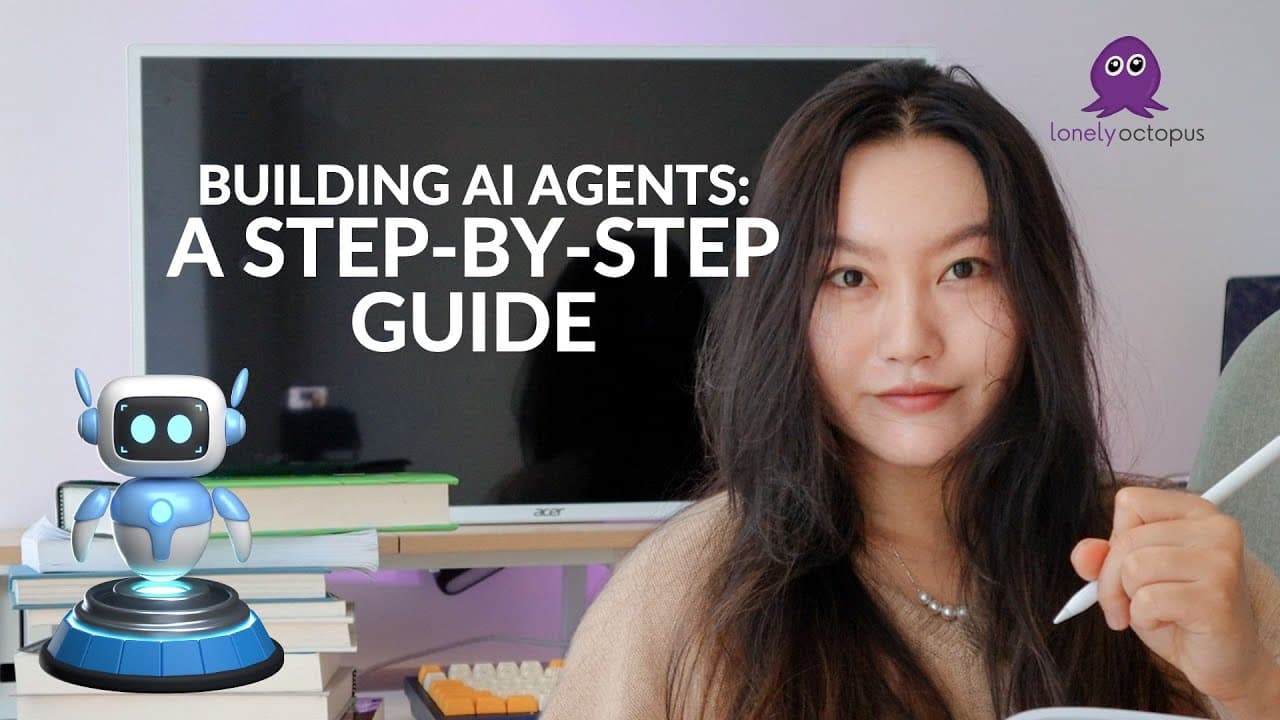
To build AI agents effectively, start by understanding their essential components, such as models, tools, and memory. Choose the right implementation method—code or no-code—based on your project's needs. Important workflow patterns like prompt chaining and routing can help structure your agent's tasks, while features such as guardrails ensure they operate correctly.
Transcript
hello friends how's it going good morning good evening okay I think we should be fine so thank you guys for joining today my laptop broke and since it happened to be Easter um I actually it took like a few days to fix so this is actually another laptop that I'm using now so fingers crossed everybody that we can get through this live stream and have... Read More
Key Insights
- The session focuses on building AI agents, emphasizing the importance of understanding agent components before implementation.
- AI agents can be implemented using code or no-code tools, with a preference for code due to its cost-effectiveness and fewer limitations.
- Different agentic workflow patterns such as prompt chaining, routing, and parallelization are crucial for effective AI agent design.
- The importance of choosing the right model for AI agents based on task requirements, like speed, robustness, or privacy.
- Tools and memory components are essential for AI agents to interact with the environment and retain information.
- Guardrails and orchestration are vital to ensure AI agents perform their tasks correctly and manage multi-agent systems.
- The session includes live demos of AI agents built with NA10, showcasing practical applications like news aggregation and expense tracking.
- An AI Agents Bootcamp is announced, offering a comprehensive learning experience with both no-code and code options for building production-quality agents.
Install to Summarize YouTube Videos and Get Transcripts
Explore YouTube Video Summarizer or Get YouTube Transcript Extractor
Questions & Answers
Q: What is the focus of the session?
The session focuses on building AI agents, emphasizing the importance of understanding the components and workflow patterns before implementation. It covers both theoretical aspects and practical demos, highlighting the benefits of using code over no-code tools for building AI agents.
Q: What are some key components of AI agents?
Key components of AI agents include models, tools, knowledge and memory, audio and speech capabilities, guardrails, and orchestration. These components are essential for AI agents to perform tasks autonomously or semi-autonomously, interact with the environment, and ensure correct task execution.
Q: What are some examples of agentic workflow patterns?
Examples of agentic workflow patterns include prompt chaining, routing, and parallelization. Prompt chaining decomposes tasks into sequential steps, routing directs tasks to specialized sub-agents, and parallelization allows tasks to be processed simultaneously for faster results.
Q: Why is choosing the right model important for AI agents?
Choosing the right model is crucial because it determines the AI agent's capabilities, such as speed, robustness, and privacy. Different models are suited for different tasks, and selecting the appropriate one ensures the AI agent performs effectively and meets specific requirements.
Q: What are the benefits of using code over no-code tools for AI agents?
Using code for AI agents is often more cost-effective and has fewer limitations compared to no-code tools. Code allows for greater customization, control, and reliability, making it a preferred choice for building robust and scalable AI agents, especially in production environments.
Q: What is the purpose of the AI Agents Bootcamp?
The AI Agents Bootcamp is designed to provide a comprehensive learning experience for building AI agents. It offers both no-code and code options, enabling participants to create production-quality agents suitable for personal, business, or freelance use. The bootcamp includes guidance from mentors and a structured curriculum.
Q: What are some practical applications demonstrated in the session?
The session includes live demos of AI agents built with NA10, showcasing practical applications such as an AI news aggregator and a multi-input daily expenses tracker. These demos illustrate how AI agents can automate information gathering and personal finance management effectively.
Q: How does the session address different learning preferences?
The session caters to different learning preferences by offering both theoretical insights and practical demos. It provides foundational knowledge on AI agent components and workflow patterns, alongside live demonstrations and an opportunity to join the AI Agents Bootcamp for hands-on learning and mentorship.
Summary & Key Takeaways
-
The video provides a detailed guide on building AI agents, focusing on understanding agent components, workflow patterns, and implementation options. It highlights the importance of choosing the right model, tools, and memory components for effective AI agent design.
-
Live demos using NA10 showcase practical applications of AI agents, such as news aggregation and expense tracking. The session emphasizes the benefits of using code over no-code tools for building AI agents due to cost-effectiveness and fewer limitations.
-
An AI Agents Bootcamp is introduced, offering a structured program to learn and implement AI agents with production-quality outcomes. The bootcamp caters to both no-code and code users, providing a comprehensive learning experience with guidance from mentors.
Read in Other Languages (beta)
Share This Summary 📚
Summarize YouTube Videos and Get Video Transcripts with 1-Click
Try YouTube Summary with ChatGPT & Claude or YouTube Transcript Generator
Explore More Summaries from Tina Huang 📚



Summarize YouTube Videos and Get Video Transcripts with 1-Click
Try YouTube Summary with ChatGPT & Claude or YouTube Transcript Generator