How to Measure Privacy Concern Through Behavior
TL;DR
Online disclosure does not prove that users lack privacy concerns because confusing policies, limited rationality, cognitive biases, and perceived benefits shape their choices. A Twitter study found that government-monitored terms declined more than food-related comparison terms after the Snowden revelations, suggesting that subtle behavioral changes can reveal concern better than drastic actions such as deleting an account.
Transcript
All right, great. Um, so yes, I will be talking about how hard it is to infer actual privacy concern from online behavior, and I think this is important because it sort of affects, uh, privacy policies in general, it affects data governance policies. Uh, so I think, uh, it's, it, it... We need to understand exactly how to, how to infer actual priva... Read More
Key Insights
- The privacy paradox is the apparent gap between people's stated privacy concerns and their willingness to share personal information with first-party and third-party services during ordinary online activity.
- Online disclosure is not reliable proof of privacy indifference because users may not understand the risks and consequences described in lengthy, confusing privacy policies written in legal language.
- Human decision-making is boundedly rational because choices reflect not only comparisons of costs and benefits, but also emotions, cognitive biases, and other influences that people cannot fully control.
- Risk perception is influenced by perceived benefits because immediate rewards, such as likes, comments, convenient purchases, and visible shopping-cart items, can make the risks of disclosure feel lower.
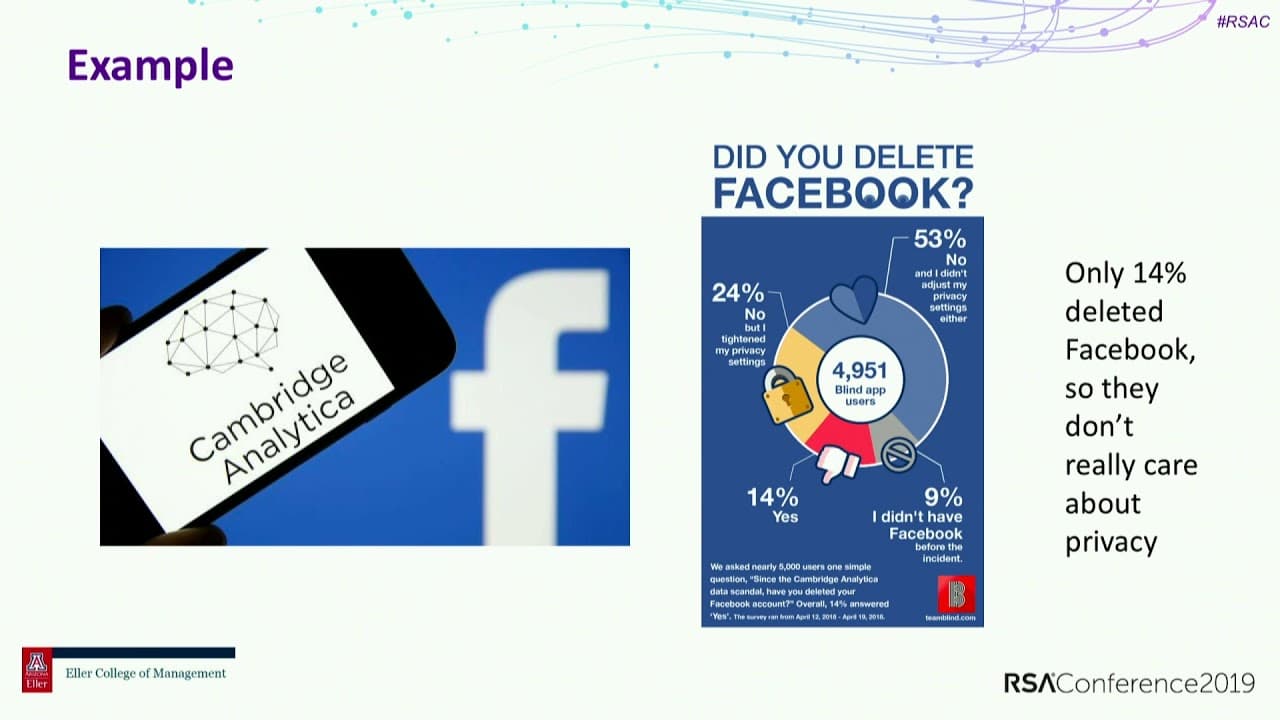
- Account deletion is an incomplete measure of privacy concern because users can respond to a scandal by changing what they post, what they share, or how they interact without leaving the platform.
- The Twitter study used a decahose, described as a ten percent random sample of tweets from 2013, to compare language before and after the Snowden revelations became public.
- Sensitive terms were words monitored by the Department of Homeland Security and related to cybersecurity, terrorism, and infrastructure security, while food-related words from an existing Twitter dictionary served as the comparison group.
- Government-monitored words decreased more sharply than food-related words after the Snowden revelations, with each monitored word showing an average decrease one percent larger than the comparison words.
Install to Summarize YouTube Videos and Get Transcripts
Explore YouTube Video Summarizer or Get YouTube Transcript Extractor
Questions & Answers
Q: What is the privacy paradox in online behavior?
The privacy paradox is the apparent conflict between what people say about privacy and what they do online. Most people report caring about privacy and security, yet observers also see extensive personal-information sharing with first parties and third parties. The presentation argues that this gap should not automatically be interpreted as dishonesty or indifference because online behavior is shaped by information limitations, cognitive biases, emotions, benefits, and risk perception.
Q: Why does online sharing not prove that users disregard privacy?
Online sharing does not prove that users disregard privacy because users may not understand the consequences of disclosure. Privacy policies can be lengthy, confusing, and written in legal language, leaving the average user without enough information to assess risks. Decisions are also affected by emotions and cognitive biases, so observed disclosure cannot be treated as the output of a fully informed, purely rational calculation.
Q: How does asymmetric information affect privacy decisions?
Asymmetric information prevents users from evaluating privacy choices with the same knowledge available to the organizations collecting or using their data. The presentation notes that users face policies that can be twenty-nine pages long and written in legal language. If people cannot understand the consequences and risks of sharing, their decision to disclose information cannot reliably demonstrate that they do not care about privacy.
Q: How do cognitive biases influence personal-information disclosure?
Cognitive biases influence disclosure by pushing decisions beyond a simple calculation of costs and benefits. People may attempt rational analysis, but emotions and other behavioral influences also affect what they share. Drawing on the concept of bounded rationality, the presentation argues that people are not utility-maximizing machines. Their disclosures therefore may not accurately represent their underlying level of privacy concern.
Q: Why can online benefits make privacy risks seem smaller?
Perceived benefits can lower perceived risk during an online interaction. Social media provides immediate benefits through likes and comments, while e-commerce provides convenience and visible progress toward purchasing an item. Research discussed in the presentation indicates that when people perceive high benefits from an activity, they tend to perceive its risks as lower. Disclosure under those conditions may still coexist with genuine privacy concern.
Q: Why is deleting Facebook an incomplete measure of privacy concern?
Deleting Facebook captures only one drastic response to a privacy scandal. A survey conducted after the Cambridge Analytica scandal asked about five thousand users whether they had deleted their accounts, and fourteen percent said they had. The presentation argues that researchers should also ask whether users changed what they said, shared, or did on Facebook, since these less visible adjustments may reveal concern without account deletion.
Q: How did researchers test for self-censorship after the Snowden revelations?
Researchers analyzed a decahose, described as a ten percent random sample of all tweets posted in 2013. They compared the use of sensitive, government-monitored terms before and after the first Snowden article appeared in The Guardian on June sixth, 2013. Food-related words from an existing Twitter dictionary formed a non-sensitive comparison group, allowing the researchers to look for a differential change in monitored language.
Q: What did the Twitter analysis find about surveillance concerns?
The analysis found an overall decrease in both sensitive and non-sensitive words, but the decline in government-monitored terms became steeper after the Snowden revelations. On average, each monitored word experienced a decrease that was one percent larger than the decrease among food-related words. The researchers interpreted this differential as evidence that concern about government monitoring changed how people expressed themselves on Twitter.
Summary & Key Takeaways
-
The privacy paradox describes an apparent conflict between people's stated privacy concerns and their continued disclosure of personal information online. Treating disclosure as proof of indifference is flawed because users often lack clear information about consequences, encounter confusing privacy policies, and make decisions under cognitive and emotional constraints.
-
Researchers should measure changes in how people use platforms, not merely whether they abandon them. After the Cambridge Analytica scandal, a survey found that fourteen percent of about five thousand respondents said they deleted Facebook, but deletion alone may overlook changes in posting, sharing, and interaction that also signal privacy concern.
-
The Twitter study compared a ten percent random sample of tweets posted before and after the June sixth, 2013 Snowden revelations. Machine learning identified anomalies, while econometric analysis estimated the event's effect. Government-monitored terms declined more sharply than food-related terms, with an average differential decrease of one percent per monitored word.
Read in Other Languages (beta)
Share This Summary 📚
Summarize YouTube Videos and Get Video Transcripts with 1-Click
Try YouTube Summary with ChatGPT & Claude or YouTube Transcript Generator
Explore More Summaries from RSAC Cybersecurity 📚

Summarize YouTube Videos and Get Video Transcripts with 1-Click
Try YouTube Summary with ChatGPT & Claude or YouTube Transcript Generator