Rise of the Supertelescopes Part 2 - Space Telescopes
TL;DR
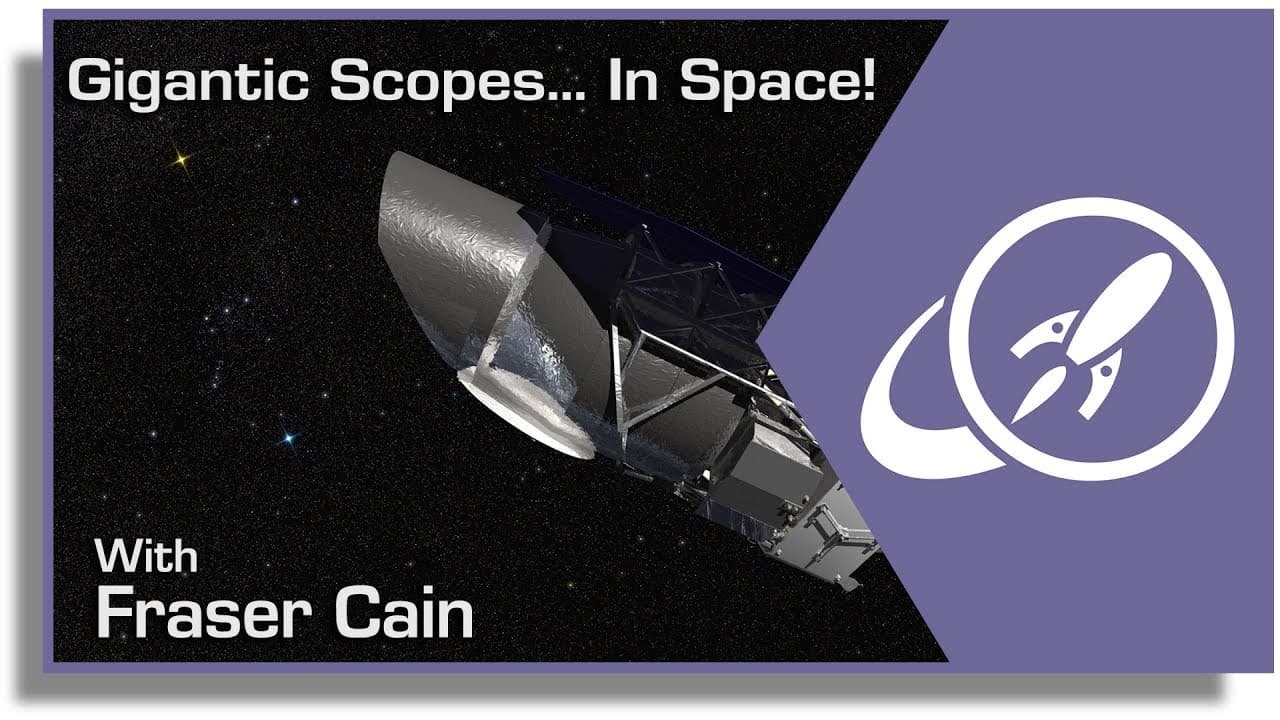
Monster space-based telescopes, such as the James Webb Space Telescope, WFIRST, LISA, and LUVOIR, will revolutionize astronomy by providing stunning views of the universe and the potential to search for extraterrestrial life.
Transcript
Welcome back to part 2 of our investigation into the new monster telescopes under construction. In the first part, we talked about the ground-based telescopes being built at various places around the world - largest of which will more than triple the size of the biggest telescopes we have right now. With telescopes this size, astronomers will have ... Read More
Key Insights
- 👾 Space-based telescopes, such as JWST, WFIRST, LISA, and LUVOIR, will enable astronomers to observe and study the Universe with unprecedented resolution and sensitivity.
- 👻 JWST's infrared capabilities and larger mirror size will allow it to observe the early Universe and potentially find evidence of life on exoplanets.
- 🫵 WFIRST's wide field of view will aid in the study of dark energy and the search for Jupiter-like exoplanets.
- 👋 LISA will be capable of detecting gravitational waves caused by various astronomical events, providing unique insights into the Universe's structure and origins.
Install to Summarize YouTube Videos and Get Transcripts
Explore YouTube Video Summarizer or Get YouTube Transcript Extractor
Questions & Answers
Q: What is the James Webb Space Telescope, and what makes it special?
The James Webb Space Telescope is a space-based telescope with a 6.5-meter primary mirror, 7 times larger than the Hubble Space Telescope's mirror. It will be able to observe the early Universe, exoplanets, and potentially detect signs of extraterrestrial life.
Q: What is the primary goal of WFIRST, and how does it differ from Hubble?
WFIRST's primary goal is to study dark energy and its effects on the expansion of the Universe. While it has the same primary mirror size as Hubble, WFIRST has a wider field of view, allowing for more efficient sky surveys and the search for Jupiter-like exoplanets.
Q: How does LISA work, and what can it detect?
LISA is a constellation of three spacecraft that can detect gravitational waves caused by events such as black hole mergers and compact object collisions. It measures changes in laser pulses sent between the spacecraft to determine the direction and magnitude of the gravitational waves.
Q: What is LUVOIR, and what makes it a significant development in space telescopes?
LUVOIR, or the Large UV Optical Infrared Surveyor Telescope, is an upcoming space telescope that will have a diameter of 15-18 meters. It will be able to directly observe Earth-sized worlds in the habitable zones of other stars, study dark matter, and observe the earliest stars in the Universe.
Summary & Key Takeaways
-
Part 2 of the investigation delves into the construction of new monster telescopes, both ground-based and space-based, which will greatly surpass the capabilities of existing telescopes.
-
The James Webb Space Telescope (JWST) will have a primary mirror 6.5 meters across, offering 7 times more collecting area than the Hubble Space Telescope. It will provide unprecedented views of the early Universe, planets, and the potential for finding evidence of extraterrestrial life.
-
The Wide Field Infrared Survey Telescope (WFIRST) will have the same primary mirror size as Hubble but a much wider field of view. Its goal is to study dark energy and reveal the atmospheres of Jupiter-like exoplanets.
-
The Laser Interferometer Space Antenna (LISA) will be a space-based observatory capable of detecting gravitational waves caused by events such as black hole mergers and compact object collisions.
Read in Other Languages (beta)
Share This Summary 📚
Summarize YouTube Videos and Get Video Transcripts with 1-Click
Try YouTube Summary with ChatGPT & Claude or YouTube Transcript Generator
Explore More Summaries from Fraser Cain 📚



Summarize YouTube Videos and Get Video Transcripts with 1-Click
Try YouTube Summary with ChatGPT & Claude or YouTube Transcript Generator