How to Replace Evernote with Recall for a Personal AI Knowledge Base
TL;DR
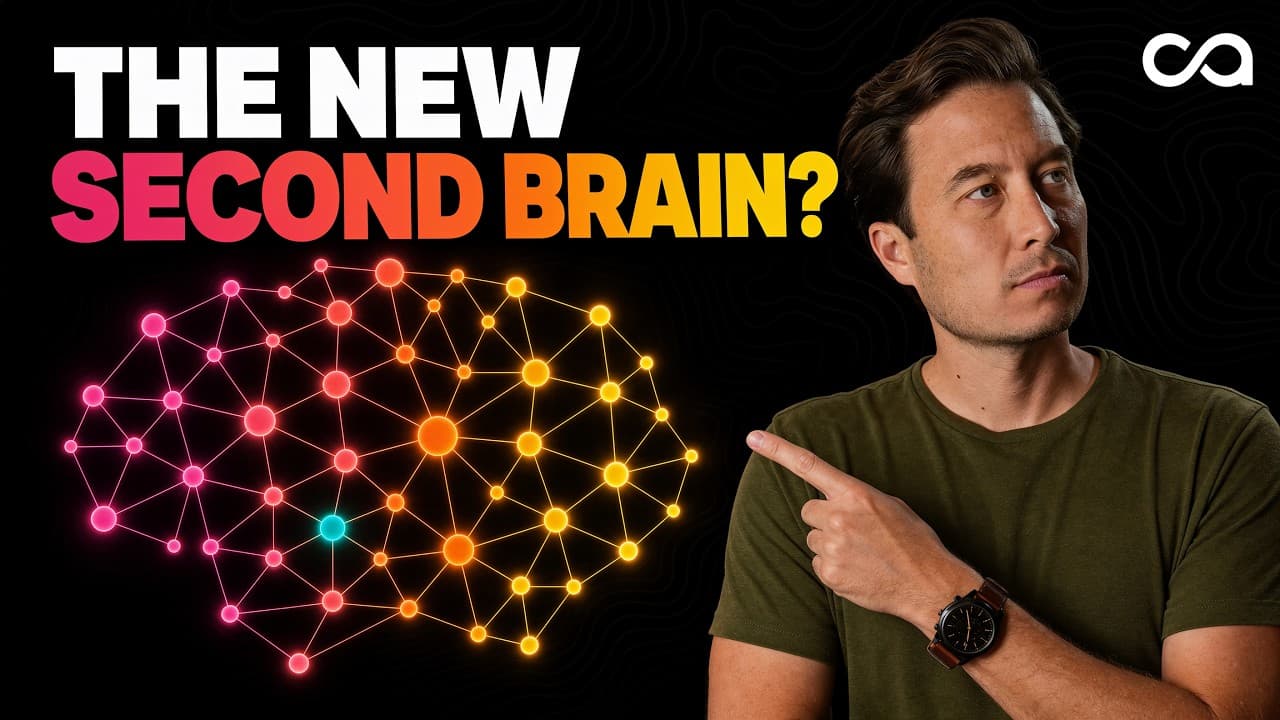
Recall can replace Evernote as a main note tool for some users by centralizing notes, clips, and summaries with a personal context. It shines in fast capture, tagging, and AI-assisted synthesis, but users report gaps like persistent memory between chats and initial setup hurdles. The test covered four teammates over three weeks, each with distinct workflows and verdicts.
Transcript
Not long ago, I put out a video on something I call personal context management. [music] And the idea behind it is very simple. The true potential both of artificial intelligence and [music] your potential comes from giving AI context that only you can give. [music] The knowledge either in your head or in your files. That changes how this all works... Read More
Key Insights
- Recall positions itself as a personal context manager where your own data fuels AI responses and outputs.
- The main advantage is one central tool that ingests clips, articles, videos, PDFs, and more and structures them with tags and a flexible hierarchy.
- Users value fast mobile capture, browser clipper integration, and automatic summarization that preserves essential context.
- A primary benefit is the ability to generate outline ideas, draft content, and retrieve related sources through a chat interface.
- The testers used Recall to create a knowledge base, brainstorm, and generate briefs, showing practical uplift in real projects.
- A key limitation is that Recall initially lacks persistent memory of the user across chats, reducing user personalization.
- Some testers found Recall better at surfacing structured content and ideas than at producing fully polished outputs.
- The experience highlighted the balance between staying focused on note taking versus becoming a broader productivity app.
Install to Summarize YouTube Videos and Get Transcripts
Explore YouTube Video Summarizer or Get YouTube Transcript Extractor
Questions & Answers
Q: What is Recall and why would someone want to replace Evernote with it?
Recall is presented as a personal context management tool that uses your own curated knowledge as the fuel for AI responses. The four testers replaced or reduced use of Evernote to centralize notes, clips, and summaries, aiming for a more integrated system where AI helps organize and generate content from personal data. In practice, this meant faster capture, easier retrieval, and a more coherent knowledge base across projects.
Q: How did Julia approach replacing Evernote with Recall?
Julia aimed to replace a decade of Evernote notes by leveraging Recall for quick capture and organization. She relied on Recall’s web clipper and browser extensions to save articles, added tags and a power structure within Recall, and used mobile capture for speed. Her verdict was that Recall could replace Evernote for her, though it required moving away from familiar folders toward a tag-based system.
Q: What features did Joey use to assist content creation in Recall?
Joey used Recall to save videos, articles, and PDFs and connected them via chat to generate outlines and draft content in his own voice. The tool offered high level topic extraction, timestamps, transcripts, and the ability to pull out key concepts with sources linked. He found Recall superior to Claude for packaging ideas into usable drafts.
Q: What was Allesia’s experience with Recall for research workflows?
Allesia used Recall to consolidate scattered research into a visual knowledge graph. She could import Substack material, watch how Recall tagged and organized information, and generate research briefs. She highlighted that Recall acts as more than a thought partner, functioning as a co-pilot to brainstorm and assemble a comprehensive knowledge base for later use.
Q: What concerns or gaps did the testers identify in Recall?
A recurring gap was that Recall did not yet know the user personally beyond the current chat, lacking persistent memory of names or roles. This affected personalization and some workflow efficiency. Testers noted that addressing persistent memory or user profiles would improve reliability and alignment with individual writing styles and goals.
Q: How did Recall perform in quizzes and knowledge checks during the test?
The testers used an AI knowledge quiz feature drawn from an AI course to challenge their understanding. The quiz simulated real scenarios and tested recall’s ability to surface relevant material, with scores varying but generally indicating strong engagement with the knowledge base. The exercise demonstrated Recall’s potential for reinforcing learning and discipline through structured repetition.
Q: What did testers say about Recall compared to other AI writing tools?
When comparing Recall to tools like Claude, testers found Recall better at generating ideas that were packaged and ready to develop, rather than merely producing raw concepts. The ability to pull from their own data and knowledge base gave Recall a competitive edge for writing, research, and content planning, while still revealing gaps in personalization and long-term memory.
Q: What is the overall verdict on Recall as a replacement for traditional note apps?
The overall verdict is nuanced: Recall works well as a centralized second brain for knowledge management and AI-assisted writing, especially for users who want to unify notes with context and AI outputs. However, the absence of persistent memory across chats and some initial setup friction mean it may not yet fully replace traditional note apps for all users. For certain workflows, it provides significant value and speed improvements.
Summary & Key Takeaways
-
Recall streamlines knowledge capture from web clips and transcripts into a single knowledge graph, enabling faster research and writing workflows.
-
The four testers showed strong preferences for Recall over existing tools in their specific tasks, especially in content creation and research coordination.
-
A notable gap identified was Recall not yet knowing each user’s identity and preferences consistently, highlighting a need for more persistent user memory and personalization.
Read in Other Languages (beta)
Share This Summary 📚
Summarize YouTube Videos and Get Video Transcripts with 1-Click
Try YouTube Summary with ChatGPT & Claude or YouTube Transcript Generator
Explore More Summaries from Tiago Forte 📚


Summarize YouTube Videos and Get Video Transcripts with 1-Click
Try YouTube Summary with ChatGPT & Claude or YouTube Transcript Generator