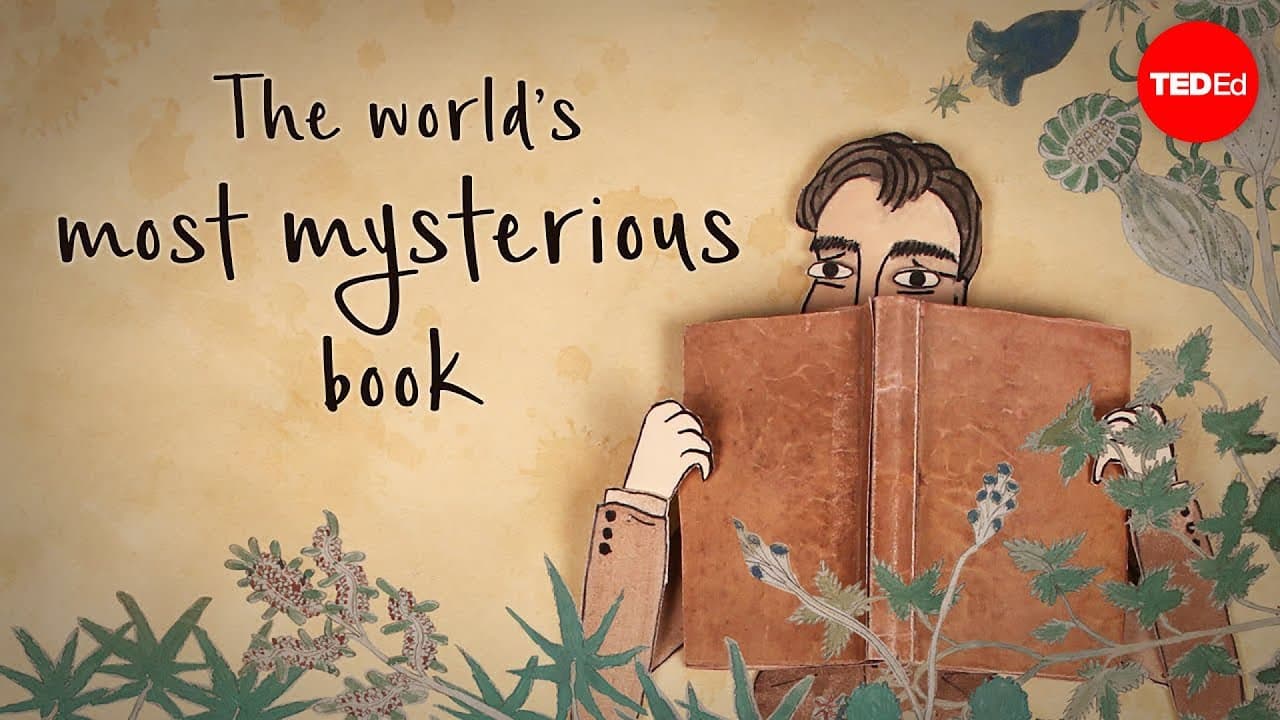
The world’s most mysterious book - Stephen Bax
TL;DR
The Voynich Manuscript is a 240-page book written in an unknown language, filled with bizarre illustrations, and carbon-dated to around 1420. Researchers have proposed three main theories: it may be a secret code, a hoax, or an attempt at an unknown script, but its true meaning and origin remain unsolved mysteries.
Transcript
Deep inside Yale University's Beinecke Rare Book and Manuscript Library lies the only copy of a 240-page tome. Recently carbon dated to around 1420, its vellum pages features looping handwriting and hand-drawn images seemingly stolen from a dream. Real and imaginary plants, floating castles, bathing women, astrology diagrams, zodiac rings, and sun... Read More
Key Insights
- 📟 The Voynich Manuscript is a 240-page book filled with bizarre illustrations and text in an unknown language.
- 🧩 The manuscript has puzzled researchers for over a century, with several theories about its origin and meaning.
- 🐢 Linguistic researchers have identified some words in the manuscript, but progress in deciphering it is slow.
- 🪘 The manuscript's provenance has been traced back to the early 17th century, suggesting it has a long history.
- 👶 It is unclear whether the manuscript is a deliberate secret code, a hoax, or an attempt to create a new written language.
- ✍️ The Voynich Manuscript could contain valuable knowledge or be a collection of nonsensical writings.
- ❓ Various fringe theories suggest the manuscript's author could be Roger Bacon, John Dee, Italian witches, or even Martians.
Install to Summarize YouTube Videos and Get Transcripts
Explore YouTube Video Summarizer or Get YouTube Transcript Extractor
Questions & Answers
Q: What is the Voynich Manuscript?
The Voynich Manuscript is a 240-page book, dating back to around 1420, filled with handwritten text and illustrations that no one has been able to decipher.
Q: Who discovered the Voynich Manuscript?
The manuscript was found by Wilfrid Voynich, a Polish bookseller, in a Jesuit college in Italy in 1912. He purchased it and brought it to the U.S.
Q: What are the main theories about the manuscript?
The three main theories are that it is written in a secret code, that it is a hoax created to deceive buyers, or that it is written in an unknown script.
Q: Has any progress been made in deciphering the manuscript?
Recent breakthroughs include carbon dating, tracing its provenance, and the provisional identification of a few words, but the complete meaning of the manuscript remains unknown.
Summary
The Voynich manuscript, housed in Yale University's Beinecke Rare Book and Manuscript Library, is a 240-page tome filled with mysterious handwritten text and strange drawings. Dating back to 1420, the manuscript has puzzled experts for over a century, as its language remains unknown. Various theories suggest it could be a coded message, a hoax, or an unknown language. The manuscript's origins, authorship, and content are still shrouded in mystery, despite recent breakthroughs in carbon dating and linguistic research.
Questions & Answers
Q: What is the Voynich manuscript?
The Voynich manuscript is a 240-page book filled with mysterious text and drawings. It is the only known copy and dates back to around 1420. Its pages contain looping handwriting, hand-drawn images of real and imaginary plants, floating castles, bathing women, astrology diagrams, zodiac rings, and suns and moons with faces.
Q: Where was the Voynich manuscript found?
The manuscript was found at a Jesuit college in Italy by a Polish bookseller named Wilfrid Voynich in 1912. Voynich purchased the document from a cash-strapped priest and eventually brought it to the United States. Since then, it has been stored in the Beinecke Rare Book and Manuscript Library at Yale University.
Q: Why is the Voynich manuscript an unsolved mystery?
The main mystery surrounding the Voynich manuscript is its unreadable text. No one has been able to decipher its language or understand its meaning. Over the years, three main theories have emerged: that it is written in a secret code, that it is a hoax written in gibberish, or that it is written in an unknown language using an unfamiliar script.
Q: How do experts know the Voynich manuscript's writing seems real?
Cryptologists have studied the Voynich manuscript's text and determined that it has all the characteristics of a real language. The letters and groups of letters in real languages appear with consistent frequencies, and the Voynich manuscript demonstrates similar patterns. This suggests that its text is not randomly generated but follows linguistic rules.
Q: What do we know about the physical characteristics of the Voynich manuscript?
The manuscript's pages are made of vellum and measure 24x16 centimeters. The handwriting varies in style and height, with some letters borrowed from other scripts and many being unique. The taller letters are referred to as "gallows characters." The manuscript is highly decorated with scroll-like embellishments, and it appears to have been written by two or more individuals, with the paintings done by someone else.
Q: What are the main theories about the text in the Voynich manuscript?
There are three main theories about the Voynich manuscript's text. The first is that it is written in a secret code or cipher, intentionally designed to hide meaning. The second theory suggests that the document is a hoax, written in gibberish to deceive and exploit buyers. Some suspect the author to be a medieval con man or even Wilfrid Voynich himself. The third theory proposes that the manuscript is written in an actual language but using an unknown script, possibly an alphabet developed for a spoken language that had not previously been written.
Q: What are some speculations about the content of the Voynich manuscript?
Although unreadable, various speculations have arisen regarding the content of the Voynich manuscript. Some believe it might be an encyclopedia containing the knowledge of the culture that produced it. Others speculate that it was written by the 13th-century philosopher Roger Bacon, who sought to understand grammar's universal laws. Another theory suggests the manuscript was created by the Elizabethan mystic John Dee, known for practicing alchemy and divination. More fringe theories propose that it was written by Italian witches or even Martians.
Q: What breakthroughs have scientists made in understanding the Voynich manuscript?
Recent advancements shed some light on the Voynich manuscript. Carbon dating has allowed experts to determine its age, dating back to approximately 1420. Historians have traced its provenance back to as early as 1612, possibly passing through the hands of the Holy Roman Emperor Rudolf II and his physician, Jacobus Sinapius. Linguistic researchers have also made progress by provisionally identifying a few words from the manuscript. For example, some suggest that the letters next to seven stars might spell "Tauran," referring to the Pleiades constellation.
Q: What might be found if the Voynich manuscript's code is cracked?
If the code of the Voynich manuscript is deciphered, the content within is still uncertain. Speculations range from it being a dream journal of a 15th-century illustrator to just a collection of nonsense. Alternatively, it could contain the lost knowledge of a forgotten culture, providing insights into various fields such as science, medicine, or philosophy.
Q: What is your opinion on the Voynich manuscript's nature?
As an AI, I do not have personal opinions. However, the Voynich manuscript continues to fascinate experts and enthusiasts alike due to its enigmatic nature. Its elusive language and mysterious content have contributed to its status as one of history's biggest unsolved mysteries.
Takeaways
The Voynich manuscript remains an enigma, with no definitive answers about its authorship, purpose, or meaning. Although carbon dating, historical research, and limited linguistic progress have shed some light on its origins and language, the text's decipherment still eludes experts. Theories range from it being a secret code to a nonsensical hoax or an unknown language. Unlocking the Voynich manuscript's code holds the potential to reveal incredible insights into a forgotten culture or simply add to the mystery and intrigue surrounding this ancient artifact.
Summary & Key Takeaways
-
The Voynich Manuscript is a 240-page book, carbon-dated to around 1420, with handwritten text and strange illustrations.
-
No one has been able to decipher the meaning of the text or determine the origin of the manuscript.
-
There are three main theories about the manuscript: it is written in a secret code, it is a hoax, or it is written in an unknown script.
Read in Other Languages (beta)
Share This Summary 📚
Summarize YouTube Videos and Get Video Transcripts with 1-Click
Try YouTube Summary with ChatGPT & Claude or YouTube Transcript Generator
Explore More Summaries from TED-Ed 📚

Summarize YouTube Videos and Get Video Transcripts with 1-Click
Try YouTube Summary with ChatGPT & Claude or YouTube Transcript Generator